The Lighter Side of Transformation

with Lisa Wessan, LICSW

Moving beyond binary thinking: what are dialectical and non-dualistical truths?

“If you can recognize and accept your pain without running away from it, you will discover that although pain is there, joy can also be there at the same time.” Thich Nhat Hanh, No Mud, No Lotus

“Grief is the price we pay for love.”
Queen Elizabeth II
(21 April 1926 – 8 September 2022)

“Even when all the experts agree, they may well be mistaken.”  ~ Bertrand Russell

“In preparing for battle, I have always found that plans are useless,
but planning is indispensable.” ~ Dwight Eisenhower

“The reverse of truth has a thousand shapes
and a boundless field.” ~ Michel de Montaigne

“Do I contradict myself?
Very well then, I contradict myself,
(I am large, I contain multitudes.)”
~ Walt Whitman, Leaves of Grass

“Whoever is winning at the moment
will always seem to be invincible.” ~ George Orwell

“Family values don’t stop at the Rio Grande.”  ~ George W. Bush

“Sometimes you need to get knocked down before you can
really figure out what your fight is.” ~ Chadwick Boseman

What do all these quotes have in common?  They are blending opposing beliefs into a non-dualistic framework, which is, for most people, is not easy to hold in the mind without some cognitive dissonance.

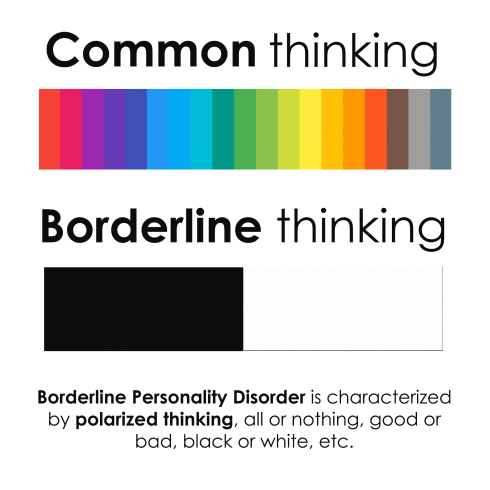
One of the reasons I love to teach Dialectical Behavior Therapy Skills (DBT) is to help people move from binary to non-binary thinking.  In this way, DBT serves to help people live with massive emotional and cognitive dissonance and yet not have an emotional meltdown (or use self-harm to distract or medicate from the pain of holding the contrasting beliefs).

For example, when you get into the DBT flow of consciousness, you realize that you can both love and hate someone.  You realize that on some level, you are amazing, perfect and rocking “as is,” yet you can improve.  Yes, you are good enough, yet you can improve!  You realize that you are sometimes brilliant, and sometimes really foolish, but still lovable, no matter what. You embrace the FACT that you inevitably will make mistakes, but you are NOT a mistake.  You are still awesome, lovable and worthy, no matter what cocka-locka-cuckoo stunt you got into, either consciously or unconsciously. You come to accept that “There is no shame in my game!”

So dialectical thinking helps you get out of the black and white mental trap, the “All or Nothing,” Right or Wrong, Worthy or Unworthy, Perfect or Imperfect name game.  Practicing dialectical skills helps relieve so much of your negative inner dialogue, which can potentially lead you down a slippery slope, perhaps causing a spiral into a depression and even self-harming thoughts.

Over time, DBT gently muzzles the harsh inner Critic and lets you move forward with plans to grow, learn, change and improve yourself, your relationships and your life.

Borderline1

DBT makes it so much easier to “Disable the Label” of your diagnosis, gender challenge, financial issue, body image or weight issue and more.  For years, I have said that I believe DBT skills will someday soon be taught to everyone by the 3rd grade level…Now Lady Gaga, superstar and mental health advocate, has started a foundation, MENTAL HEALTH FIRST AID to bring DBT Skills Training into all the public schools in the USA. Why? Because after years of suffering, once she learned DBT Skills, she had a dramatic recovery from her mental health issues, and now she is making this possible for everyone.

It is essential that we all move out of this painful and extremely unproductive dualistic perfectionist damnation of ourselves and others!  Enough is enough, right? The exquisite radical acceptance that comes from dialectical thinking starts within, and then permeates into our relationships, politics and the world at large.

Yes, it is possible to temporarily hate ourselves for a few minutes for being a bit unconscious or even whacko in the moment, and then with the help of improved self-talk, gently shift back to a more bearable level of acceptance, possibly reach a more comfortable forgiveness level and then back to a more loving baseline. With training, this could be reduced from days/weeks of self-hate to a few minutes…that’s a big win in my practice!

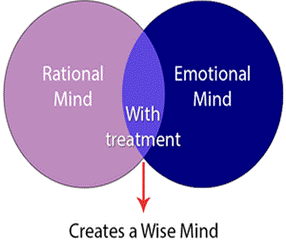
This DBT process uses evidence-based skills culled from the vast Mindfulness research, Interpersonal Effectiveness, Distress Tolerance and Emotion Regulation fields.  These skills help people move from being in the extreme of “Emotion Mind” or “Rational Mind” into their “Wise Mind” and function better on every level.

Ven diagram 1 Wise Mind

Here are some of the common myths that we deconstruct in our DBT groups:

“Dialectics reminds us of the many paradoxes that are built into our Universe:

  1. The universe is filled with opposing sides/opposing forces. There is always more than one way to see a situation, and more than one way to solve a problem. Yet two things that seem like opposites can both be true.
  1. Everything and every person is connected in some way, in the way that the waves and the ocean are one. It is also believed that the slightest move of the butterfly affects the furthest star.
  2. Change is the only constant. Meaning and truth evolve over time. Each moment is new; reality itself changes with each moment.
  3. Change is transactional. What we do influences our environment and other people in it. The environment and other people influence us.” (Linehan, 2015)

For today, I challenge you to start letting go of your dualistic mind traps, end all “Compare and Despair” drama and gently start to shift into a more compassionate, empathetic and dialectical mindset that will allow yourself and others to be good enough around you, as is, while you are all improving.  Here’s the emotional math: less judging, more inner peace.  Simple, but not easy!

Onward and Upward🌀

Lisa Wessan

Reference:
Linehan, M. (2015). DBT Skills Training Handouts and Worksheets. Second edition. New York: Guildford Press. Page 150.

Copyright © by Lisa Wessan 2022. All rights reserved.
www.LisaWessan.com
1 Comment »

The Illusion of Duality and Separation Continues: Be an Ambassador for Peace

“When my brothers try to draw a circle to exclude me, I shall draw a larger circle to include them.”
~ Transgender civil rights activist Pauli Murray

Teach Peace

I love Pauli Murray’s  quote, because in 20 words it captures the essence of the evolution of consciousness.  Throughout history, we seem to move from tribal sections to Oneness consciousness, and then back to tribal sections again.  It’s as if we are doing a spiritual Cha-Cha, two steps forward and one step back!

Whether it is the topic of Transgender folks, refugees, or any atypical humans in question, it is the “other” that triggers some xenophobic response — it all boils down to one thing — we are either living in Oneness as part of the web of life,  or as separate warring factions.

Oops! It can also be dialectical, that we are living in Oneness AND we are 10,000 screaming factions ready to bomb each other to death.

Sadly, in these times we have very much devolved back to warring factions again. The We-Them paradigm is super strong now. There has been a surge in general hate crimes, and I recently read that there was a 47% increase in anti-Semitism. Yes, it seems that the world is ripening for another Jew bashing era. I’m going to be taking a stand for Jewish lives everywhere. This goes beyond my family, friends and colleagues.

How will we ever have a peaceful, harmonious, high functioning government and society that embraces all humans (and animals) as equal life forms?  How did we relapse into this troglodyte mentality? Children in cages?  Tear gas at the borders?  Every day brings a new wave of hysteria and fear to our lives. I refuse to blame one man, or one politician, “He who shall not be named,” the Voldemort of our day…nay, nay, this wave of haters is much greater than one man, although one man can stir them up and empower them to hate.

For today, my pea brain does not have the answer to these questions.  But what I do know is that each of us makes a powerful difference in our individual lives, and can cause a meaningful ripple effect in each day.

In Judaism, repairing the world is called Tikkun Olam.    Tikkun Olam contains the idea that each of us is an agent for social justice, healing and recovery.  We are each responsible for making more positive contributions. Yes, our generosity is always for the greater good, and in fact will boomerang back to us eventually.

So in the spirit of Tikkun Olam, I’d like to share this Prayer for Peace which I believe can help heal the world, one breath at a time:

Prayer for Peace

Peace in my heart brings peace to the family.
Peace in the family brings peace to the community.
Peace in the community brings peace to the nation.
Peace in the nation brings peace to the world.
Let there be peace on earth and let it begin with me.

~ Author Unknown ~

During these turbulent times, instead of feeling like a victim,  take up the cause for peace, starting with yourself.  Find a way to be more peaceful, however that works.   Chances are, it will be a multi-modal path.  Better nutrition, exercise, meditation, forgiveness work, will all contribute to your feeling more peaceful.

I’m requesting that you take your inner peace process seriously, and please never feel guilty for taking time for whatever self care will take you there.  “Let there be peace on earth and let it begin with me” is an invitation to do whatever it takes to relax and let go of your negative thinking, unhealthy habits, addictions and whatever ails you. Never give up, you are worth it!

As Pauli Murray says, you can start to draw a larger circle to include all of us in your life’s orbit, and stop excluding “the other.” We are simply ONE FAMILY here at Earth School, it’s that simple.

May you become an Ambassador for Peace right where you are!

Onward and Upward,

Lisa Wessan


Copyright © by Lisa Wessan 2018. All rights reserved.
www.LisaWessan.com


Leave a comment »

Holiday Blues? Pause and Take a Mental Laxative (Forgiveness 101)

For some people, the holidays are a very joyful and exciting time of year.  More parties, celebrations, shopping and gift exchanges coupled with lots of social stimulation.  It’s all good…for them.

But for others, who feel painful pressure to have “forced fun” and may not have strong intimate connections, lack financial resources, struggle with illness or addiction, these times are fraught with deep loneliness and uncomfortable feelings of “Compare and Despair” (Wessan, 2011).  For this group,  we are entering “The Red Zone.”  

The Red Zone  runs through  Thanksgiving, Christmas and New Year’s Eve…and perhaps for many Valentine’s Day is also included in this over stimulating, emotionally charged, addiction riddled time of year.

When I was younger, single and living alone in New York City,  I experienced the holidays as my Red Zone.   I loved my circle of friends, but many of them were married or had moved far away. They were not available for the holidays. I found my loneliness was most acute during this time of year.

As part of my coping with loneliness,  for many years I went away for New Year’s weekend to Pumpkin Hollow Retreat Center, in Craryville, NY.  Pumpkin Hollow is a beautiful place, with magical trails on lush Berkshire hills and a thoughtful and sensitive staff.  They used to facilitate a wonderful Silent Retreat over New Year’s weekend (I noticed now they have one in late January and May).

There were moonlit walks in the woods, we ate delicious gourmet organic vegetarian meals , danced  around a huge campfire, hugged trees and meditated together in the silence.   The facilitators artfully helped us work through all the activities in silence, and I remember every year being amazed at how little language I really needed to get by and still feel peaceful and content.

For me, it was a relaxing and restorative weekend in the Berkshires, but I also I had to process some difficult feelings. 


Forgiveness 101

Being in the Silence can be a powerful cleanse,  as so many distractions are removed.  The Silence gives us time to deeply work through some acceptance and forgiveness issues, serving as a “Mental Laxative,” as  Iyanla Vanzant is known to say  (Vanzant, 2013). This is a perfect time to take a moral inventory of ourselves, and notice where we need to improve. 

Moral inventories vary, but at their core,  we make a list of the people we have harmed, consciously or unconsciously.  Then we make a list of the ways we hurt ourselves, consciously or unconsciously.  Finally, we make a list of our fears and regrets.  (The only way to do a moral inventory wrong is to not do it at all.)

All of this then requires a deep and thorough forgiveness practice, ultimately letting go of all of it.  Then it is done.  We have a fresh start.  

You can use this Forgiveness Prayer to help you get started.  Practice Suggestion:  Read it into your Smart Phone’s Voice Memo app (or tape recorder) very slowly. Pause 5-10 seconds between each line.  Save it, and then play it back to yourself with your eyes closed, allowing yourself to feel it deeply.  As faces and names to forgive bubble up in your consciousness, you can make a note of them to add to your lists.

For all those we have harmed, knowingly or unknowingly,
we are truly sorry. Forgive us and set us free.
For all those who have harmed us, knowingly or unknowingly,
we forgive them and we set them free.
And for the harm we have done to ourselves,
knowingly or unknowingly, we are truly sorry.
We forgive ourselves and we set ourselves free.
~ Author Unknown ~

Afterwards, we may also need to talk to a few people and apologize for our behavior (or in some cases neglect).  Hard Fact: In order to really feel healthy, whole, clean and strong  inside, it is essential to give our inner emotional pipes a good Roto-Rooter cleaning by resolving any awkward or tender hurts. Apologies and amends need to be in the process.  Fun Fact: Asking for forgiveness is the final piece in our quest for inner calm, or should I say, the Final Peace?!!  

But you don’t have to go away for a whole weekend to give yourself an effective Mental Laxative…you can carve out some time each day, or each week,  to sit quietly and review your life to forgive the imperfect moments. What worked well? What did not go so well?  Whom did you judge too harshly?  Even taking a brief inventory of your emotional interior will have huge pay offs in the long run.  

One more Mental Laxative Practice Suggestion:  set a timer for 10 minutes.  Do as much of your list making as you can in that time, and then stop.  It will be enough.  Do this on a weekly basis, or more frequently if you are ready. Ten minutes of taking a Mental Laxative twice a  week is a great beginning, perhaps once over the weekend and once during the week?  Do what feels right for you.

As you progress, this could ideally become a daily activity…and who would you be if you had no resentments, anger, unresolved grief and rage?  You would bloom on in a whole new way.

In addition, I believe that holding onto negative thoughts and unresolved anger, resentment, fear and grief will fester within, and eventually manifest into some kind of physical illness and/or mood disorder.  We need to keep all of our pipes clean!  Digestive pipes and emotional pipes, which actually work together in the big picture.

As the hallowed halls of the Mindfulness research and Functional Medicine have taught us, every thought becomes a chemical reaction in our bodies.  Please note, the Mind-Body connection is not philosophical, theoretical or conjectured.  It is grounded in science (Turner, 2014).

We need to be aware of this and carve out the time to release and let go of our negative and stinking thinking.  If we don’t, it will just putrefy within, and poison our relationships as well.


What is Reflective Listening?

Being heard is so close to being loved, that for the average person they are almost indistinguishable.  – David Augsburger

Another worthwhile activity to do if you find yourself being in the Red Zone now is to volunteer your time, talent and special treasure in places that will appreciate you.

Before I became a therapist, I used to volunteer at a Suicide Hotline called HELPLINE, at the Marble Collegiate Church in New York,  which for me, was an exhilarating service.  It was founded by the late, great Reverend Norman Vincent Peale, may he rest in peace.  (There is also an excellent Blanton-Peale counseling center located at Marble, with wonderful psychospiritual therapists on staff, see reference below).

Most Hotlines have a fascinating and useful training program which enhances all human relationships.  I first learned the power of Reflective Listening in my 10-week HELPLINE training, and it transformed my life. 

Reflective Listening is being able to let someone else talk and just be present for them,  listening quietly.  When they pause, then you reflect back the essence of what they have just said.  This feels very soothing and loving to the agitated talker. The person feels so validated by your Reflective Listening, it is often enough to help them  get “off the ledge.” Listening is a form of loving each other that soothes, heals and restores us.

Learning Reflective Listening  was the bulk of my HELPLINE training, plus there was also a lot to learn about making referrals and gaining trust. 

Coming from a culture of chronic interrupters and non-listeners, I had learned some ineffective communication habits over the years, which I continue to strive to improve.   The impulse to speak out and interrupt is fierce, but knowing that it compromises relationships and hurts people helps me to zip my lip, as best as I can.  For today, I remain a humble work in progress, that’s for sure.

My hope for the future is that the Hotline’s training program is something that will be  taught to all humans by the sixth grade. Similar to the skills learned in Dialectical Behavior Therapy (DBT, which should also be part of elementary school education) during training we learned about interpersonal effectiveness, mindfulness, distress tolerance and emotion regulation.  These skills give us the foundation for better emotional balance, and allow us to be more present for others’ pain and suffering, as well as our own. 


Ask yourself the magical question, “How can I be useful today?”

I understand that a Hotline gig may not be your cup of tea.  Volunteering at a soup kitchen, animal shelter, nursing home, botanical garden, museum, Indivisible, MoveOn or anywhere can also be very uplifting during the Red Zone. 

Nursing homes always need a river of volunteers to help with feeding, reading, translation services and transporting  non-ambulatory residents .  I learned this when I was in graduate school, as one of my internships was at the Jewish Home and Hospital for the Aged in the Bronx.  I was facilitating several  therapy groups each week, but there was a huge volunteer staff that coordinated all these helpful tasks for the residents.  I was so impressed with the volunteers’ compassion and zeal to help these nursing home residents.  

Yes, there is a time for self care, and then sometimes it is better to focus on others’ needs more than your own, to take a break from the painful  ME-ME-ME inner dialogue you might be having.


Transparency is Healing

Finally, being in the Red Zone totally in secret is just exhausting and no fun.  Be honest and authentic about your feelings — transparency is healing —  and see who matches your energy.  You might find a few people who also feel put upon and even hate the holidays — great — these will be your Red Zone buddies and comrades in getting through the muck of the season. 

Make it a point, however, to be victorious together, e.g.”let’s stay sober and clean through this nightmare,” or “This too shall pass. How can we be useful today?”  or “Let’s go for a hike and get away from the shopping madness.” Complaining is draining, so it’s important to find ways to support each other to rise above the chaos of the season.

Being able to laugh about it, the complete absurdity and paradox of Christmas especially, is so refreshing.  Whenever I see huge displays of gifts and glittery objects everywhere tempting us to buy-buy-buy, I chuckle to myself and think “What would Jesus say about all this?  Would He be happy with this display?”  Yikes.

I’m not judging, nay, nay,  I actually love the glittery Hand of G-d in all of this (Wessan, 2012).  But you know  the commercialization of Christmas becomes excessive and downright irritating at times — so I like to take a step back and think about the real reason for the season…our awesome connectivity, celebrating our Oneness, and the mystery of the Numinous in our lives.  

Another reason is the magnitude of  working through the bittersweet feelings of existence together and being brave enough to peacefully co-exist in this tumultuous world.   We can acknowledge the dialectical paradox, that sometimes we want to live and sometimes we don’t, but we choose life anyway.  We need to be courageous during this time, knowing that we are struggling in the Red Zone while “everyone else” seems to be having the best time ever. 


In Conclusion

For this holiday season, The Red Zone,  I encourage you to try something different:

  • Experiment with a daily or weekly Mental Laxative experience, or go away on a retreat for more in depth forgiveness work.
  • Volunteer somewhere that will give you  a chance to focus on someone else, take a break from “Poor me, Poor Me, Pour me a drink” thinking.
  • Give honesty a chance, come clean and tell a few people how you really feel. Defrost some of that hidden grief, rage, loss, loneliness, “Compare and Despair” and all the inner stressful thinking that puts a damper on your days.

I promise if you follow some of these suggestions you will feel lighter, brighter and perhaps, dare I say it, even more peaceful during this relentless Red Zone. 

Good health is wealth, go for it!


References

Dialectical Behavior Therapy Skills (DBT).   This is a four part psychoeducation program that covers Mindfulness, Emotion Regulation, Distress Tolerance and Interpersonal Effectiveness. It takes one year to complete the curriculum.

Turner, K. (2014).  Radical Remission: Surviving Cancer Against All Odds.   New York: Harper Collins. 

Vanzant, I. (2013). Forgiveness: 21 Days to Forgive Everyone for  Everything. Carlsbad, CA: Smiley Books.

Wessan, L. (2011, September 27). Compare and Despair: How Free Do You Want to Be?  Retrieved from https://mirthmaven.blog/2011/09/27/compair-and-despair-how-free-do-you-want-to-be/

Wessan, L. (2005, October 14) Forgiving is not condoning. (8 minute video)  Retrieved from https://www.youtube.com/watch?v=avBEdDJJGrk

Wessan, L. (2012, July 13). The Glittery Hand of God. (3 minute video).  Retrieved from https://www.youtube.com/watch?v=PT2lSvLft4o&t=4s

Blanton-Peale Institute and CounselingCenter, New York, NY,  for individual, family and couples counseling.  Accepts most insurance.  Highly recommended for quality psychospiritual therapy.  Founder: the late great Reverend Norman Vincent Peale. 

Pumpkin Hollow Retreat Center, Craryville, NY. Owned and operated by the Theosophical Society.  Organic vegetarian food served from their own farm, non-dogmatic, beautiful retreat center. Highly recommend, especially the retreats on Therapeutic Touch, and the Silent Retreat.


Copyright © 2018 by Lisa Wessan. All rights reserved.


1 Comment »

When you are addicted to Drama…

Dear Drama

Even if you don’t have a chemical addiction (Alcohol, Pills, Sugar, Flour, Dairy,  Cigarettes etc), you might be addicted to crises, drama, or intense emotions that put you center stage.

You could even be addicted to isolation, anger, hatred, “Compare and Despair”  and other emotional states…it’s universal.  Ideally, no one would feel shame about their impulse issue, and more than half the battle is naming and releasing the shame around these issues. “If you can name it, you can tame it!” is one of the most hopeful slogans of my guild.  We are all striving to grow, learn and heal from whatever ails us.

In my Westford, MA, DBT Skills Group (Dialectical Behavior Therapy), we recently explored addiction models, including Total Abstinence, Harm Reduction and Dialectical Abstinence.

Total Abstinence is useful  when you have tried 1000x or more to practice Moderation Management but it failed. Moderation Management has you set a boundary or limit to what you can do before you are at risk.   For example, if you have a challenge with alcohol, saying “Two drinks per evening, and no more than twice a week.”  If you consistently zoom past that limit then Moderation Management has failed, and you cannot get well with that system.

Complete abstinence is usually for those who know that “One cookie is not enough, and a thousand are too many. ”   For those people who cannot enjoy one or two cookies, for whom the desire to keep going will override all rational thought, complete abstinence from cookies is the easier, softer way.   You make the decision once and for all, and then keep surrendering to it because you know it is less painful than the alternative inner haggling dialog on whether to indulge “this time” or not.

So when moderation is impossible…then you know.  Usually you cannot skip straight  into to total abstinence…most of us do the hokey pokey for a while with Moderation Management before we surrender. Fun  fact: The whole journey is necessary  for your inner process to be complete. 

Dialectical Abstinence is a middle path for those who cannot,  or will not, practice total abstinence from their substance abuse, or addictive behavior, yet ultimately desire total abstinence.  Yes, it’s the perfect paradox, “I want to abstain, but I won’t right now.”  Moderation Management and Harm Reduction are applied here to manage your addiction and prevent a complete relapse.

Harm Reduction is allowing for a thought system to be flexible enough so that if someone has one drink, or one cookie, they don’t say, “Oh what’s the use, why bother, I might as well go all the way and finish the bottle (or box of cookies)!”   Harm reduction takes you out of the dualistic, all or nothing, black and white thinking so that you might have three cookies and then say, “Ok, that exceeded my limit, but I’m going to stop right here. It’s good enough for today.”

As my old beloved professor Christopher Lasch at the University of Rochester once said “We live in a culture of addiction.”  Lasch was fairly well known for his book on The Culture of Narcissism: American Life in an Age of Diminishing Expectations (1979), but he had a deep belief that the rise in our addictive culture was correlated to our self-absorbed lifestyles.

Self Centered

So much of our need to medicate ourselves or have a Pity Party for ourselves is tied into our “Me-Me-Me” anxiety and fear.  Clearly there is no simple altruistic solution for our  multidimensional addictions.  The research and science on this vast topic has repeatedly shown that  when we do aim to give service and get out of our heads for a while we can find some relief and peace when focusing on fulfilling others’ needs.

And yet, if you are obsessed with others’ well being and are codependent, then you have another kind of addiction…which requires detaching and letting go of others’ business!  Oh my, it’s a slippery slope in the land of addiction!

I find with my DBT students that many of them are recovering Drama Queens and Kings.  Before they started this healing process, they were often embroiled in wildly high risk and/or  debilitating situations.  Once they realize that they do have an addiction to Drama, they start letting go of the the need to be center stage, stirring the pot and getting everyone around them wound up.  But it requires a process of compounded skill building, education, homework and practice,  and re-wiring their brains in order to shift from the “Poor Me” narrative to the “Serene Me” experience.

When someone says, “Poor me, poor me, pour me a drink!”   they are stuck in Victim Consciousness and do not see how many choices and options they have.   Slowly, slowly, with DBT training, rehab treatment, or 12 Step processes they start to see how many other options they have besides using their addiction to cope.

We live in a time where treatment for addiction and mood disorder is available, and the only way to do recovery wrong is to not do it at all.  So if you or a loved one are struggling with something along the addiction spectrum, trust that there is a solution for you.  As the Dalai Lama says, “Never Give Up!”

Copyright © by Lisa Wessan 2018. All rights reserved.

Leave a comment »

Thanksgiving Gratitude Quotes

There are a plethora of wonderful quotes and passages on the topic of gratitude.
I thought I’d share a few of mine, with some annotations, and let them continue to spread more good energy in the world!
* * *
“Cultivate the habit of being grateful for every good thing that comes to you, and to give thanks continuously.  And because all things have contributed to your advancement, you should include all things in your gratitude.”
~ Ralph Waldo Emerson

“I am too blessed to be stressed and too anointed to be disappointed!”
~ Author Unknown

Ralph Waldo Emerson and this unknown author really grasped the enormity of the amount of goodness which lavishes us at all times.  We are typically not thinking about how well gravity keeps us on this Earth, without crushing us; how our bodies work with such precision and accuracy (most of the time); how the air we breathe and the food we eat sustain us.  From the micro to vast macro levels, we are swimming in an abundance of complexity and richness. To be in awe of the magnificence of this mosaic of life, and let that gratitude sustain you — regardless of the cash and prizes in your life — is a path to more inner peace.

In my Thursday night DBT Skills Group (Dialectical Behavior Therapy), we recently explored this poem by Pat Schneider (Schneider, 2005)  to gain insight into the mystery of the generosity and kindness of the Universe:

The Patience of Ordinary Things

It is a kind of love, is it not?
How the cup holds the tea,
How the chair stands sturdy and foursquare,
How the floor receives the bottoms of shoes
Or toes. How soles of feet know
Where they’re supposed to be.
I’ve been thinking about the patience
Of ordinary things, how clothes
Wait respectfully in closets
And soap dries quietly in the dish,
And towels drink the wet
From the skin of the back.
And the lovely repetition of stairs.
And what is more generous than a window?

*  *  *

“We tend to forget that happiness doesn’t come as a result of getting something we don’t have, but rather of recognizing and appreciating what we do have.”

~ Frederick Keonig

“Acknowledging the good that you already have in your life is the foundation for all abundance.”

~ Eckhart Tolle

“The quality of your life equals the ratio of appreciation to complaint.”
~ Alan Cohen

Complaining is draining. One of my teachers in NYC once said, “If you  would abstain from complaining for 30 days, it would transform your life.”  Yes, I took on that challenge and it was an amazing month. I learned that what I focus on increases.  When I focus on what’s good, it expands.  When I focus on lack, illness, anger, scarcity, exhaustion, it gets worse. In sum, the intense energy I expend on complaining can be flipped to be uses instead in the arena of creative solutions.  As it is written, “What goes into someone’s mouth does not defile them, but what comes out of their mouth, that is what defiles them.”  (Matt. 15:11.)  Let your words be the seeds for a greater tomorrow, consider each word you speak a new seedling that will start to grow. You want to plant loving, smart, solution focused seeds.  They will turn into strong action plans, and help you manifest your dreams.

*  *  *

“Feeling gratitude and not expressing it is like wrapping a present and not giving it.”
~William Arthur Ward

Some people have a difficult time expressing their feelings, even good ones. Feeling grateful and not saying anything about it is a sad loss of the beautiful and healing vibrational power of gratitude.  Just saying “Thank You” out loud has a profound shift on your inner chemical factory.  It has been proven in many studies how every thought becomes a chemical reaction in your body. (Emoto, 2004)

In the 12 Step world (Alcoholics Anonymous and all the related  recovery programs) , it is often said “Grateful people don’t pick up.”  The power of gratitude can help a resentful, angry addict focus on what’s working and good, and not feel the need to reach for the substance of choice for self medication, as in “Poor me, poor me, pour me a drink!” Having an “Attitude of Gratitude” is recovery code for focusing on what’s good, and to quit ruminating about what’s bad.

Making a gratitude list before bedtime is a classic and wonderful way to pre-pave the  way for a good night’s sleep. Gratitude calms the mind and reconnects to the Source Energy from which all our good comes to us. Here’s an example from one of my clients of one way to write your gratitude list:

“At night, I find written inventories helpful. I keep them brief and to the point, with three columns: plus, minus and gratitude.  In the first column, I list things I did well that day…In the second column, I list things I did not do well that day (binged on anger, lied or kept someone waiting).  In the final column, I list all the ways in which I am grateful.  I try to make this at least as long as my  other two columns!”
~ S. P., Massachusetts

Another way to amplify this positive energy is to send thank you notes. I love writing thank you notes in longhand on beautiful stationary because the energy  channeled from my hand gets directly transferred to the paper, and then the recipient can feel my gratitude even stronger than via text or email.

Writing thank you notes allows you to experience the deep gratitude and positive goodness a minimum of three times. First, there is the  immediate wave of gratitude in the moment of the experience. Second, when I write the thank you note  I re-experience the gratitude again.  Finally,  the third wave of gratitude comes back in a boomerang effect when the recipient calls, texts or emails me to thank me for my thank you note!  We often have a wonderful exchange, and the gratitude rises again.

In Conclusion

I invite you to experiment in the laboratory of your life…take on one or more of these practices to experience more gratitude in your life, feel better, and then create more positive results:

  • Say thank you more often.
  • See how it feels to write out your gratitudes each day.
  • Abstain from complaining for 30 days, and focus on your gratitude list instead.
  • Send out a few thank you notes to people whom have enriched your life, whether for a brief encounter or even for long term relationships.

thanksgiving2

Copyright © by Lisa Wessan 2017. All rights reserved.
________________________________________________________________
Sources:

12 Step Recovery Programs – There are currently over 200 free programs worldwide. After the first three, Alcoholics Anonymous, Gamblers Anonymous and  Overeaters Anonymous, the evidence of a strong recovery rate was significant enough to apply the 12 Steps to many other addictions, including nicotine, cocaine, pills, hoarding/clutter, internet, videogames and more.  If you are struggling with an addiction, search for a 12 Step program that will help you.

Matthew 15:11, New International Version (NIV).

Emoto, M. (2004). Hidden Messages in Water. Hillsboro, OR: Beyond Words Publishing.

Schneider, P. (2005). The patience of ordinary things. In Another River: new and selected poems. Amherst MA: Amherst Artists and Writers Press.


2 Comments »

The awe and wonder of giving blood…

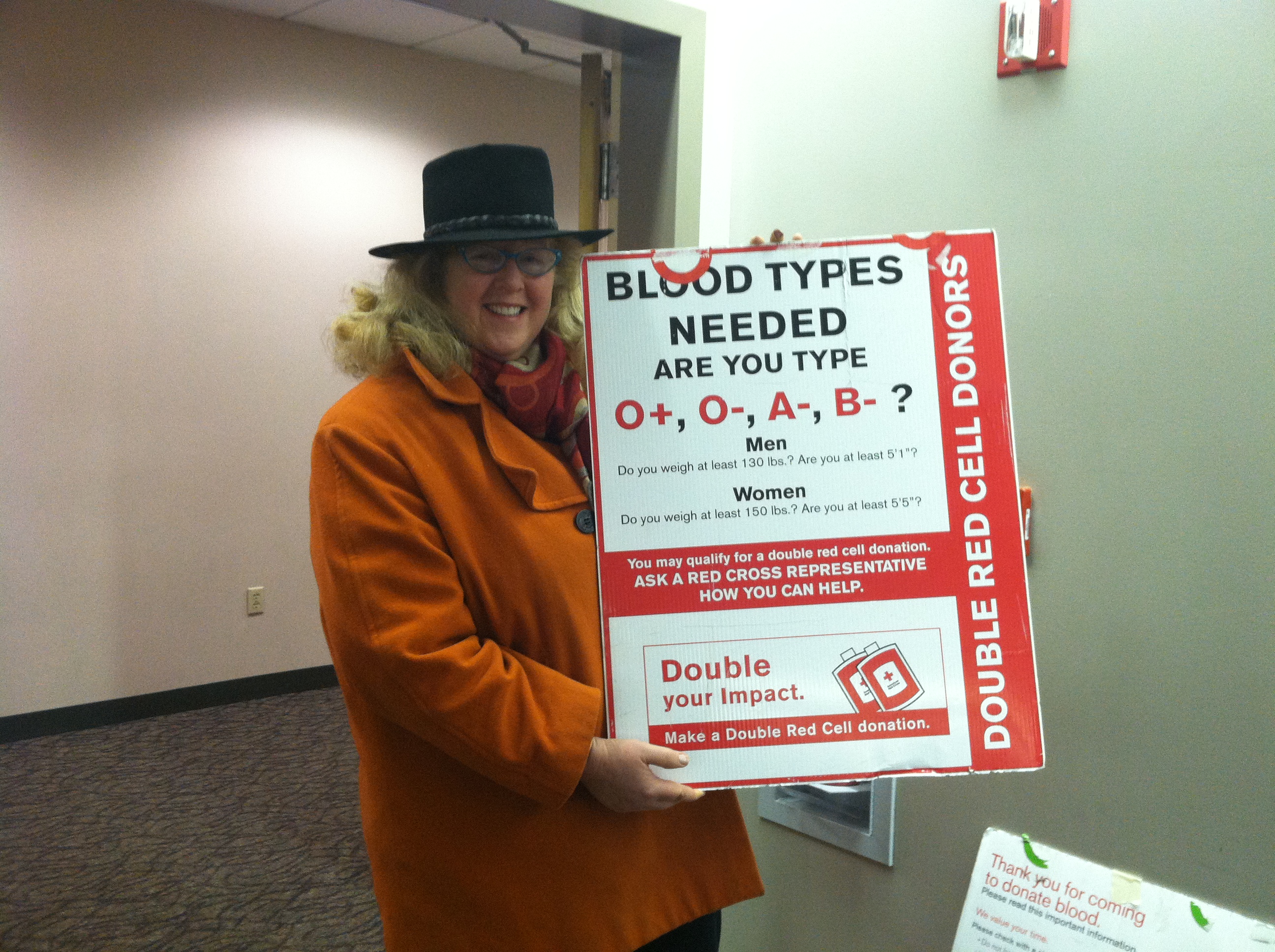
Lisa Wessan, advocating for blood donation at Red Cross.

Lisa Wessan, advocating for blood donation at Red Cross.

For most people, during the month of December we look for ways to give extra love, charity, dinners, trips, gifts, bonuses…we are in an intense giving mode.   I wish for every dollar spent at the mall someone donated blood — saving approximately three lives per donation — now that’s massively good giving!

What’s great about donating blood is that you can give it away every eight weeks, at the most, or any amount of times after that during the year.  You can give at each seasonal equinox, or twice a year, whatever you donate, it’s all good.

Each time I give blood I am reminded of the great mystery of our blood, and how it works tirelessly to keep us alive,  coupled  with the awe and  wonder of the human body.  Plus the amazing process by which the Red Cross extracts my blood and delivers it to someone who needs it — just astounding.  So well done.  Bravo!  Kudos to the Red Cross for your exemplary service.

So here’s your reminder that an opportunity awaits you…do you want to raise your self-esteem? Do estimable acts!  Giving blood is a mood changer, uplifter and total Mitzvah blessing, in the full sense of the word.  Go for it! Click here to find nearest donation center in USA.

2 Comments »

Worthwhile film, “Enlighten Up!”

The film, “Enlighten Up!” is full of transformational wisdom and fun, (available at Netflix). Just loved it… http://ow.ly/3vvzg

Leave a comment »

Laughing with the joys and troubles of life leads to growth…

Reporter Julia Gavin did a very nice job on this article, with special features, one case study and more….thank you Julia!

Reference:

Gavin,. J. (2010). Laughing with the Joys and Troubles of Life Leads to Growth 
The Chelmsford Patch.


1 Comment »