The Lighter Side of Transformation

with Lisa Wessan, LICSW

Holiday Blues? Pause and Take a Mental Laxative (Forgiveness 101)

For some people, the holidays are a very joyful and exciting time of year.  More parties, celebrations, shopping and gift exchanges coupled with lots of social stimulation.  It’s all good…for them.

But for others, who feel painful pressure to have “forced fun” and may not have strong intimate connections, lack financial resources, struggle with illness or addiction, these times are fraught with deep loneliness and uncomfortable feelings of “Compare and Despair” (Wessan, 2011).  For this group,  we are entering “The Red Zone.”  

The Red Zone  runs through  Thanksgiving, Christmas and New Year’s Eve…and perhaps for many Valentine’s Day is also included in this over stimulating, emotionally charged, addiction riddled time of year.

When I was younger, single and living alone in New York City,  I experienced the holidays as my Red Zone.   I loved my circle of friends, but many of them were married or had moved far away. They were not available for the holidays. I found my loneliness was most acute during this time of year.

As part of my coping with loneliness,  for many years I went away for New Year’s weekend to Pumpkin Hollow Retreat Center, in Craryville, NY.  Pumpkin Hollow is a beautiful place, with magical trails on lush Berkshire hills and a thoughtful and sensitive staff.  They used to facilitate a wonderful Silent Retreat over New Year’s weekend (I noticed now they have one in late January and May).

There were moonlit walks in the woods, we ate delicious gourmet organic vegetarian meals , danced  around a huge campfire, hugged trees and meditated together in the silence.   The facilitators artfully helped us work through all the activities in silence, and I remember every year being amazed at how little language I really needed to get by and still feel peaceful and content.

For me, it was a relaxing and restorative weekend in the Berkshires, but I also I had to process some difficult feelings. 


Forgiveness 101

Being in the Silence can be a powerful cleanse,  as so many distractions are removed.  The Silence gives us time to deeply work through some acceptance and forgiveness issues, serving as a “Mental Laxative,” as  Iyanla Vanzant is known to say  (Vanzant, 2013). This is a perfect time to take a moral inventory of ourselves, and notice where we need to improve. 

Moral inventories vary, but at their core,  we make a list of the people we have harmed, consciously or unconsciously.  Then we make a list of the ways we hurt ourselves, consciously or unconsciously.  Finally, we make a list of our fears and regrets.  (The only way to do a moral inventory wrong is to not do it at all.)

All of this then requires a deep and thorough forgiveness practice, ultimately letting go of all of it.  Then it is done.  We have a fresh start.  

You can use this Forgiveness Prayer to help you get started.  Practice Suggestion:  Read it into your Smart Phone’s Voice Memo app (or tape recorder) very slowly. Pause 5-10 seconds between each line.  Save it, and then play it back to yourself with your eyes closed, allowing yourself to feel it deeply.  As faces and names to forgive bubble up in your consciousness, you can make a note of them to add to your lists.

For all those we have harmed, knowingly or unknowingly,
we are truly sorry. Forgive us and set us free.
For all those who have harmed us, knowingly or unknowingly,
we forgive them and we set them free.
And for the harm we have done to ourselves,
knowingly or unknowingly, we are truly sorry.
We forgive ourselves and we set ourselves free.
~ Author Unknown ~

Afterwards, we may also need to talk to a few people and apologize for our behavior (or in some cases neglect).  Hard Fact: In order to really feel healthy, whole, clean and strong  inside, it is essential to give our inner emotional pipes a good Roto-Rooter cleaning by resolving any awkward or tender hurts. Apologies and amends need to be in the process.  Fun Fact: Asking for forgiveness is the final piece in our quest for inner calm, or should I say, the Final Peace?!!  

But you don’t have to go away for a whole weekend to give yourself an effective Mental Laxative…you can carve out some time each day, or each week,  to sit quietly and review your life to forgive the imperfect moments. What worked well? What did not go so well?  Whom did you judge too harshly?  Even taking a brief inventory of your emotional interior will have huge pay offs in the long run.  

One more Mental Laxative Practice Suggestion:  set a timer for 10 minutes.  Do as much of your list making as you can in that time, and then stop.  It will be enough.  Do this on a weekly basis, or more frequently if you are ready. Ten minutes of taking a Mental Laxative twice a  week is a great beginning, perhaps once over the weekend and once during the week?  Do what feels right for you.

As you progress, this could ideally become a daily activity…and who would you be if you had no resentments, anger, unresolved grief and rage?  You would bloom on in a whole new way.

In addition, I believe that holding onto negative thoughts and unresolved anger, resentment, fear and grief will fester within, and eventually manifest into some kind of physical illness and/or mood disorder.  We need to keep all of our pipes clean!  Digestive pipes and emotional pipes, which actually work together in the big picture.

As the hallowed halls of the Mindfulness research and Functional Medicine have taught us, every thought becomes a chemical reaction in our bodies.  Please note, the Mind-Body connection is not philosophical, theoretical or conjectured.  It is grounded in science (Turner, 2014).

We need to be aware of this and carve out the time to release and let go of our negative and stinking thinking.  If we don’t, it will just putrefy within, and poison our relationships as well.


What is Reflective Listening?

Being heard is so close to being loved, that for the average person they are almost indistinguishable.  – David Augsburger

Another worthwhile activity to do if you find yourself being in the Red Zone now is to volunteer your time, talent and special treasure in places that will appreciate you.

Before I became a therapist, I used to volunteer at a Suicide Hotline called HELPLINE, at the Marble Collegiate Church in New York,  which for me, was an exhilarating service.  It was founded by the late, great Reverend Norman Vincent Peale, may he rest in peace.  (There is also an excellent Blanton-Peale counseling center located at Marble, with wonderful psychospiritual therapists on staff, see reference below).

Most Hotlines have a fascinating and useful training program which enhances all human relationships.  I first learned the power of Reflective Listening in my 10-week HELPLINE training, and it transformed my life. 

Reflective Listening is being able to let someone else talk and just be present for them,  listening quietly.  When they pause, then you reflect back the essence of what they have just said.  This feels very soothing and loving to the agitated talker. The person feels so validated by your Reflective Listening, it is often enough to help them  get “off the ledge.” Listening is a form of loving each other that soothes, heals and restores us.

Learning Reflective Listening  was the bulk of my HELPLINE training, plus there was also a lot to learn about making referrals and gaining trust. 

Coming from a culture of chronic interrupters and non-listeners, I had learned some ineffective communication habits over the years, which I continue to strive to improve.   The impulse to speak out and interrupt is fierce, but knowing that it compromises relationships and hurts people helps me to zip my lip, as best as I can.  For today, I remain a humble work in progress, that’s for sure.

My hope for the future is that the Hotline’s training program is something that will be  taught to all humans by the sixth grade. Similar to the skills learned in Dialectical Behavior Therapy (DBT, which should also be part of elementary school education) during training we learned about interpersonal effectiveness, mindfulness, distress tolerance and emotion regulation.  These skills give us the foundation for better emotional balance, and allow us to be more present for others’ pain and suffering, as well as our own. 


Ask yourself the magical question, “How can I be useful today?”

I understand that a Hotline gig may not be your cup of tea.  Volunteering at a soup kitchen, animal shelter, nursing home, botanical garden, museum, Indivisible, MoveOn or anywhere can also be very uplifting during the Red Zone. 

Nursing homes always need a river of volunteers to help with feeding, reading, translation services and transporting  non-ambulatory residents .  I learned this when I was in graduate school, as one of my internships was at the Jewish Home and Hospital for the Aged in the Bronx.  I was facilitating several  therapy groups each week, but there was a huge volunteer staff that coordinated all these helpful tasks for the residents.  I was so impressed with the volunteers’ compassion and zeal to help these nursing home residents.  

Yes, there is a time for self care, and then sometimes it is better to focus on others’ needs more than your own, to take a break from the painful  ME-ME-ME inner dialogue you might be having.


Transparency is Healing

Finally, being in the Red Zone totally in secret is just exhausting and no fun.  Be honest and authentic about your feelings — transparency is healing —  and see who matches your energy.  You might find a few people who also feel put upon and even hate the holidays — great — these will be your Red Zone buddies and comrades in getting through the muck of the season. 

Make it a point, however, to be victorious together, e.g.”let’s stay sober and clean through this nightmare,” or “This too shall pass. How can we be useful today?”  or “Let’s go for a hike and get away from the shopping madness.” Complaining is draining, so it’s important to find ways to support each other to rise above the chaos of the season.

Being able to laugh about it, the complete absurdity and paradox of Christmas especially, is so refreshing.  Whenever I see huge displays of gifts and glittery objects everywhere tempting us to buy-buy-buy, I chuckle to myself and think “What would Jesus say about all this?  Would He be happy with this display?”  Yikes.

I’m not judging, nay, nay,  I actually love the glittery Hand of G-d in all of this (Wessan, 2012).  But you know  the commercialization of Christmas becomes excessive and downright irritating at times — so I like to take a step back and think about the real reason for the season…our awesome connectivity, celebrating our Oneness, and the mystery of the Numinous in our lives.  

Another reason is the magnitude of  working through the bittersweet feelings of existence together and being brave enough to peacefully co-exist in this tumultuous world.   We can acknowledge the dialectical paradox, that sometimes we want to live and sometimes we don’t, but we choose life anyway.  We need to be courageous during this time, knowing that we are struggling in the Red Zone while “everyone else” seems to be having the best time ever. 


In Conclusion

For this holiday season, The Red Zone,  I encourage you to try something different:

  • Experiment with a daily or weekly Mental Laxative experience, or go away on a retreat for more in depth forgiveness work.
  • Volunteer somewhere that will give you  a chance to focus on someone else, take a break from “Poor me, Poor Me, Pour me a drink” thinking.
  • Give honesty a chance, come clean and tell a few people how you really feel. Defrost some of that hidden grief, rage, loss, loneliness, “Compare and Despair” and all the inner stressful thinking that puts a damper on your days.

I promise if you follow some of these suggestions you will feel lighter, brighter and perhaps, dare I say it, even more peaceful during this relentless Red Zone. 

Good health is wealth, go for it!


References

Dialectical Behavior Therapy Skills (DBT).   This is a four part psychoeducation program that covers Mindfulness, Emotion Regulation, Distress Tolerance and Interpersonal Effectiveness. It takes one year to complete the curriculum.

Turner, K. (2014).  Radical Remission: Surviving Cancer Against All Odds.   New York: Harper Collins. 

Vanzant, I. (2013). Forgiveness: 21 Days to Forgive Everyone for  Everything. Carlsbad, CA: Smiley Books.

Wessan, L. (2011, September 27). Compare and Despair: How Free Do You Want to Be?  Retrieved from https://mirthmaven.blog/2011/09/27/compair-and-despair-how-free-do-you-want-to-be/

Wessan, L. (2005, October 14) Forgiving is not condoning. (8 minute video)  Retrieved from https://www.youtube.com/watch?v=avBEdDJJGrk

Wessan, L. (2012, July 13). The Glittery Hand of God. (3 minute video).  Retrieved from https://www.youtube.com/watch?v=PT2lSvLft4o&t=4s

Blanton-Peale Institute and CounselingCenter, New York, NY,  for individual, family and couples counseling.  Accepts most insurance.  Highly recommended for quality psychospiritual therapy.  Founder: the late great Reverend Norman Vincent Peale. 

Pumpkin Hollow Retreat Center, Craryville, NY. Owned and operated by the Theosophical Society.  Organic vegetarian food served from their own farm, non-dogmatic, beautiful retreat center. Highly recommend, especially the retreats on Therapeutic Touch, and the Silent Retreat.


Copyright © 2018 by Lisa Wessan. All rights reserved.


1 Comment »

When you are addicted to Drama…

Dear Drama

Even if you don’t have a chemical addiction (Alcohol, Pills, Sugar, Flour, Dairy,  Cigarettes etc), you might be addicted to crises, drama, or intense emotions that put you center stage.

You could even be addicted to isolation, anger, hatred, “Compare and Despair”  and other emotional states…it’s universal.  Ideally, no one would feel shame about their impulse issue, and more than half the battle is naming and releasing the shame around these issues. “If you can name it, you can tame it!” is one of the most hopeful slogans of my guild.  We are all striving to grow, learn and heal from whatever ails us.

In my Westford, MA, DBT Skills Group (Dialectical Behavior Therapy), we recently explored addiction models, including Total Abstinence, Harm Reduction and Dialectical Abstinence.

Total Abstinence is useful  when you have tried 1000x or more to practice Moderation Management but it failed. Moderation Management has you set a boundary or limit to what you can do before you are at risk.   For example, if you have a challenge with alcohol, saying “Two drinks per evening, and no more than twice a week.”  If you consistently zoom past that limit then Moderation Management has failed, and you cannot get well with that system.

Complete abstinence is usually for those who know that “One cookie is not enough, and a thousand are too many. ”   For those people who cannot enjoy one or two cookies, for whom the desire to keep going will override all rational thought, complete abstinence from cookies is the easier, softer way.   You make the decision once and for all, and then keep surrendering to it because you know it is less painful than the alternative inner haggling dialog on whether to indulge “this time” or not.

So when moderation is impossible…then you know.  Usually you cannot skip straight  into to total abstinence…most of us do the hokey pokey for a while with Moderation Management before we surrender. Fun  fact: The whole journey is necessary  for your inner process to be complete. 

Dialectical Abstinence is a middle path for those who cannot,  or will not, practice total abstinence from their substance abuse, or addictive behavior, yet ultimately desire total abstinence.  Yes, it’s the perfect paradox, “I want to abstain, but I won’t right now.”  Moderation Management and Harm Reduction are applied here to manage your addiction and prevent a complete relapse.

Harm Reduction is allowing for a thought system to be flexible enough so that if someone has one drink, or one cookie, they don’t say, “Oh what’s the use, why bother, I might as well go all the way and finish the bottle (or box of cookies)!”   Harm reduction takes you out of the dualistic, all or nothing, black and white thinking so that you might have three cookies and then say, “Ok, that exceeded my limit, but I’m going to stop right here. It’s good enough for today.”

As my old beloved professor Christopher Lasch at the University of Rochester once said “We live in a culture of addiction.”  Lasch was fairly well known for his book on The Culture of Narcissism: American Life in an Age of Diminishing Expectations (1979), but he had a deep belief that the rise in our addictive culture was correlated to our self-absorbed lifestyles.

Self Centered

So much of our need to medicate ourselves or have a Pity Party for ourselves is tied into our “Me-Me-Me” anxiety and fear.  Clearly there is no simple altruistic solution for our  multidimensional addictions.  The research and science on this vast topic has repeatedly shown that  when we do aim to give service and get out of our heads for a while we can find some relief and peace when focusing on fulfilling others’ needs.

And yet, if you are obsessed with others’ well being and are codependent, then you have another kind of addiction…which requires detaching and letting go of others’ business!  Oh my, it’s a slippery slope in the land of addiction!

I find with my DBT students that many of them are recovering Drama Queens and Kings.  Before they started this healing process, they were often embroiled in wildly high risk and/or  debilitating situations.  Once they realize that they do have an addiction to Drama, they start letting go of the the need to be center stage, stirring the pot and getting everyone around them wound up.  But it requires a process of compounded skill building, education, homework and practice,  and re-wiring their brains in order to shift from the “Poor Me” narrative to the “Serene Me” experience.

When someone says, “Poor me, poor me, pour me a drink!”   they are stuck in Victim Consciousness and do not see how many choices and options they have.   Slowly, slowly, with DBT training, rehab treatment, or 12 Step processes they start to see how many other options they have besides using their addiction to cope.

We live in a time where treatment for addiction and mood disorder is available, and the only way to do recovery wrong is to not do it at all.  So if you or a loved one are struggling with something along the addiction spectrum, trust that there is a solution for you.  As the Dalai Lama says, “Never Give Up!”

Copyright © by Lisa Wessan 2018. All rights reserved.

Leave a comment »

The awe and wonder of giving blood…

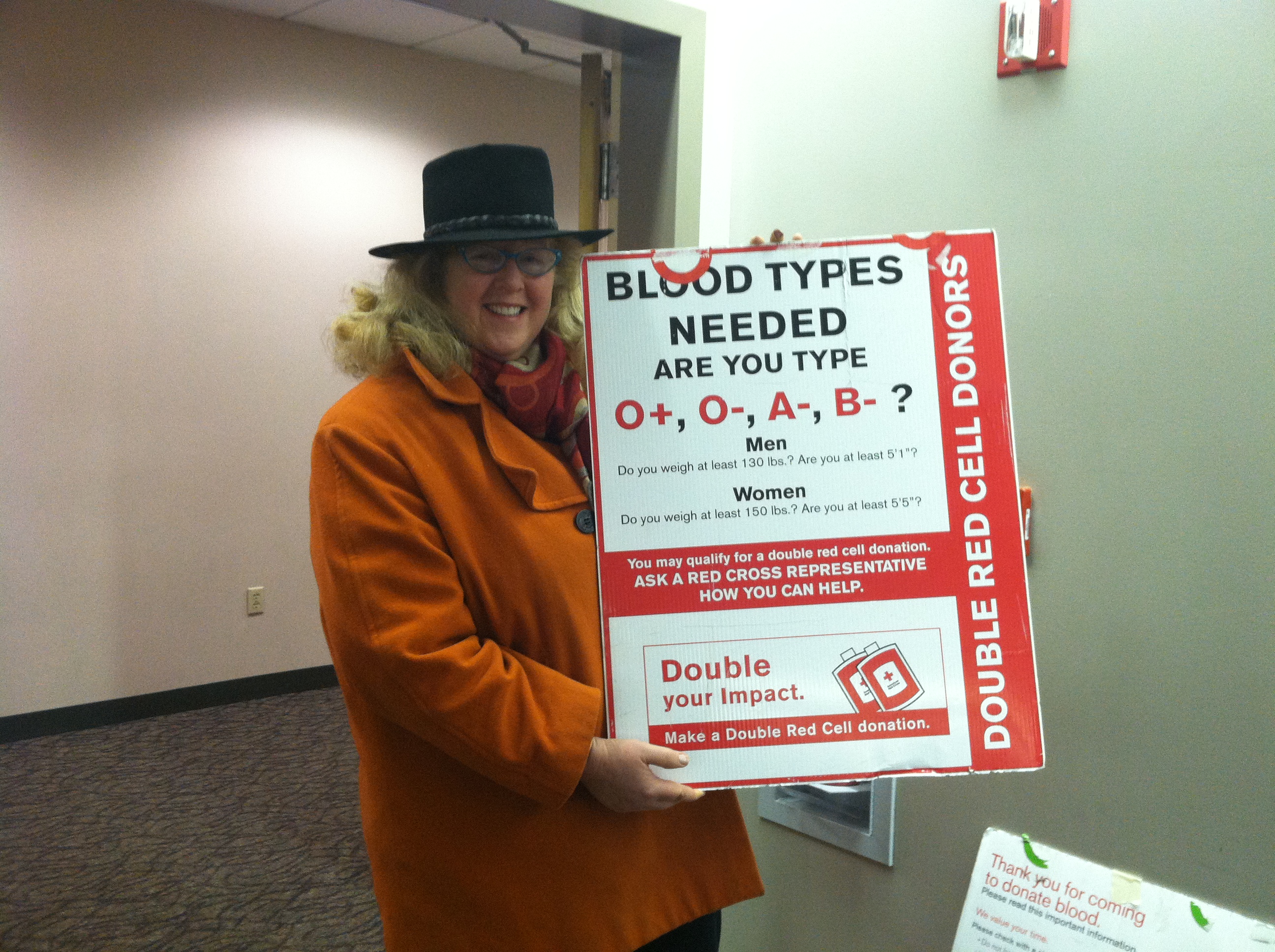
Lisa Wessan, advocating for blood donation at Red Cross.

Lisa Wessan, advocating for blood donation at Red Cross.

For most people, during the month of December we look for ways to give extra love, charity, dinners, trips, gifts, bonuses…we are in an intense giving mode.   I wish for every dollar spent at the mall someone donated blood — saving approximately three lives per donation — now that’s massively good giving!

What’s great about donating blood is that you can give it away every eight weeks, at the most, or any amount of times after that during the year.  You can give at each seasonal equinox, or twice a year, whatever you donate, it’s all good.

Each time I give blood I am reminded of the great mystery of our blood, and how it works tirelessly to keep us alive,  coupled  with the awe and  wonder of the human body.  Plus the amazing process by which the Red Cross extracts my blood and delivers it to someone who needs it — just astounding.  So well done.  Bravo!  Kudos to the Red Cross for your exemplary service.

So here’s your reminder that an opportunity awaits you…do you want to raise your self-esteem? Do estimable acts!  Giving blood is a mood changer, uplifter and total Mitzvah blessing, in the full sense of the word.  Go for it! Click here to find nearest donation center in USA.

2 Comments »

Compare and Despair: How free do you want to be?

A few weeks ago I became aware that one of my top-tier, close relatives unfriended me on Facebook…ouch! My first reaction was tightness in my neck and throat, I took a deep breath. Yes, surprisingly, breathing always helps dissolve some of the stress. But then I remembered that she was a teenager, and that it is possible she wanted more privacy in her postings with her friends. I made a choice to believe the best possible reason, and let it go.

This relative is dear to my heart – but I will not ask her, “Why did you unfriend me?” It could only lead to more grief. In the past, when I have asked other relatives “Why?” questions, I was scolded. “Why are you angry?” or “What’s wrong?” can trigger some people who would rather not discuss their feelings. I learned from those times.

The past few weeks, however, when I visited my Facebook page (once or twice during the week), I noticed I had this sad, unresolved grief about being unfriended by this relative. It wasn’t going away, despite my rational emotional response to it.

The good news:

Here is another moment in life when I can actually experience free will – I have a choice: will I let this Facebook event bother me and dwell on it, allowing this teenager to interrupt my thoughts and mental flow, living in my head rent free, causing me to spiral into a possible depression?

Or…will I focus on the strengths of our relationship and trust my first reaction?

I have a history of getting caught up in the toxic realm of negative thinking, which I prefer to call the Compare and Despair syndrome…

What is the Compare and Despair syndrome (“CAD”)? CAD operates on two levels. The first level is when I CAD myself to myself. There is the idealized version of me, and then there is the Lisa du jour; however I happen to be now. How this looks: I tell myself stories about how I could have been better…the classic CAD vernacular is fraught with guilt, self-wounding words and phrases such as I shoulda, woulda and coulda, always, never, and if only. CAD thoughts try to figure out how XYZ could be avoided.. In this case, how to avoid being unfriended on Facebook.

For example, “If only I were more athletic, thinner, richer, my relative wouldn’t have unfriended me…” As if my alleged lack of worth caused this teen to unfriend me. Nay, nay, I say, we don’t go there anymore…

The second level of CAD is when I compare myself to others, which always leads to pain. Practicing CAD with siblings, peers, colleagues and other is always a lose/lose situation; CAD becomes torturous when I read Vogue Magazine or The Week and am triggered by a tsunami of CAD, as I compare my voluptuous body with anorexic models and celebrities. It’s wonderful to read about someone’s success and be inspired – that’s always worthwhile. But to read about someone and feel less than, well, it’s time for some treatment for CAD.

So how can I choose to have a better mental health day? For today, I choose to focus on who loves me, who wants to be with me, who are my real friends, and who does care to connect with me. This is a choice! It’s also a practice –a psychospiritual practice.

From my experience, there is no will power when it comes to transformation. I cannot just make myself think about something – or not think about it — as if I am a programmable robot. No, it takes an army of angels to help me turn around these negative, toxic thoughts. From experience, professional training and years of helping others do this, I have come to understand that we have many kinds of helpers, both fleshly and invisible, who will, for the asking, intervene on our behalf.

Most healthy people by default are non-invasive and non-interfering with our troubles and thoughts. We need to pick up the phone and ask one of them for help. Sometimes this can be accomplished in a five-minute phone call. Sometimes we need to meet with someone for a longer talk, or seek professional help. Whatever, getting better starts with asking for help. Once we roll that stone away, the Universe can move in and fill us with the wisdom, compassion, unconditional love and the connection that we truly crave.

The good news here is that my little relative did a big favor for me. By unfriending me on Facebook, I was able to deconstruct this painful moment and turn it around into a joyful affirmation of my life.

So it’s true: my joy, my love and my experience of life are not dependent on who is my friend, on Facebook or otherwise. Instead of asking, “Why did she unfriend me?” I can ask “How can I be useful today? How can I make a difference? How can I give support, love and creative energy on this planet today?” Yes, asking the “HOW?” question is uplifting and invigorating. Asking “WHY?” just leads to a dip into negative thinking.

I have a few favorite affirmative prayers that can transform Facebook pain into something better. One of my favorites: “I am an irresistible magnet for God’s Goodness, and I attract the right friends, clients, peers and always get what I need.” I repeat this many times, until the soothing effect feels complete. Each time I say it, I am reminded of how much goodness and love IS in my life…and in my big picture, all is well. I am better, not bitter…

There’s also the old saying, “Man’s rejection is God’s protection.” I can choose to believe that this relative and I are really on very different vibrational planes – maybe even different Universes – so why can’t I accept that she is truly not a close friend to begin with? Let’s face it, trace it and erase it, DONE! (This is a great philosophy for people who are dating. I used to say this whenever a romantic situation wasn’t working out well. ) Whenever I am rejected, it is surely for the best, because everything is working towards my highest and best outcome.

Finally, we all end up at the Cosmic Café…at the end of time, at the beginning of time, forever; our souls are connected to each other in the web of life, in the Oneness of the Universe. There is no way to NOT be connected to this delightful little teenager! She and I are already One…why is my pea brain stressing over being unfriended, while our souls are joined together at the Cosmic Café forever? Indeed, whenever I want to connect with her, I can still pick up the phone, text her, or arrange for a visit. It’s all good.

Facebook is a great test for how lightly I am wearing my life. Am I experiencing my life as a loose garment, comfortable and easy, or is it tight, constrictive, punishing and unbearable?

Our greatest achievements do not show up on our résumé, on television or in the media, or in our bank accounts. There are no cash and prizes for these personal victories. Each day is another day of turning a defeat into a victory, a scar into a star, and the feeling is priceless. I can laugh at it and move on, free of any Facebook baggage. How free do you want to be? That is the question.

Copyright © by Lisa Wessan 2011. All rights reserved.

1 Comment »

Worthwhile film, “Enlighten Up!”

The film, “Enlighten Up!” is full of transformational wisdom and fun, (available at Netflix). Just loved it… http://ow.ly/3vvzg

Leave a comment »

Defining the Laughgasm (Laughing Orgasm)

As sex educator Dr. Yvonne K. Fulbright has noted, “While I’ve had some out-of-this-world orgasms, I personally think that a good laugh gives orgasm a run for its money. Nothing is more delicious than losing yourself in a side-splitting, seemingly endless crying with laughter session. It’s no wonder that being drunk with laughter has so many benefits. Laughter boosts your immune system, healing and cleansing your mind, body and soul. It increases the level of endorphins and neurotransmitters that are health-enhancing while lowering the level of stress hormones in your body, like cortisol. Laughter provides fantastic physical and emotional release. It gives your body a good workout, exercising the diaphragm, contracting the abdominals and working up your heart rate. It enhances your mood, drawing you away from any negative emotions, like anger, that are consuming you. In being utterly contagious, laughter also connects us. Hmmm, kind of sounds a lot like orgasm.”

I would never say that laughter could replace sex and orgasms, but there are times when a good full-bodied laugh can certainly help you experience the relief, release and feeling of refreshment you might have from an orgasm, plus it can reboot your nervous system, similar to an orgasm…that is, clear the mind, settle the synapses, relax-reboot and all is well…

I met my first laughter meditation teacher when I lived New York City, his name is Laraaji. Besides facilitating a brilliant laughter meditation class, Laraaji is also a powerful musician and peace activist. Laraaji says “Laughing and orgasming are very similar. For me, ejaculatory orgasm is draining. Instead of coming, its more like leaving. I prefer orgasmic laughter, it nourishes my nervous system, keeps my expressional vehicle loose, and puts me in touch with my feelings. As part of my yogic practice each morning, I have a hearty laughgasm.” Watch Laraaji having a LaughGasm here…

Laraaji facilitates a wonderful two-hour laughter meditation program in NYC…definitely worthwhile if you’re in the city and want to have a mind-blowing laughathon. He’s not big on social media, but he does share his beautiful zither music here.

In my keynote speeches, seminars and consulting work on therapeutic laughter, my audiences often have laughgasms, but I have never labeled them or called them out on it…are we ready? Dare I do it? Should I even consider marketing my work as offering Laughgasms? What do you think?

4 Comments »

Earth laughs in flowers. ~ Emerson

Earth laughs in flowers. ~ Ralph Waldo Emerson

Leave a comment »

World Peace Through Laughter? Is this a joke?

When I did my first training for certification in Laughter Yoga, Laughter Meditation and Laughter Therapy, my teacher, Madan Kataria, MD, talked about his vision for world peace through laughter. Some scoffed, but he planted a seed in me during that training…I had a vision of having a large room, or even Madison Square Garden, filled with Muslims and Jews, experiencing extended, massive periods of laughter together. Not laughing at jokes – not that there’s anything wrong with that – but laughing at the absurdities, incongruities and paradoxes that surround the Palestinian/Israeli conflict and that permeate the prejudices in all confused religious conflicts.

Besides all the extraordinary physiological benefits from laughter which you have experienced – the lowering of cortisol levels, muscle relaxation, and improved memory and cognitive functioning – I have seen what laughing together in groups can do. It dissolves anxieties, tensions, prejudices, fears and allows people to feel safe enough to say what they need to say. Laughter is surprisingly disarming, and when we laugh together our walls and facades come down. Laughter is the great equalizer, one of the most profound democratizing energetic forces available for transformation.

Well, it happened this summer…right here 30 miles north of Boston, due to the progressive spiritual leadership of the Qutbi Masjid (mosque) of North Billerica, MA, and Congregation Shalom of North Chelmsford, MA. These two enlightened communities teamed up for a day of healing in the Merrimack Valley. I was invited to be the keynote speaker at this Health and Wellness Fair…what an exciting moment!

My vision for a harmonious Middle East, for more brotherly acceptance and respect (and eventually love) seems to be happening now. My hope and prayer is that this moves from the micro to the macro level, one laugh at a time. Read more about this incredible event in this recent article from THE JEWISH JOURNAL.

Leave a comment »

Invitation for centenarians, gerontologists and studio audience participants…

I am currently seeking healthy, alert and oriented centenarians to be interviewed for “The Super Centenarian Series” in 2011, my new my cable television topic. If you know any centenarians in the greater Boston area, please invite them to contact me.

I am also interested in talking with gerontologists and health care professionals who work with the elderly for the caregiver segments.

Also, if you would like to be part of our studio audience, please join us!

Leave a comment »

Nothing is impossible…

Nothing is impossible, the word itself says “I’M POSSIBLE!” ~ Audrey Hepburn

Leave a comment »