The Lighter Side of Transformation

with Lisa Wessan, LICSW

Empower Yourself: Enhance Interpersonal Effectiveness and Reduce Social Anxiety

Take charge of your social interactions and personal growth with a 14-week Dialectical Behavior Therapy Skills Training Group (DBT). Learn effective strategies from expert Lisa Wessan to build confidence, set boundaries, and communicate assertively.

You can develop skills to set healthy boundaries, communicate clearly, and become resilient to others’ disapproval. Learning effective ways to interact can reduce social anxiety and enhance your success and relationships. You’ll also discover useful strategies for making requests and easing into small talk, such as discussing work, weather, or the weekend. By focusing on skill-building rather than willpower, you can foster more fulfilling social interactions.

Developing interpersonal effectiveness skills also involves investing time, effort, and resources. Many individuals choose to develop these skills when they seek change in their behavioral patterns. Sometimes your inner dialogue says “I am sick and tired of being sick and tired! I need to do SOMETHING to turn this around!” Research suggests that focusing attention on skill development leads to improvement in those areas, including social skills.

Neale Donald Walsch once wrote, “Life begins at the end of your comfort zone.” Yes, becoming comfortable with discomfort takes time and practice. By learning neuroscience-based skills, you can improve your ability to build new neural networks and succeed in mastering interpersonal skills.

Solution-Focused Therapy

The next virtual DBT Skills Group focused on Interpersonal Effectiveness and Mindfulness will run from September 30 to December 30, 2025. The course is taught by Lisa Wessan, LICSW, CLYL, RM, who trained directly with DBT founder Dr. Marsha M. Linehan and has over a decade of group facilitation experience. This 14-week program features weekly 90-minute sessions at $80 per week, providing participants with hands-on practice in social skills within small groups of 6-10.

To learn more, please visit https://www.lisawessan.com/dialectical-behavioral-therapy

🌀🌀 Register early for DBT groups, as enrollment involves several steps. Avoid waiting until the last week to sign up.

Onward and Upward✨

Lisa Wessan

Leave a comment »

Welcome to our Podcast, PROCESS RECORDINGS

My colleague, Heath Hightower, Ph.D of Somerville, MA, invited me to join him on this exciting adventure in learning. We started percolating on ideas in the summer of 2024. It was an invigorating and joyful process to brainstorm ideas with Heath. We come from different backgrounds, have colorful geographical and spiritual contrast. This adds more flavor to the feast. Fast forward to 2025, where we have now recorded 18 episodes…

For each topic, such as ANXIETY, we have a Part I and Part 2. In Part 1, we review the terms and definitions of the issue. We do a brief literature review. Heath favors research studies and analytical journals. I go deep on clinical books for intense bibliotherapy. Together, we present an excellent overview and foundation of the topic.

In Part 2, we delve into solution focused practical skills. These skills are tactical and useful for moving into a gentle healing and recovery mode.

Skill Power vs. Will Power? Hands down, Skill Power wins every time! How do you recover from anxiety? How can you turn around toxic shame? How do you set healthy boundaries? Yes, Part 2 explores the “HOW TO” realm. This includes tools, tips, and techniques that Heath and I have found useful. (Together we have over 50 years of combined experience!)

To start your journey with Heath and I, please visit PROCESS RECORDINGS. May these discussions help you increase your capacity for success, abundance, love and more inner peace in your journey towards wholeness💙

Leave a comment »

Mastering Dialectical Behavior Therapy Skills (DBT): 14-Week Distress Tolerance and Mindfulness Skills Training, starts June 10, 2025, 7:30 – 9 PM EST (on Zoom)

Serenity is not freedom from the storm, but peace amidst the storm…

Hi, 

I’m excited to be teaching the next 14-week semester of Dialectical Behavior Therapy Skills (DBT).  This semester we will cover Distress Tolerance & Mindfulness Skills.

🌀 Click here for the current DBT FLYER.

DBT skills significantly help to reduce the escalation of your inflammatory emotions. They also lessen the painful, polarized and perfectionist thinking that often cause your meltdowns. You will learn to find your peaceful “Middle Path” here. 

There are many powerful skills included in this semester’s work. We hope you will create your own personal Distress Tolerance tool kit. Use the techniques that work the best for you.

Unfortunately, there is no “one size fits all” with these various techniques. You need to be a good scientist in the laboratory of your life and try them all out.  To that end, DBT provides excellent handouts, worksheets and exercises to help you practice between sessions. You will eventually find the techniques that you love. These techniques will help you pause successfully. They will transform difficult moments into something better.

You might have someone in mind for this next DBT Group. If so, please have them contact me soon at my web site – www.lisawessan.com – and fill out the Contact Form. This private form helps them briefly tell me the best times to reach them. (It also guides them to check out their insurance for the Out of Network benefit.)

Please know, this is a NO-SPAM zone, and no one’s email is saved unless requested to do so.

14-week fee: $1120 for continuing students, $1420 for new students (includes one Intake session.)  

It is an honor to serve your friends, family, patients or clients with this powerful, experiential, transformative curriculum.

Onward and Upward✨
Lisa Wessan

“If you can recognize and accept your pain
without running away from it,
you will discover that although pain is there,
joy can also be there at the same time.”

~ Thich Nhat Hanh, No Mud, No Lotus

Lisa Wessan, LICSW, CLYL, RM
Psychotherapist, Dialectical Behavior Therapy Skills Trainer (DBT),
Podcaster, Author, Speaker
www.lisawessan.com
UP NEXT: DBT Distress Tolerance & Mindfulness Skills (Virtual, June 3 – September 2, 2025)
🌀✨🌀✨🌀✨🌀✨🌀✨🌀✨🌀✨🌀✨🌀✨🌀✨🌀✨🌀✨🌀✨🌀

Leave a comment »

Effective Dialectical Behavior Therapy (DBT): Open Enrollment Now

 
“Between stimulus and response there is a space. In that space is our power to choose our response. In our response lies our growth and our freedom.” ~ Viktor E. Frankl


I am delighted to announce that the next virtual 14-week Dialectical Behavior Therapy Skills (DBT) Group will be meeting on Tuesday evenings, 7:30 – 9 PM EST, February 18 – May 20, 2025.  We will be covering both the Mindfulness and Emotion Regulation modules.  (This is an ongoing group that has open enrollment periods three times per year.)

[If you would like to receive a copy of the full 14-week curriculum, please request one HERE. (This is a NO-SPAM Zone, so your email will not be added to any list unless you request it.]

The Mindfulness material includes:

  • Learning how to be a good observer, describing your feelings, participating more fully in life
  • How to become non-judgmental of yourself and others
  • Staying in the present moment with more ease
  • Practicing being effective for the greater good of your family, workplace, community
  • Accessing Wise Mind (aka higher self, higher consciousness)
  • Understanding Reality Acceptance and detaching from negative or critical thoughts.
  • Shifting from Willfulness to Willingness

The Emotion Regulation module has four sections:

  • Understanding and Naming Emotions
  • Changing Emotional Responses
  • Reducing Vulnerability to Emotion Mind (your highly reactive and difficult emotions)
  • Managing Extremely Difficult Emotions

As DBT founder Dr. Marsha Linehan says, “It is difficult to manage your emotions when you do not understand how emotions work. Knowledge is power.”

GROUP ATMOSPHERE: My students are well mannered, high functioning and convivial.  For those who occasionally tend to demand more attention, want to give inappropriate feedback and/or act out in any way, I do have a strong “Respectful Communication Policy” in place and several useful group rules which help to maintain a safe, harmonious and cohesive group atmosphere.  All are welcome, but there is no allowance for rude or harsh behavior.

Group members will continue to process their unresolved traumas in their individual therapy, not in this group. This is a therapeutic psychoeducation program. (It is NOT group therapy.)

For dates, fees, videos and more details, please visit
Dialectical Behavioral Therapy | Lisa Wessan

May this serve you or your loved ones well in their journey towards wholeness and more inner peace.

Onward and Upward🌀

Lisa Wessan

Leave a comment »

UP NEXT: Spring/Summer 2024 Dialectical Behavior Therapy (DBT) Skills Training May 21 – August 27, 2024 (on Zoom)

Hi,
I’m excited to be continuing to teach the evidence-based Dialectical Behavior Therapy Skills Training (“DBT”) on Tuesdays nights, 7:30 – 9:00 PM EST, in the Zoom Classroom…

It takes one year to complete the full curriculum, but I divide the work into three trimesters.

January – April we study “Emotion Regulation,” May – August is “Distress Tolerance,” September – December is “Interpersonal Effectiveness.” We explore and review Mindfulness skills the first few weeks of each trimester. 

UP NEXT: we are moving towards wholeness and more inner peace studying “Distress Tolerance.”

There are still a few spots still open for this Spring/Summer term.  Learn more here: 

Dialectical Behavioral Therapy | Lisa Wessan

Fast Facts: 

  • All 90-minute groups are $75/Week (see FAQ on web site for PPO/insurance details).
  • Students pay in full prior to start of group. [New students need to complete their registration forms, intake sessions and fees no later than 5/17/24.]
  • My students are educated and well mannered, high functioning and convivial.  For those who occasionally tend to demand more attention, want to give inappropriate feedback and/or act out in any way, I do have a strong “Respectful Communication Policy” in place and several useful group rules which help to maintain a safe, harmonious and cohesive group atmosphere.  All are welcome, but there is no allowance for disruptive behavior.
  • Group members will continue to process their unresolved traumas in their individual therapy, not in this group. This is a therapeutic psychoeducation program. (It is NOT group therapy.)
  • Group size ranges from 6-12 students.

May this serve you or other loved ones well✨

Lisa Wessan, LICSW, CLYL, RM
Psychotherapist, Dialectical Behavior Therapy Skills Trainer (DBT)
www.lisawessan.com
🌀✨🌀✨🌀✨🌀

“The mind that is awakening laughs at itself a lot. It laughs as the echo of old patterns show up.”
Wisdom Quotes from The Way of Mastery (#23)

Leave a comment »

From Borderline to Balance: Dialectical Behavior Therapy for Post-Traumatic Stress Disorder (DBT-PTSD)

Abstract: This article offers a perspective on the impact of Dialectical Behavior Therapy (DBT) in treating Borderline Personality Disorder (BPD) and trauma. The author shares valuable insights on renaming BPD to “Intense Trauma Syndrome” for reduced stigma and increased therapeutic support. The post effectively conveys the author’s experience with DBT and the positive outcomes observed with clients. The inclusion of Solution Focused Therapy and reframing cognitive beliefs adds depth to the content, enhancing its value. Overall, it provides a comprehensive view of the transformative nature of DBT in addressing trauma-related challenges.

When I first became interested in the Dialectical Behavior Therapy methods and curriculum (DBT), one of my mentors said, “Lisa, I strongly advise you NOT to get involved with this work. If you offer DBT Skills, you will attract the WORST clients!  They will all be severely agitating with Borderline, Bipolar or severe mood disorders, it will be a nightmare for you!”

I heard what she said, and I did respect her opinion, but there was something so powerfully intriguing about the evidence-based science behind DBT, and the fact that so many people were getting well from it – people who had been considered “treatment resistant” prior to their DBT exposure.

I do like a challenge, however, and I was not afraid of this high risk population. Something inside me told me to continue…against the advice of this mentor, and other practitioners I knew.

It is now twelve years since my first DBT training, and I’m still excited to be sharing the DBT curriculum with adults (21+) in my virtual Zoom classroom.  I have had the privilege of witnessing hundreds of my DBT clients, in both individual and group sessions, go through this cognitive re-structuring process, shed their false beliefs, deconstruct their traumas, grieve and move on to have healthy, happy, contented lives.

In the process, I have learned that approximately 70% of my clients with Borderline Personality Disorder (BPD) suffer from severe co-occurring post-traumatic stress disorder (PTSD),  related to traumas that occurred during childhood. These traumas were not processed or expressed at the time,  and they caused a corruption of the client’s personality, mental and social skills.

These unresolved traumas, when treated, often bring upon a rebirth process, and the client is no longer exhibiting the Borderline symptoms.  Therefore, I humbly submit that it would serve everyone if BPD could be renamed Intense Trauma Syndrome (ITS).

Here is why:

  1. The term Borderline is heavily stigmatized in my guild.  “Borderline” sounds as if someone is on the edge of a cliff about to jump, perhaps on the verge of…suicide? Murder? Something worse?  Witness my mentor’s advice above, plus, each week I receive calls from clients who tell me “No one will work with me because I am Borderline.”  This is frustrating and heartbreaking to me.  Why is this heavily traumatized group eschewed because of their condition? Where should they go?  How will they get well? If BPD were to be re-labeled as Intense Trauma Syndrome, I think they would be helped by more therapists!  But this requires more than a branding campaign…
  2. Borderline clients often exhibit highly dissociative symptomatology, chronic suicidality, and ongoing non-suicidal self-injury.  This is also a big turn-off to my guild.  Many of my colleagues will NOT work with suicidal clients.  Why?  Too much liability, too many collateral calls, too much danger. Moreover,  my clients feel as if they are tacitly shamed by the mental health profession for being Borderline.   Yet I have found that this population, when they are truly sick and tired of being sick and tired, pick up these DBT Skills and other therapeutic interventions, and start their healing process.  They will always agree to a Safety Plan and stick with it. They learn, grow, and become healthier and successful members of society.   They do recover!
  3. When I tell my Borderline clients they have Intense Trauma Syndrome, and request that they stop describing themselves as Borderline, they start to feel so much better about their emotional challenges.  Many Borderline clients have described severe shame and self-hate due to their diagnosis. They feel hopeless and bereft of a cure. Receiving the Borderline diagnosis can make them feel worse!
    ⭐Here’s the H.O.P.E.  for Borderline clients,  Hold On, Pain Ends.⭐

Solution Focused Therapy

My DBT Skills groups cover the entire curriculum in one year, divided into three 14-week trimesters. This training includes the strengthening of the commitment to overall wellness and psychoeducation, DBT skills training, skills-assisted exposure, with radical acceptance of the past trauma and its effects on their lives.

Four leaf DBT

Finally, you explore the practice of self-compassion – as you learn to Fail Forward – and make efforts to build a life worth living. When a client has graduated from their Intense Trauma Syndrome to the more normative anxiety, career, dating, relationship challenges they are on their way to be fulfilled and satisfied with their lives.

The Intense Trauma Syndrome causes people to become quite polarized in their thinking. They often see the world in black and white, all or nothing, right or wrong, good or evil terms.  There is not much wiggle room for the vast spectrum of imperfection that exists in all of us!  One of the earliest cognitive shifts we work on is the ability to hold OPPOSITE VIEWS in their minds without having a meltdown.

Common Dialectical Beliefs

I teach that it is perfectly all right to love someone, but also to hate them at times. It is fine to be in a room of friends or family, and yet feel very lonely.  It is not a serious problem to want to go out, and want to stay home in the same breath. It is possible to feel strong and vulnerable. 

Prior to learning DBT skills, these opposing thoughts would cause a lot of stress for them, and cause them to feel as if they were having a meltdown.  To help them decompress from their polarized inner self-hating dialogue, I have learned to reduce their stress by saying, “You can feel dual emotions, you are ok and safe with these conflicting thoughts…In fact, you are not having a breakdown, you are having a breakthrough!”  This often helps them to reframe the intensity of their emotions into a more helpful and practical view.
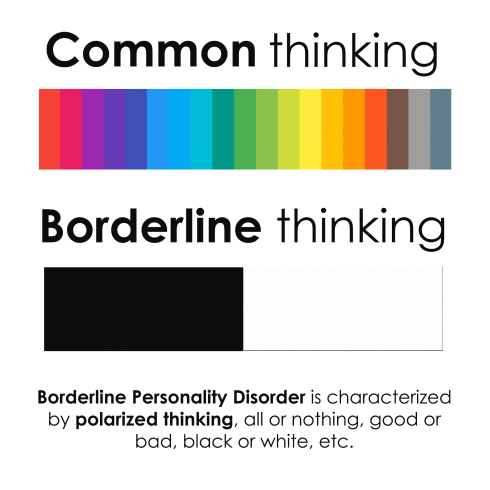
Borderline1

What they need to learn is to go within and ask, “What do I need now?”  or “How can I make this better?”  Instead of saying “What’s wrong with me? Why am I like this?   I hate this!  I feel crazy! I can’t take it, I want to die!” In individual therapy, we can also explore their different Parts (with Internal Family Systems Therapy/IFS)  and gain understanding of their Exiled parts (Anderson, F.,  Sweeney, M. Schwartz, R.  2017)

I teach my clients to stop asking WHY questions, but to ask HOW questions instead.  When we ask WHY, “Why am I like this?  Why don’t I enjoy parties?  Why am I so annoying to people? Why is this person ignoring me?  Why do people dislike me? “Why am I still single?” they are on a slippery slope into anxiety and depression and possible self-harm.

When they learn to ask HOW questions, they start to change, “How can I make this better?”  “How can I be useful?”  “How can I learn to stay calm when I am triggered?”  The HOW questions lead to discovery, growth, healing and empowerment.

In Conclusion

Dialectical Behavior Therapy for Post-Traumatic Stress Disorder is a powerful healing modality.  From my experience, those clients suffering with BPD are particularly helped by this cognitive restructuring process, since typical pharmacological and generic talk therapy interventions are not always helpful.  From my perspective, DBT serves as a newly installed behavioral software program. It is slowly downloaded into their minds through the completion of hundreds of handouts, worksheets, discussions, weekly practice and role playing.  In sum, the DBT behavioral software in their minds replaces their previously corrupted and faulty software that was hurting them.
Copyright © by Lisa Wessan 2024. All rights reserved.

Leave a comment »

How Dialectical Behavior Therapy (DBT) Skills help you learn to manage and cope better with difficult emotions, as “Serenity is not freedom from the storm, but peace amid the storm” – S. A. Jefferson-Wright.

I’m excited to announce that we are hastening slowly to transform the world from the inner to outer, one DBT student at a time…

Lisa Wessan, LICSW, DBT Skills Trainer

Up next: we will be exploring “Emotion Regulation and Mindfulness Skills” from January 23 – April 23, 2024 in the Zoom Classroom.  (All registration forms, intake sessions and tuition fees must be completed by January 19, 2024).

Four leaf DBT

The Emotion Regulation module has four sections:

  • Understanding and Naming Emotions
  • Changing Emotional Responses
  • Reducing Vulnerability to “Emotion Mind”
  • Managing Extremely Difficult Emotions
DBT Mindfulness

The Mindfulness material includes:

  • Learning to be a good observer
  • Being non-judgmental
  • Staying in the present
  • Practicing being effective
  • Accessing “Wise Mind” (aka higher self, higher consciousness)
  • Understanding Reality Acceptance and detaching from negative or critical thoughts.

As DBT founder Dr. Marsha Linehan says, “It is difficult to manage your emotions when you do not understand how emotions work. Knowledge is power.”

During this 14-week program:

  • You learn to cope better with social anxiety issues, negative thinking and stop falling into the Blame Game.
  • You learn to abstain from the Compare and Despair syndrome.
  • You practice “Face it, trace it and erase it” as you work the DBT Skills and grow stronger and wiser with effective emotional regulation and self-expression.
  • You learn to access “Wise Mind” and regain your center, remain calm.  You learn to take a stand for your inner peace, and become bulletproof to bullies, others’ judgments and negative, invalidating remarks.
  • You learn to practice Radical Acceptance, as needed, and problem solve when possible. You are no longer living with victim consciousness.

If this DBT Skills training group sounds good to you, please get in touch with me to start your enrollment process. Just complete the Contact Form on my web site to begin (not to worry, this is a No-Spam Zone! Your email will not be added to any mailing lists unless you request it).

🌀 For exact dates, fees, insurance info, FAQs, DBT Flyer, videos and more details, please visit https://www.lisawessan.com/dialectical-behavioral-therapy

Onward and Upward✨

Lisa Wessan

Copyright © by Lisa Wessan 2024. All rights reserved.
Leave a comment »

Pandemic Retreat Tip 4 – Allowing time for Daily Grief Work

avoiding-5-stages-grief-visibility-program

Our culture has difficulty sitting still with feelings.  There is too often an attempt to keep busy and ignore the discomfort of our negative feelings. It has been my experience that many otherwise healthy people want to bypass their phases of grief and jump into positive thinking, avoiding those dark and mysterious pathways of  emotion.

Now we are faced with micro and macro levels of Ambiguous Loss and Grief.   Ambiguous Loss is when you lose someone but not all the way.  For example, you could lose a loved one to illness, such as Alzheimers Disease, Alcoholism, Cancer, Food Addiction/Anorexia. Your loved one might be lost at sea or on a mountain.

Ambiguous Loss is most painful when you live with someone who is “here but not here.”  If your loved one watches multiple hours of Netflix, or video games, and you miss them, you are experiencing Ambiguous Loss.  If your loved one is slowly deteriorating from any illness or addiction, and you are watching them slowly disappear, you are experiencing Ambiguous Loss. When you break up a relationship, divorce, move away, you experience Ambiguous Loss, “here but not here.”

Today we have the Ambiguous Loss of our culture and daily routines. By not seeing the people, places and things that make up our life, we develop anticipatory anxiety of what will come next.  The anxiety then quickly morphs into Anticipatory Grief.

What is Anticipatory Grief?

I defer to Scott Berinato who unpacks our micro and macro Anticipatory Grief so usefully in his recent article in the Harvard Business Review (23 March 2020).  Berinato interviews David Kessler, who is one of our leading grief experts, and explores Kessler’s overview of our current pandemic existence. Learn more here: That Discomfort You’re Feeling is Grief.  

You may  think you are lonely, or exhausted, or anxious. That may be true. But I would agree with Berinato and Kessler in that you probably have unexpressed grief (and rage), which is clogging up your inner world.

It’s exhausting to repress grief and “act as if” you are perfectly fine. Yet we are called upon to buckle up and deal with life on life’s terms, so there is no binary solution here. We are asked to grieve our current losses and future losses PLUS carry on and live our lives.  So how is this possible?   By scheduling some Grief Work time into your calendar. Allowing time to release and let go will enhance your life as you release the inner pressure. Give yourself permission to unravel a bit.

Tears are the language of grief. Something I frequently suggest to my clients is  “Make some time to do your Grief Work.  Let it flow out of you.”  Most people resist this process and just hope by keeping super busy (or medicated or numbed with screen time) they can bypass the Grief Work.  Nay, nay, it must be done.  Cry now or cry later, but crying will help release those grief-balls that are jamming you up.

CS Lewis grief (2)

When we begin to honestly defrost our grief with each other and then seek solutions for our dilemmas, we start to feel a little better.  I am a fan of the stoic philosophy, but just focusing on solutions and keeping a stiff upper lip all the time is not helpful — something within shuts down and can go numb inside from repressing all that emotion.

Perhaps one of the silver linings from the Corona virus is that now, in this time of profound herd vulnerability, we will be more authentic with ourselves and each other?  Simple, but not easy. This is a practice that takes as long as it takes, perhaps lifetimes.

I have come to believe that your vulnerability is your superpower.  When you are brave enough to be vulnerable, you release, let go and successfully move on.  This is part of the multidimensional journey to wholeness and deep fulfillment💙

References:

Berinato, S. (23 March 2020). Harvard Business Review. That discomfort you are feeling is grief. Retrieved from https://hbr.org/2020/03/that-discomfort-youre-feeling-is-grief

Mitchell, S. (1988). Tao Te Ching. New York: Harper Collins.

Wessan, L. (05 JAN 2019). On the “Myth of Closure,” Ambiguous Loss and Complicated Grief.  Retrieved from https://mirthmaven.blog/2019/01/05/on-the-myth-of-closure-ambiguous-loss-and-complicated-grief/

Helpful Scriptures for increased bravery and courage for your Grief Work:
Psalms 23, 31, 46, 126
Deuteronomy 31:6
Ecclesiastes 1:18
Proverbs 14:13

Copyright © by Lisa Wessan 2020. All rights reserved.

Leave a comment »

One of my favorite dialectical quotes…

#DBT du jour:

“Love tells me I’m everything. Wisdom tells me I’m nothing. And between the two my life flows.”

– Sri Nisargadatta

What does dialectical mean?  Learn more HERE.

If you are challenged with depression, anxiety, social issues, relationship troubles, impulse issues or addiction, DBT skills will help you become healthier, stronger and more capable of coping with your emotions.  DBT is a Solution Focused therapy that gets effective results, and quickly!

Up Next:  Mindfulness and Interpersonal Effectiveness skills training in Westford, MA starts 11/06/19. Learn more HERE.

Fun fact: when you worry about the past too much, you become depressed; when you obsess about the future, you become anxious.  Learning to live in the present moment, aka practicing Mindfulness, can reduce 90% of your depression and anxiety.  Yes, you will still need to learn better ways to solve your life’s issues, but if you learn to stay in the  present  you will be so much more peaceful and useful.  Learning Mindfulness skills helps you get there.

If this speaks to you, please visit lisawessan.com and complete the CONTACT FORM.  I will contact you within 24 hours to discuss joining our next DBT group or working together individually, whatever you need.

Onward and Upward,
Lisa Wessan

Four leaf DBT


Leave a comment »

On Receiving Accolades at the State House in Boston

When I left my job at NBC as a Talk Show Producer, I knew that there was never going to be a time when fame, fortune, cash and prizes were going to make me happy.  Not that I was ever famous, or super wealthy.  But I had lived in that world, worked at 30 Rockefeller Plaza for over a decade amidst the affluence and glittery abundance of mid-town Manhattan.  Working in the Entertainment Division at NBC was being at celebrity central, especially working on the talk shows.

What I learned, after a while, is that these things cannot sustain deep joy and wonder.  Working in that world was not inspiring me, and I felt I was somehow skimming the surface of life. I knew at some point that I was going to move on…

Fast forward…Yes, moving from trauma to transformation is now the name of my game.  As it is for most of my peers,  we are mostly off the radar, not seeking the limelight and quite happy doing what we do in the privacy of our consulting rooms.

So imagine my surprise and delight when I learned I was going to be honored for my deep dive into psychospiritual matters!  This was quite the shockeroo…

Who would have guessed that working with clients through their mysterious process of defrosting grief, recovering from illness, loss, abuse and neglect, teaching skills on emotion regulation, mindfulness, interpersonal effectiveness, finding new purpose in life, and finally building new dreams would be honored?   Not me. 

Getting kudos for how we work through the muck of it all? Incredible! Clearly, there is no Red Carpet in therapy land!  (Perhaps one day, however, when my book is out there, it will become a best seller, and then a blockbuster film…that would be fun and quite the wild ride.  Being a bit conflicted about being on the big arena,  I will need to continue to choose “Courage over comfort,” as Brené Brown  says.  Book tours, screenings, interviews, all positive and negative.  “Courage over comfort” helps me to accept leaving my safe, small world and moving on!)

In the meantime, it’s wonderful to live in Massachusetts, one of the more enlightened states that takes the time to acknowledge our inner journey, and how important it is to use mental health resources when the going gets tough.  Massachusetts is great at de-stigmatizing mental health issues.  There is tremendous support here for everyone to get what they need and move on.  

The Big Day…

On March 6, 2019, there was a beautiful and moving ceremony at the State House in Boston to honor a few of us maverick social workers who are doing extraordinary things in our practice.

Several politicians gave speeches, Senator Ed Kennedy acknowledged us by name (see his Facebook post below)  and there were lots of hugs and cheers throughout the event.  In addition, our photos with brief bios were on display in the State House during National Social Work Month in March.  (So fun and unexpected!)

Each of us that were honored that day has taken our original graduate training and morphed into providers who are doing unexpected works.  We all went past graduate school and expanded into unpredictably useful areas  (Click HERE for the original press release.)

My unusual areas of work involve Walk and Talk Therapy,  Therapeutic Laughter Training and Dialectical Behavior Therapy.  (You can learn more about these topics at my web site, www.lisawessan.com)

I appreciated Senator Ed Kennedy’s comments on Facebook and his ongoing support of our work (see below). It was a special day and fun to be with my magnificent peers.

Here are some photos from the day:


Thank you for sharing in the gratitude and excitement of this moment in my career!  It was certainly one of the highlights of my time here in Massachusetts.

Up Next?

The journey continues — and this is truly a shameless plug — I’m an organically wired promoter, and cannot help sharing good science tested information or personal anecdotal results from the Lisa Laboratory of Life!  So if you want to keep in touch, you can follow this blog, or send me a message at my web site to receive my periodic newsletter.

Stay tuned for more quality news as we journey together from Trauma to Transformation!

Onward and Upward,

Lisa Wessan


Copyright © by Lisa Wessan 2019. All rights reserved.


2 Comments »