Yes to Life: In Spite of Everything by Viktor E. Frankl
My rating: 5 of 5 stars
I appreciate the succinct and compact composition of this unabridged audio book. As much as I loved Frankl’s earlier book, Man’s Search for Meaning, this one extracts the essence of Frankl’s Logotherapy (the power of meaning and purpose in life). He provides valuable ideas and interventions geared towards Solution Focused therapy.
I continue to be touched, moved and inspired by Frankl, on ever deeper and more meaningful levels💙
View all my reviews
Say Yes to Life: In Spite of Everything, by Viktor E. Frankl
Leave a comment »
Learning to Live in AMBIGUITY with peace, even joy

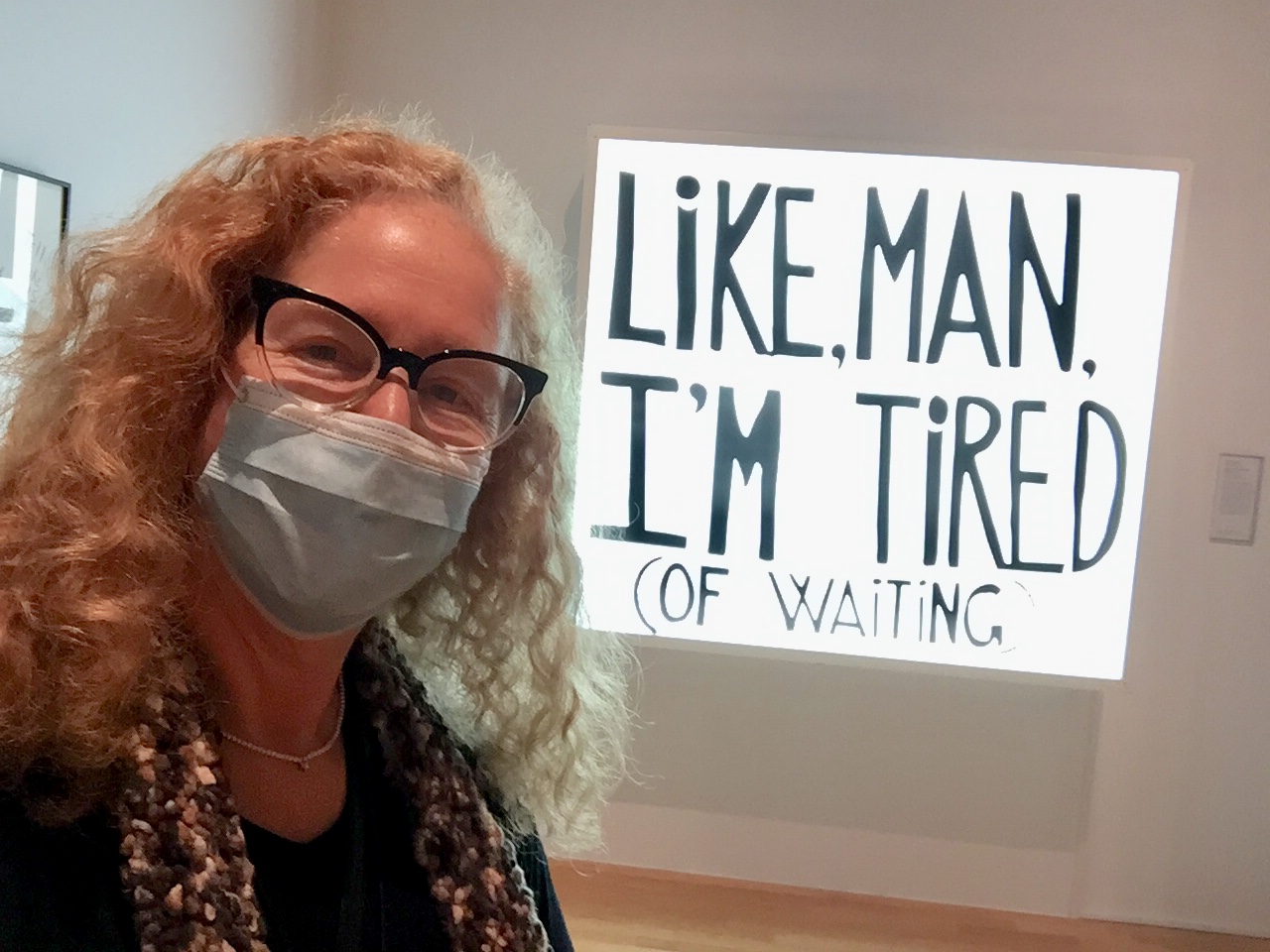
So here is my Cultural Appropriation du jour…I hope Mr. Durant does not mind me borrowing his racial justice motif for these politically toxic times…Mea culpa, mea culpa, I just can’t resist.
I know that learning to live in ambiguity with any measure of peace — even joy — is a clear marker for how healthy I am inside.
To improve your mental state, I ask you to find ways to feel more useful. To that end, I think it’s ALWAYS more effective to replace the WHY questions with the HOW questions. Let me unpack this a bit…
When you ask WHY IS THIS HAPPENING, you never get a satisfying or truly acceptable answer. Plus, no one really knows exactly WHY harsh things happen. Oh yes, there are tons of theories, but ultimately, it’s never quite known for sure. There are too many complicated, multi-dimensional issues to pinpoint “The Reason Why” something – or someone – is in such a negative state.
That’s why I think that asking the HOW questions is going to give you a big payoff. For example, asking “How can I be helpful? How can I be useful? How can I make this better?” in your micro world, at home, work, school, will shift you into taking positive actions. Then you will start to feel as if you are part of the solution, as elusive as it may seem to be at times.
Plus asking “How can I help?” takes the focus off of you…dare I say it? So much mental anguish comes from the Pity Party we have for ourselves. Moreover, too much self absorption leads to the impulse issues being activated, such as drinking, drugging, food binges, shopping, gambling, porn and so on. As I’ve heard it said, “Poor me, poor me, POUR ME A DRINK!”
In sum, compared to sitting and watching the news on your digitals, having a depressing Pity Party, marinating in fear and anxiety, asking the HOW questions is surely a better path.
Here is the beautiful and amazing 5D Flow…Peace in your heart can bring peace to the world. Yes, as you feel more peaceful and useful, you radiate that energy out and it definitely has a ripple effect.
As it is written:
Peace in my heart brings peace to the family.
Peace in the family brings peace to the community.
Peace in the community brings peace to the nation.
Peace in the nation brings peace to the world.
Let there be peace on earth and let it begin with me.
~ Author Unknown ~
Best of all, when you ask HOW questions, you are no longer feeling like a victim! When you ask “Why is this happening [to me]? ” “Why don’t they just blah blah blah?” You feel powerless, impotent, ineffective and probably a tad depressed or anxious.
Ideally, with good inner work. you could become bulletproof to the news. At your best, you want to feel all the feelings in the grief-rage-sadness spectrum, and then move on quickly to what you love. Why? Because as I have learned from many teachers, what you focus on INCREASES…where your attention goes, your energy flows. If you focus on hate and all the haters, you will feel more hateful and angry. Simple, but not easy.
Finally, you’re probably tired of people reminding you to cultivate an attitude of gratitude, but truly, that is a big part of the solution here. Learning to ask How can I be useful, coupled with a daily — even HOURLY – gratitude list, could carry you a long way during these challenging cockalocka poo poo slinging times.
❤Here’s to learning to live in the WAITING ROOMS of life with more peace and joy❤
Related Reading:
On the myth of closure, ambiguous loss and complicated grief by Lisa Wessan
The Art of Living is the Art of Waiting by Lisa Wessan
Copyright © by Lisa Wessan 2020. All rights reserved.
www.LisaWessan.com
Pandemic Retreat Tip 4 – Allowing time for Daily Grief Work

Our culture has difficulty sitting still with feelings. There is too often an attempt to keep busy and ignore the discomfort of our negative feelings. It has been my experience that many otherwise healthy people want to bypass their phases of grief and jump into positive thinking, avoiding those dark and mysterious pathways of emotion.
Now we are faced with micro and macro levels of Ambiguous Loss and Grief. Ambiguous Loss is when you lose someone but not all the way. For example, you could lose a loved one to illness, such as Alzheimers Disease, Alcoholism, Cancer, Food Addiction/Anorexia. Your loved one might be lost at sea or on a mountain.
Ambiguous Loss is most painful when you live with someone who is “here but not here.” If your loved one watches multiple hours of Netflix, or video games, and you miss them, you are experiencing Ambiguous Loss. If your loved one is slowly deteriorating from any illness or addiction, and you are watching them slowly disappear, you are experiencing Ambiguous Loss. When you break up a relationship, divorce, move away, you experience Ambiguous Loss, “here but not here.”
Today we have the Ambiguous Loss of our culture and daily routines. By not seeing the people, places and things that make up our life, we develop anticipatory anxiety of what will come next. The anxiety then quickly morphs into Anticipatory Grief.
What is Anticipatory Grief?
I defer to Scott Berinato who unpacks our micro and macro Anticipatory Grief so usefully in his recent article in the Harvard Business Review (23 March 2020). Berinato interviews David Kessler, who is one of our leading grief experts, and explores Kessler’s overview of our current pandemic existence. Learn more here: That Discomfort You’re Feeling is Grief.
You may think you are lonely, or exhausted, or anxious. That may be true. But I would agree with Berinato and Kessler in that you probably have unexpressed grief (and rage), which is clogging up your inner world.
It’s exhausting to repress grief and “act as if” you are perfectly fine. Yet we are called upon to buckle up and deal with life on life’s terms, so there is no binary solution here. We are asked to grieve our current losses and future losses PLUS carry on and live our lives. So how is this possible? By scheduling some Grief Work time into your calendar. Allowing time to release and let go will enhance your life as you release the inner pressure. Give yourself permission to unravel a bit.
Tears are the language of grief. Something I frequently suggest to my clients is “Make some time to do your Grief Work. Let it flow out of you.” Most people resist this process and just hope by keeping super busy (or medicated or numbed with screen time) they can bypass the Grief Work. Nay, nay, it must be done. Cry now or cry later, but crying will help release those grief-balls that are jamming you up.

When we begin to honestly defrost our grief with each other and then seek solutions for our dilemmas, we start to feel a little better. I am a fan of the stoic philosophy, but just focusing on solutions and keeping a stiff upper lip all the time is not helpful — something within shuts down and can go numb inside from repressing all that emotion.
Perhaps one of the silver linings from the Corona virus is that now, in this time of profound herd vulnerability, we will be more authentic with ourselves and each other? Simple, but not easy. This is a practice that takes as long as it takes, perhaps lifetimes.
I have come to believe that your vulnerability is your superpower. When you are brave enough to be vulnerable, you release, let go and successfully move on. This is part of the multidimensional journey to wholeness and deep fulfillment💙
References:
Berinato, S. (23 March 2020). Harvard Business Review. That discomfort you are feeling is grief. Retrieved from https://hbr.org/2020/03/that-discomfort-youre-feeling-is-grief
Mitchell, S. (1988). Tao Te Ching. New York: Harper Collins.
Wessan, L. (05 JAN 2019). On the “Myth of Closure,” Ambiguous Loss and Complicated Grief. Retrieved from https://mirthmaven.blog/2019/01/05/on-the-myth-of-closure-ambiguous-loss-and-complicated-grief/
Helpful Scriptures for increased bravery and courage for your Grief Work:
Psalms 23, 31, 46, 126
Deuteronomy 31:6
Ecclesiastes 1:18
Proverbs 14:13
Copyright © by Lisa Wessan 2020. All rights reserved.
 The Lighter Side of Transformation