The Lighter Side of Transformation

with Lisa Wessan, LICSW

Understanding Toxic Positivity and Grief Management

Katie Couric spoke to a therapist about how she grieved her husband Jay’s death, the dangers of toxic positivity and the benefits of negativity.
— Read this excellent piece katiecouric.com/health/dangers-of-toxic-positivity-benefits-of-negativity

Notes on Toxic Positivity:
🌀Couric’s article reminds me of the importance of doing daily negativity maintenance to release and let go of your unexpressed grief, rage, disgust and other negative feelings. You cannot do a Spiritual or Cognitive By-Pass and remain healthy and well.

🌀Tears are the language of grief, and messy, hard crying jags are on the road to wellness.

🌀 At the same time, you need to learn to practice Grief Etiquette with what you share and with whom. Sometimes it is necessary to set boundaries with people who want to share ongoing, chronic painful issues without solutions. For example, I have one friend who would tell me incredibly detailed stories about her acne. After many years of listening to her, I just could not listen anymore. I finally got up the courage to tell her “I love you, I care about you, but I don’t want to hear about your skin issues at the granular level. Just tell me the headlines, and new treatments or solutions you are working on.” She was hurt at first, but after a few awkward weeks, she eventually accepted my boundary and we were able to move forward.

🌀After reading this article, I will never again say “Everything happens for a reason” (out loud). Mea culpa, mea culpa…
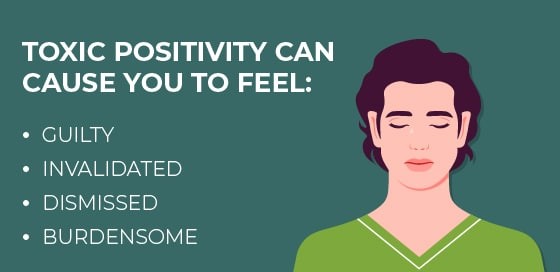
🌀Am I too positive? I have learned the lesson that “what I focus on increases, where the attention goes, energy flows.” So yes, I usually veer towards focusing on the positive – because I want to manifest a better future. I’ve learned that “thoughts become things,” so it’s worthwhile to be mindful of your negative thought streams. Yet I do not want to be toxically positive either! Couric taught me to allow more time for friends to dwell on their losses before moving into the solution focused mindset, or not at all. Sometimes people just want to talk.

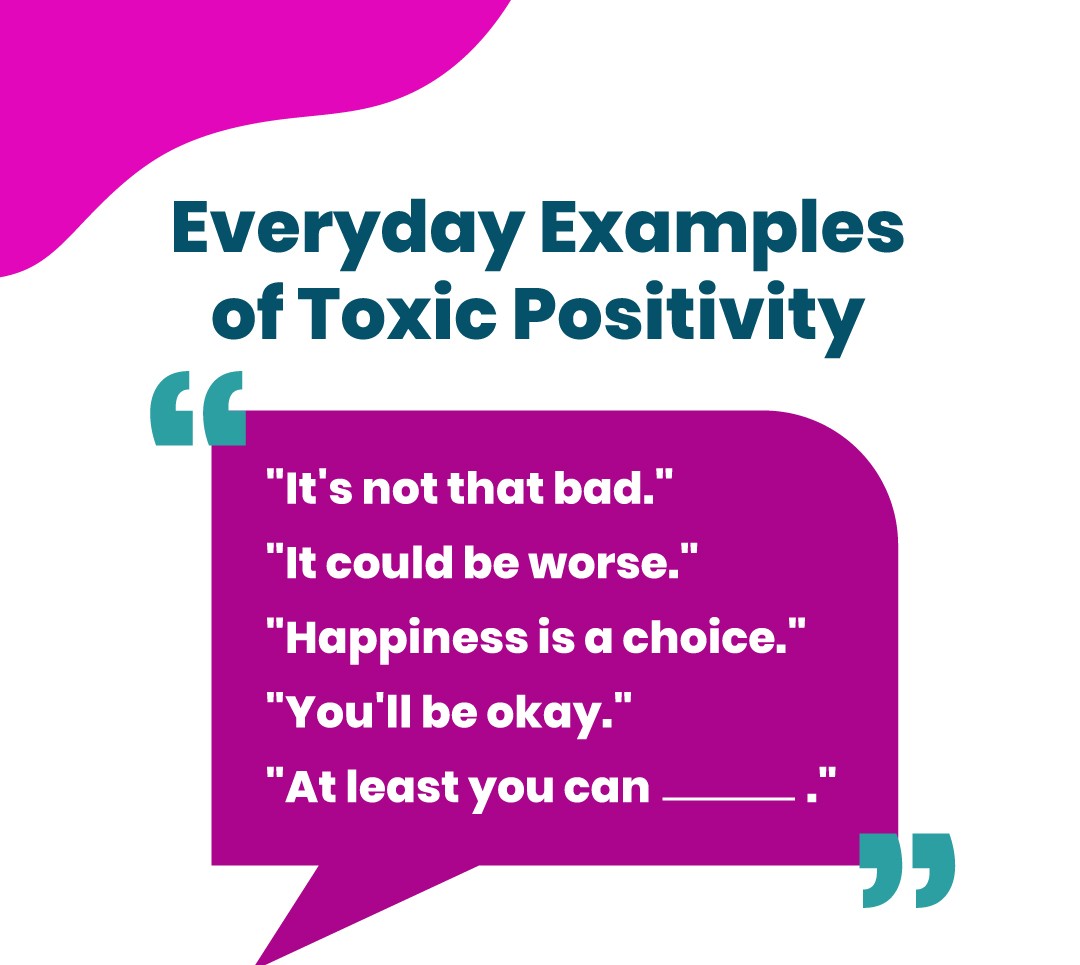
🌀I have been on the receiving end of toxic positivity too, and I don’t like it. There are loving people in my life who have basically said, “It can’t be that bad. You can do anything!” (whatever the challenge is) This kind of statement – meant to be uplifting – can actually be invalidating and hurtful. Listening is loving. In the best scenario, it’s good to hear the pain, allowing others to release their anxiety and tensions, and then eventually approach solutions. I would like to be asked, “Are you ready to discuss solutions yet, or do you need to vent some more?”  

🌀The science on this says that complaining is good for releasing the anxiety and tensions. In trauma work, it is commonly accepted that “the issues are in our tissues,” (van der Kolk, 2020), so we need to find ways to release and let go of those issues. If we don’t, that’s when we start somaticizing and develop illnesses from our unexpressed grief and negative thoughts.

🌀 In my dialectical world (DBT), I have learned to embrace the paradox of life being both amazing and harsh. Glennon Doyle said it best, “Life is both beautiful and brutal, it is BRUTIFUL!” (Doyle, 2020) The truth is none of us escape the challenges and plot twists of life. There is a Buddhist proverb that says everyone gets 10,000 Joys and 10,000 Sorrows, no exceptions. Tall, short, thin, fat, rich, poor, we all move through the 10,000 Joys and Oys of life. The key is to embrace the tough phases, using the tools of Radical Acceptance, Self-Compassion. Impermanence and Coping Ahead.

Just for today, I want to challenge you to practice being as authentic as possible, to improve your health and longevity. Start allowing yourself to release and let go of the negative streams of thought, knowing that once you clear it out solutions will arise. Then you can look for the good, be ready for the new insight, idea or fresh suggestions that come your way.
REFERENCES

Untamed, by Glennon Doyle (2020)

Toxic Positivity: Keeping It Real in a World Obsessed with Being Happy, by Whitney Goodman, LMFT (2022)

The Let Them Theory: A Life-Changing Tool That Millions of People Can’t Stop Talking About, by Mel Robbins (2024)

The Body Keeps the Score: Brain, Mind, and Body in the Healing of Trauma,  by Bessel van der Kolk M.D. (2020)


Leave a comment »

Just for Today, by Sybil F. Partridge

1.  Just for today I will be happy.  This assumes that what Abraham Lincoln said is true, that “most folks are about as happy as they make up their minds to be.”  Happiness is from within; it is not a matter of externals.

2.  Just for today I will try to adjust myself to what is, and not try to adjust everything to my own desires.  I will take my family, my business, and my luck as they come and fit myself to them.

3.  Just for today I will take care of my body.  I will exercise it, care for it, nourish it, not abuse nor neglect it, so that it will be a perfect machine for my bidding.

4.  Just for today I will try to strengthen my mind.  I will learn something useful.  I will not be a mental loafer.  I will read something that requires effort, thought and concentration.

5.  Just for today I will exercise my soul in three ways;  I will do somebody a good turn and not get found out.  I will do at least two things I don’t want to do as William James suggests, just for exercise.

6.  Just for today I will be agreeable.  I will look as well as I can, dress as becomingly as possible, talk low, act courteously, be liberal with praise, criticize not at all, nor find fault with anything and not try to regulate nor improve anyone.

7.  Just for today I will try to live through this day only, not to tackle my whole life problem at once.  I can do things for twelve hours that would appall me if I had to keep them up for a lifetime.

8.  Just for today I will have a program.  I will write down what I expect to do every hour.  I may not follow it exactly, but I will have it.  It will eliminate two pests, hurry and indecision.

9.  Just for today I will have a quiet half hour all by myself and relax.  In this half hour sometimes I will think of God, so as to get a little more perspective into my life.

10.  Just for today I will be unafraid, especially I will not be afraid to be happy, to enjoy what is beautiful, to love, and to believe that those I love, love me.

If we want to develop a mental attitude that will bring us peace and happiness, here is Rule #1:

Think and act cheerfully, and you will feel cheerful.

Written by Sybil F. Partridge   1916 and printed in
How To Stop Worrying, And Start Living, by Dale Carnegie, 1951

LW:  I love this credo for living – it covers all areas of life. Yet if you try to do it perfectly you will make yourself miserable. Whenever you set a new intention, or want to develop a positive new habit, or break an old negative habit, start something new, always remember, “Progress not Perfection.” Learn to validate your baby steps, moving forward slowly is good enough! Old ways are tough to change, but it will get done. Slowly, slowly, you can do it. You can do hard things…There is a solution…Never give up.  Yes, aim high, but be always be gentle with yourself. 

This song by Libana, I Will Be Gentle With Myself,  comforts me when I make a mistake, or seem to be delayed in my process.

Just for today, I want to be a WINNER, not a WHINER! Winners take risks, fall down, get up, and start again. May this serve you well 💙

Leave a comment »

What is the 4-week rolling enrollment period for Dialectical Behavior Therapy (DBT) skills training?

Dr. Marsha Linehan, founder of the DBT psychoeducation curriculum, understood that some people might miss trimester deadlines to start at the beginning of each semester. In classic non-binary, non-dualistic DBT fashion, it’s possible to be both late and on time at the same moment—what does that really mean?

Three times a year, several weeks before and during the Mindfulness Module, new students can join the ongoing DBT group to start at beginning of the next cycle.

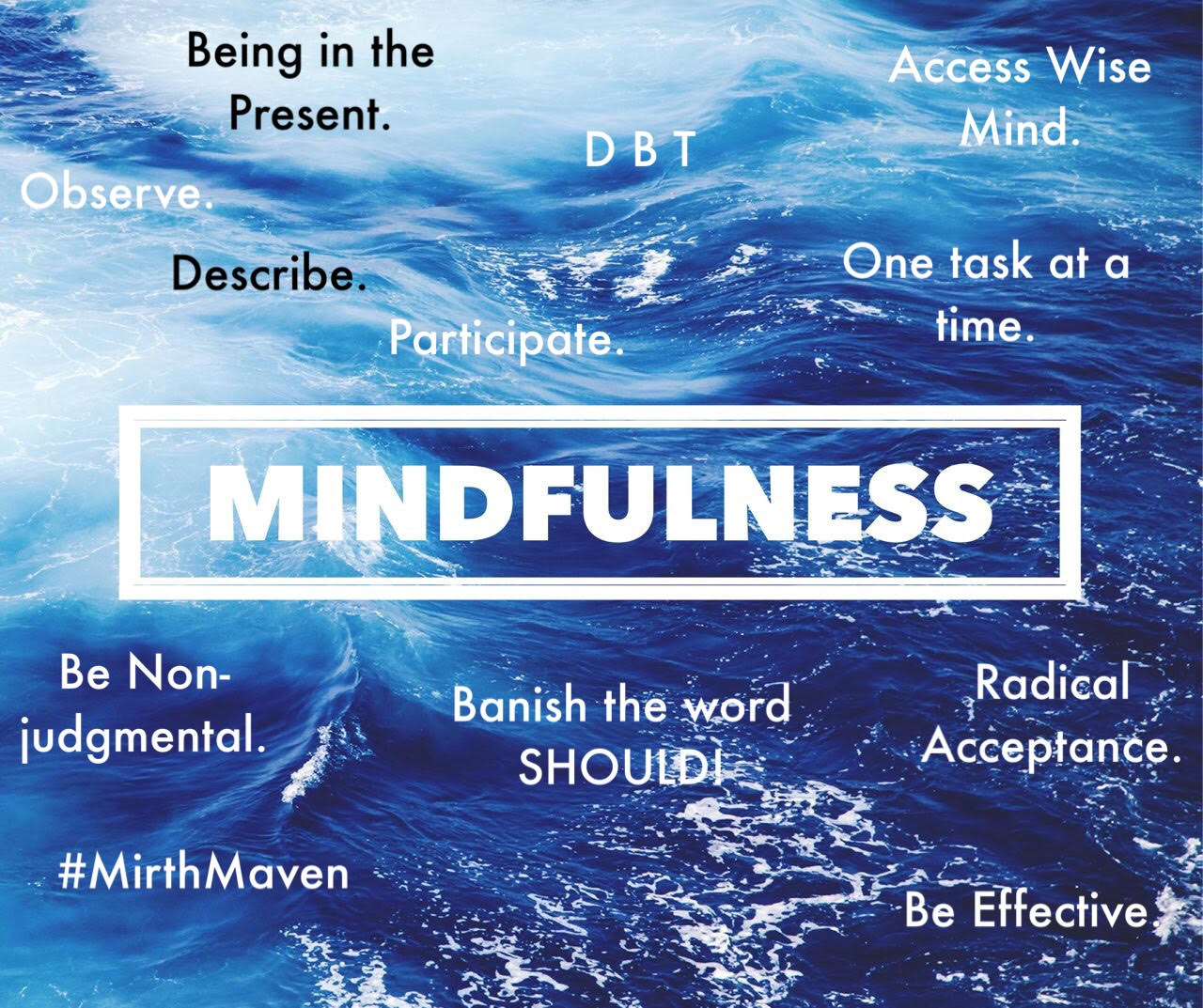
Here are a few of the main topics for the Mindfulness Module:

Good, better, best enrollment process?

Best is registering early, completing the intake session and forms in advance, and starting on Day 1.

Better is waiting until the last few weeks, the crunch time—and just managing to finish in time.

Good is joining after the class has begun, missing a week or two, but still getting involved. Continuing and then thriving thereafter. (When this happens, the new student pays a pro-rated fee for the group reflecting the missed sessions.)

If you or someone you know has been wanting to join this group but keeps missing the deadlines, there’s still a chance! The final cut-off for this semester is January 27. Once we finish the Mindfulness Module and begin the Interpersonal Effectiveness material, no new members will be able to join.

There are reasons behind all of this, and this is just the briefest summary! Ideally, all DBT students would register weeks before the class begins, making the experience much more relaxing for everyone involved.

If you or someone you know could benefit from this solution-focused, science-backed, and proven personal growth program, don’t wait to get started. My next Tuesday evening group meets from January 6 – April 7, 2026. You can learn more here: https://www.lisawessan.com/dialectical-behavioral-therapy

Onward and Upward✨

Lisa Wessan

Leave a comment »

Effective Dialectical Behavior Therapy (DBT): Open Enrollment Now

 
“Between stimulus and response there is a space. In that space is our power to choose our response. In our response lies our growth and our freedom.” ~ Viktor E. Frankl


I am delighted to announce that the next virtual 14-week Dialectical Behavior Therapy Skills (DBT) Group will be meeting on Tuesday evenings, 7:30 – 9 PM EST, February 18 – May 20, 2025.  We will be covering both the Mindfulness and Emotion Regulation modules.  (This is an ongoing group that has open enrollment periods three times per year.)

[If you would like to receive a copy of the full 14-week curriculum, please request one HERE. (This is a NO-SPAM Zone, so your email will not be added to any list unless you request it.]

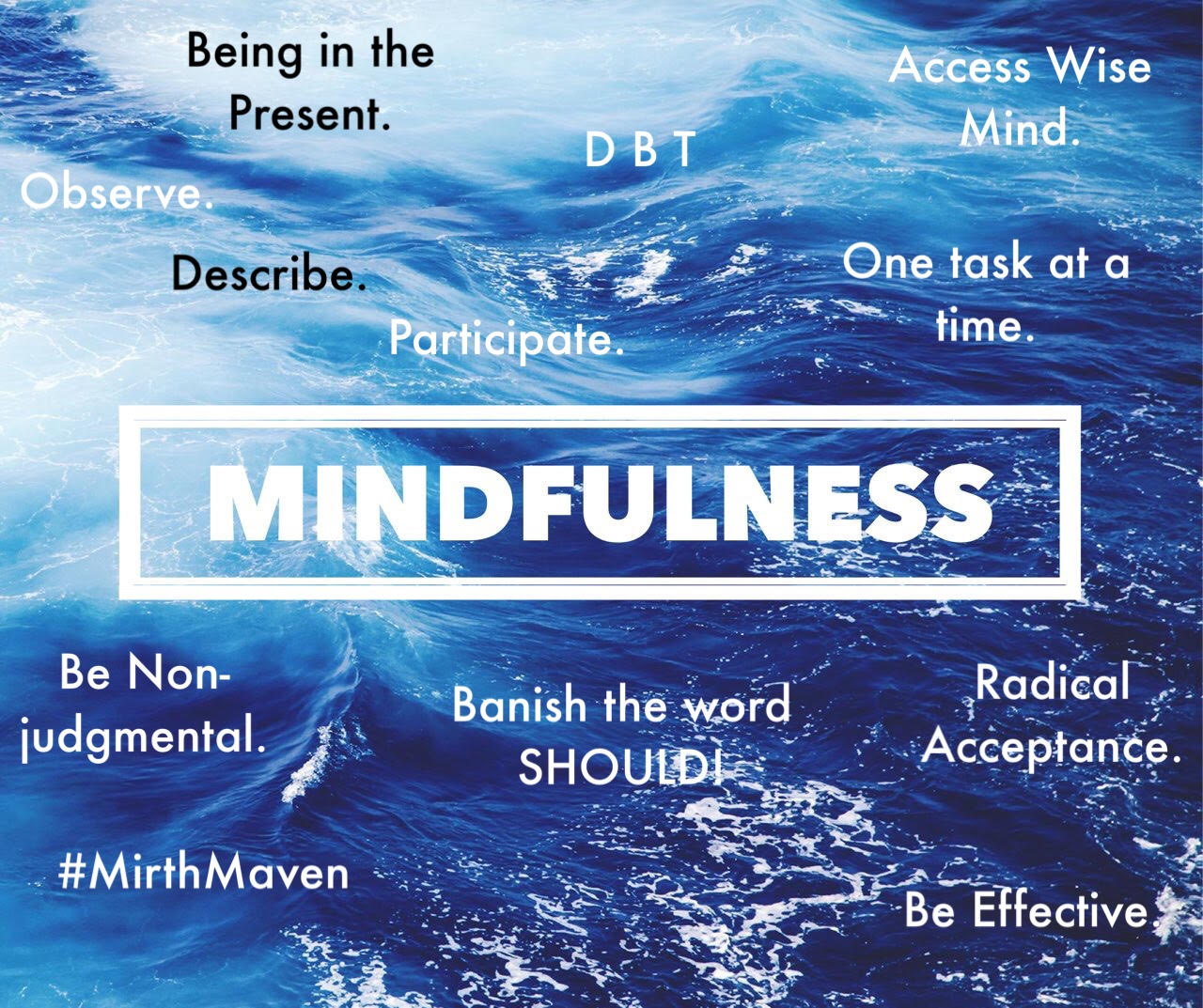
The Mindfulness material includes:

  • Learning how to be a good observer, describing your feelings, participating more fully in life
  • How to become non-judgmental of yourself and others
  • Staying in the present moment with more ease
  • Practicing being effective for the greater good of your family, workplace, community
  • Accessing Wise Mind (aka higher self, higher consciousness)
  • Understanding Reality Acceptance and detaching from negative or critical thoughts.
  • Shifting from Willfulness to Willingness

The Emotion Regulation module has four sections:

  • Understanding and Naming Emotions
  • Changing Emotional Responses
  • Reducing Vulnerability to Emotion Mind (your highly reactive and difficult emotions)
  • Managing Extremely Difficult Emotions

As DBT founder Dr. Marsha Linehan says, “It is difficult to manage your emotions when you do not understand how emotions work. Knowledge is power.”

GROUP ATMOSPHERE: My students are well mannered, high functioning and convivial.  For those who occasionally tend to demand more attention, want to give inappropriate feedback and/or act out in any way, I do have a strong “Respectful Communication Policy” in place and several useful group rules which help to maintain a safe, harmonious and cohesive group atmosphere.  All are welcome, but there is no allowance for rude or harsh behavior.

Group members will continue to process their unresolved traumas in their individual therapy, not in this group. This is a therapeutic psychoeducation program. (It is NOT group therapy.)

For dates, fees, videos and more details, please visit
Dialectical Behavioral Therapy | Lisa Wessan

May this serve you or your loved ones well in their journey towards wholeness and more inner peace.

Onward and Upward🌀

Lisa Wessan

Leave a comment »

How Dialectical Behavior Therapy (DBT) Skills help you learn to manage and cope better with difficult emotions, as “Serenity is not freedom from the storm, but peace amid the storm” – S. A. Jefferson-Wright.

I’m excited to announce that we are hastening slowly to transform the world from the inner to outer, one DBT student at a time…

Lisa Wessan, LICSW, DBT Skills Trainer

Up next: we will be exploring “Emotion Regulation and Mindfulness Skills” from January 23 – April 23, 2024 in the Zoom Classroom.  (All registration forms, intake sessions and tuition fees must be completed by January 19, 2024).

Four leaf DBT

The Emotion Regulation module has four sections:

  • Understanding and Naming Emotions
  • Changing Emotional Responses
  • Reducing Vulnerability to “Emotion Mind”
  • Managing Extremely Difficult Emotions
DBT Mindfulness

The Mindfulness material includes:

  • Learning to be a good observer
  • Being non-judgmental
  • Staying in the present
  • Practicing being effective
  • Accessing “Wise Mind” (aka higher self, higher consciousness)
  • Understanding Reality Acceptance and detaching from negative or critical thoughts.

As DBT founder Dr. Marsha Linehan says, “It is difficult to manage your emotions when you do not understand how emotions work. Knowledge is power.”

During this 14-week program:

  • You learn to cope better with social anxiety issues, negative thinking and stop falling into the Blame Game.
  • You learn to abstain from the Compare and Despair syndrome.
  • You practice “Face it, trace it and erase it” as you work the DBT Skills and grow stronger and wiser with effective emotional regulation and self-expression.
  • You learn to access “Wise Mind” and regain your center, remain calm.  You learn to take a stand for your inner peace, and become bulletproof to bullies, others’ judgments and negative, invalidating remarks.
  • You learn to practice Radical Acceptance, as needed, and problem solve when possible. You are no longer living with victim consciousness.

If this DBT Skills training group sounds good to you, please get in touch with me to start your enrollment process. Just complete the Contact Form on my web site to begin (not to worry, this is a No-Spam Zone! Your email will not be added to any mailing lists unless you request it).

🌀 For exact dates, fees, insurance info, FAQs, DBT Flyer, videos and more details, please visit https://www.lisawessan.com/dialectical-behavioral-therapy

Onward and Upward✨

Lisa Wessan

Copyright © by Lisa Wessan 2024. All rights reserved.

Leave a comment »

Say Yes to Life: In Spite of Everything, by Viktor E. Frankl

Yes to Life: In Spite of Everything by Viktor E. Frankl

My rating: 5 of 5 stars


I appreciate the succinct and compact composition of this unabridged audio book. As much as I loved Frankl’s earlier book, Man’s Search for Meaning, this one extracts the essence of Frankl’s Logotherapy (the power of meaning and purpose in life). He provides valuable ideas and interventions geared towards Solution Focused therapy.

I continue to be touched, moved and inspired by Frankl, on ever deeper and more meaningful levels💙


View all my reviews

Leave a comment »

Walk and Talk Therapy featured on Boston Chronicle with Lisa Wessan

Lisa Wessan featured on Inside/Outside episode

09.09.20 – ABC News/The Boston Chronicle, Inside/Outside episode. Finding Peace in the Great Outdoors. I was interviewed by great team from the Boston Chronicle concerning my work with Walk and Talk Therapy. This was part of a longer story about how we are taking our work outside during the pandemic.

Leave a comment »

Pandemic Retreat Tip 4 – Allowing time for Daily Grief Work

avoiding-5-stages-grief-visibility-program

Our culture has difficulty sitting still with feelings.  There is too often an attempt to keep busy and ignore the discomfort of our negative feelings. It has been my experience that many otherwise healthy people want to bypass their phases of grief and jump into positive thinking, avoiding those dark and mysterious pathways of  emotion.

Now we are faced with micro and macro levels of Ambiguous Loss and Grief.   Ambiguous Loss is when you lose someone but not all the way.  For example, you could lose a loved one to illness, such as Alzheimers Disease, Alcoholism, Cancer, Food Addiction/Anorexia. Your loved one might be lost at sea or on a mountain.

Ambiguous Loss is most painful when you live with someone who is “here but not here.”  If your loved one watches multiple hours of Netflix, or video games, and you miss them, you are experiencing Ambiguous Loss.  If your loved one is slowly deteriorating from any illness or addiction, and you are watching them slowly disappear, you are experiencing Ambiguous Loss. When you break up a relationship, divorce, move away, you experience Ambiguous Loss, “here but not here.”

Today we have the Ambiguous Loss of our culture and daily routines. By not seeing the people, places and things that make up our life, we develop anticipatory anxiety of what will come next.  The anxiety then quickly morphs into Anticipatory Grief.

What is Anticipatory Grief?

I defer to Scott Berinato who unpacks our micro and macro Anticipatory Grief so usefully in his recent article in the Harvard Business Review (23 March 2020).  Berinato interviews David Kessler, who is one of our leading grief experts, and explores Kessler’s overview of our current pandemic existence. Learn more here: That Discomfort You’re Feeling is Grief.  

You may  think you are lonely, or exhausted, or anxious. That may be true. But I would agree with Berinato and Kessler in that you probably have unexpressed grief (and rage), which is clogging up your inner world.

It’s exhausting to repress grief and “act as if” you are perfectly fine. Yet we are called upon to buckle up and deal with life on life’s terms, so there is no binary solution here. We are asked to grieve our current losses and future losses PLUS carry on and live our lives.  So how is this possible?   By scheduling some Grief Work time into your calendar. Allowing time to release and let go will enhance your life as you release the inner pressure. Give yourself permission to unravel a bit.

Tears are the language of grief. Something I frequently suggest to my clients is  “Make some time to do your Grief Work.  Let it flow out of you.”  Most people resist this process and just hope by keeping super busy (or medicated or numbed with screen time) they can bypass the Grief Work.  Nay, nay, it must be done.  Cry now or cry later, but crying will help release those grief-balls that are jamming you up.

CS Lewis grief (2)

When we begin to honestly defrost our grief with each other and then seek solutions for our dilemmas, we start to feel a little better.  I am a fan of the stoic philosophy, but just focusing on solutions and keeping a stiff upper lip all the time is not helpful — something within shuts down and can go numb inside from repressing all that emotion.

Perhaps one of the silver linings from the Corona virus is that now, in this time of profound herd vulnerability, we will be more authentic with ourselves and each other?  Simple, but not easy. This is a practice that takes as long as it takes, perhaps lifetimes.

I have come to believe that your vulnerability is your superpower.  When you are brave enough to be vulnerable, you release, let go and successfully move on.  This is part of the multidimensional journey to wholeness and deep fulfillment💙

References:

Berinato, S. (23 March 2020). Harvard Business Review. That discomfort you are feeling is grief. Retrieved from https://hbr.org/2020/03/that-discomfort-youre-feeling-is-grief

Mitchell, S. (1988). Tao Te Ching. New York: Harper Collins.

Wessan, L. (05 JAN 2019). On the “Myth of Closure,” Ambiguous Loss and Complicated Grief.  Retrieved from https://mirthmaven.blog/2019/01/05/on-the-myth-of-closure-ambiguous-loss-and-complicated-grief/

Helpful Scriptures for increased bravery and courage for your Grief Work:
Psalms 23, 31, 46, 126
Deuteronomy 31:6
Ecclesiastes 1:18
Proverbs 14:13

Copyright © by Lisa Wessan 2020. All rights reserved.

Leave a comment »

Coronavirus Retreat Tip #1

Dog in mask

Over the years I have been trained up to always see the pros and cons of each challenge. Not to be in denial of the pain, trauma and suffering — but to see the possibility of hidden value in the challenges.  “What if everything that is happening to you is happening for you?” asked  Colin Tipping years ago in a lecture in New York.   That thought percolated through me for years before I could finally understand what it truly meant, and the freedom and peace of mind that comes from living with this deep level of acceptance. 

What are the pros and cons of this Covid-19 challenge we now face? Here are some resources which have helped me sort this out and remain more peaceful and relaxed during this difficult time. 

To be transparent as ever,  I am feeling the full dialectical nature of this moment: sometimes I feel a deep peace and stillness within, and at the same time I feel the edge of a panic attack creeping up on me.  The difference between now and 30 years ago, however,  is that I have learned to observe my inner world so much better…so when I sense that edge, I use some breathwork, distress tolerance skills and physical release to shift out of it.  (More on those skills in the next Coronavirus post).

Over the next few days, I’m going to unpack some useful tips for coping with this extra level of anxiety we all share from the pandemic.  As always,  I have been sorting and cycling through my personal tool kit, plus I have found some new and impactful ideas that I will share here too.  The best of the best for you, my dear reader…as we trudge this road through the forced Retreat to wellness and bliss.

First, listening to Jack Kornfield  and Tim Ferriss discuss ways to re-frame and re-focus during this difficult time gave me more insight and some good practical advice. Kornfield’s  75 years on this Earth have been well spent.  As a brief overview, he was a Buddhist Monk in Thailand, then served as co-founder of the Insight Meditation Center in Barre, MA,  then became a psychologist. Now he is involved in many educational and activist programs to help bring mindfulness and other useful transformative skills to the public. 

Tim Ferriss is one of my favorite teachers. First, I love Ferriss’  passion for extreme wellness.  I love his awesome lifestyle hacks and his never ending curiosity about world class performers  and the minutia of their morning routines, what they eat for breakfast,  favorite books, how they sleep and more. He also has an impressive history of  brilliant investing, living with bipolar illness and managing well.  Yes, I’m a fan of Ferriss! 

You can access this podcast wherever you listen to your podcasts:  Listen to #414: Jack Kornfield — How to Find Peace Amidst COVID-19, How to Cultivate Calm in Chaos from The Tim Ferriss Show in Podcasts.

For your consideration, here is my brief summary of this  podcast. During this two hour, wide ranging conversation, you will learn: 

  1. During the first hour, “It’s not about perfecting yourself, it’s about perfecting your Love.”  Learning to live in this world with more love, embracing the inner and outer imperfections with radical acceptance is one path to more inner peace and joy here.  Kornfield delves into some wonderful coping and practice skills to help move through the anxiety and depression of these pandemic days.
  2. From 1:07 there is a discussion of psychedelic research aka Sacred Medicines, for the treatment of drug resistant depression and anxiety.   Kornfield discusses the mysteries of our multi-dimensional selves.  “We are learning to use sacred medicines to know who we are.”  Apparently, this paradigm shifting research helps us form more positive and useful world views. Ferriss cites exciting and impressive research coming out of Johns Hopkins Medical School which has gotten robust results.   After listening to this  segment, I made a note to read The Cosmic Game, by psychiatrist Stanislav Grof, which describes the wisdom and understanding that hundreds of trials of Sacred Medicines have offered seekers in laboratory conditions, to help better understand the nature of consciousness Itself. (As it happens, Harvard Medical School is hosting a large conference here in Boston  May 1-2, 2020, on Meditation and Psychotherapy: Learning from Non-Ordinary States).
  3.  From 1:23 Kornfield deconstructs suicide and suicidal patterns and how to reduce treatment resistant depression.  I was intrigued with this curious idea,  how we long for “sleep,” and how for some suicide is the big sleep that they think will solve their painful life for good. Suicidal people have  worthy intentions, not the best solutions…Kornfield’s approach to suicide is practical and soothing.  
  4.  From 1:32  Kornfield explains his trauma work, and how to be in the field of compassion which allows us to process the trauma successfully. “To witness with a loving gaze, it’s not who you are, it’s something that you went through.”   This reminds me of the teaching that “We make mistakes, but we are not a mistake.”   Again, learning to pause, observe, step back and see the pain as something that we passed through is very different then feeling a permanent imprint from it, rendering us emotionally compromised,  with anxiety, depression, PTSD and other conditions.  

I hope you enjoy listening to this podcast as much as I did.  It really gave me a booster during these troubled times. There is hope! There is a solution…

Stay tuned for my next Coronavirus Retreat Tip…may these tips serve you well! 

Onwards and Upwards in good health, 

Lisa Wessan


Related reading: 

Dr. Abdu Sharkawy: My Turn: Mass panic may be worse than virus itself


Leave a comment »

Some Mindfulness and Emotion Regulation Resources for a More Peaceful Holiday Season

Hi,

I hope this message finds you well.

During the holidays, especially Thanksgiving-Christmas/Hanukah/Kawanzza-New Year’s-Valentines Day, aka The Red Zone, there are many more opportunities to feeling the pain of Compare and Despair, neglect, arguments, loss, grief and a boatload of intense feelings.

You may also be forced to spend time with a relative you despise, or be tempted to eat food or drinks that make you feel sick. While being triggered all over the place, your impulse issues may be whispering in your ear, “Drink me, eat me, buy me, smoke me, shop me, gamble me, escape into video games/Netflix” on and on.

Everyone goes through this, but some of you feel it a lot more deeply.

To that end, I want to offer you a few resources from my MirthMaven archives to help you get through The Red Zone.  May you find some wonderful skills and tools here to get through those midnight blues, or whenever the intense feelings feel like too much:

  1. Extra Tools for Letting Go  (Wessan, November 2018, 25 min). You may enjoy this useful and entertaining video of ways to quickly let go of harsh feelings.
  2. The Red Zone – Chock full of tips and techniques for help with this holiday season.
  3. Compare and Despair – added insight for social media distress, feeling left out, unloved, unwanted.

As always, let’s remember that “Feelings are not Facts,” and to practice being a good observer as the storm passes through you. Reminding yourself that “This too shall pass,” “I can do HARD things” and “Never Give Up” can help to carry you through the tough times.

At the very least, remember to use the “Take 5” breathwork method: inhale to the count of five, hold for five seconds, and release to the count of five.   Repeat for at least six rounds of Take 5 breaths, to get re-centered and regain some inner calm. 

May you have a more peaceful holiday season,

Copyright © by Lisa Wessan 2019. All rights reserved.


Leave a comment »