Abstract: This article offers a perspective on the impact of Dialectical Behavior Therapy (DBT) in treating Borderline Personality Disorder (BPD) and trauma. The author shares valuable insights on renaming BPD to “Intense Trauma Syndrome” for reduced stigma and increased therapeutic support. The post effectively conveys the author’s experience with DBT and the positive outcomes observed with clients. The inclusion of Solution Focused Therapy and reframing cognitive beliefs adds depth to the content, enhancing its value. Overall, it provides a comprehensive view of the transformative nature of DBT in addressing trauma-related challenges.
When I first became interested in the Dialectical Behavior Therapy methods and curriculum (DBT), one of my mentors said, “Lisa, I strongly advise you NOT to get involved with this work. If you offer DBT Skills, you will attract the WORST clients! They will all be severely agitating with Borderline, Bipolar or severe mood disorders, it will be a nightmare for you!”
I heard what she said, and I did respect her opinion, but there was something so powerfully intriguing about the evidence-based science behind DBT, and the fact that so many people were getting well from it – people who had been considered “treatment resistant” prior to their DBT exposure.
I do like a challenge, however, and I was not afraid of this high risk population. Something inside me told me to continue…against the advice of this mentor, and other practitioners I knew.
It is now twelve years since my first DBT training, and I’m still excited to be sharing the DBT curriculum with adults (21+) in my virtual Zoom classroom. I have had the privilege of witnessing hundreds of my DBT clients, in both individual and group sessions, go through this cognitive re-structuring process, shed their false beliefs, deconstruct their traumas, grieve and move on to have healthy, happy, contented lives.
In the process, I have learned that approximately 70% of my clients with Borderline Personality Disorder (BPD) suffer from severe co-occurring post-traumatic stress disorder (PTSD), related to traumas that occurred during childhood. These traumas were not processed or expressed at the time, and they caused a corruption of the client’s personality, mental and social skills.
These unresolved traumas, when treated, often bring upon a rebirth process, and the client is no longer exhibiting the Borderline symptoms. Therefore, I humbly submit that it would serve everyone if BPD could be renamed Intense Trauma Syndrome (ITS).
Here is why:
- The term Borderline is heavily stigmatized in my guild. “Borderline” sounds as if someone is on the edge of a cliff about to jump, perhaps on the verge of…suicide? Murder? Something worse? Witness my mentor’s advice above, plus, each week I receive calls from clients who tell me “No one will work with me because I am Borderline.” This is frustrating and heartbreaking to me. Why is this heavily traumatized group eschewed because of their condition? Where should they go? How will they get well? If BPD were to be re-labeled as Intense Trauma Syndrome, I think they would be helped by more therapists! But this requires more than a branding campaign…
- Borderline clients often exhibit highly dissociative symptomatology, chronic suicidality, and ongoing non-suicidal self-injury. This is also a big turn-off to my guild. Many of my colleagues will NOT work with suicidal clients. Why? Too much liability, too many collateral calls, too much danger. Moreover, my clients feel as if they are tacitly shamed by the mental health profession for being Borderline. Yet I have found that this population, when they are truly sick and tired of being sick and tired, pick up these DBT Skills and other therapeutic interventions, and start their healing process. They will always agree to a Safety Plan and stick with it. They learn, grow, and become healthier and successful members of society. They do recover!
- When I tell my Borderline clients they have Intense Trauma Syndrome, and request that they stop describing themselves as Borderline, they start to feel so much better about their emotional challenges. Many Borderline clients have described severe shame and self-hate due to their diagnosis. They feel hopeless and bereft of a cure. Receiving the Borderline diagnosis can make them feel worse!
⭐Here’s the H.O.P.E. for Borderline clients, Hold On, Pain Ends.⭐
Solution Focused Therapy
My DBT Skills groups cover the entire curriculum in one year, divided into three 14-week trimesters. This training includes the strengthening of the commitment to overall wellness and psychoeducation, DBT skills training, skills-assisted exposure, with radical acceptance of the past trauma and its effects on their lives.

Finally, you explore the practice of self-compassion – as you learn to Fail Forward – and make efforts to build a life worth living. When a client has graduated from their Intense Trauma Syndrome to the more normative anxiety, career, dating, relationship challenges they are on their way to be fulfilled and satisfied with their lives.
The Intense Trauma Syndrome causes people to become quite polarized in their thinking. They often see the world in black and white, all or nothing, right or wrong, good or evil terms. There is not much wiggle room for the vast spectrum of imperfection that exists in all of us! One of the earliest cognitive shifts we work on is the ability to hold OPPOSITE VIEWS in their minds without having a meltdown.
Common Dialectical Beliefs
I teach that it is perfectly all right to love someone, but also to hate them at times. It is fine to be in a room of friends or family, and yet feel very lonely. It is not a serious problem to want to go out, and want to stay home in the same breath. It is possible to feel strong and vulnerable.
Prior to learning DBT skills, these opposing thoughts would cause a lot of stress for them, and cause them to feel as if they were having a meltdown. To help them decompress from their polarized inner self-hating dialogue, I have learned to reduce their stress by saying, “You can feel dual emotions, you are ok and safe with these conflicting thoughts…In fact, you are not having a breakdown, you are having a breakthrough!” This often helps them to reframe the intensity of their emotions into a more helpful and practical view.
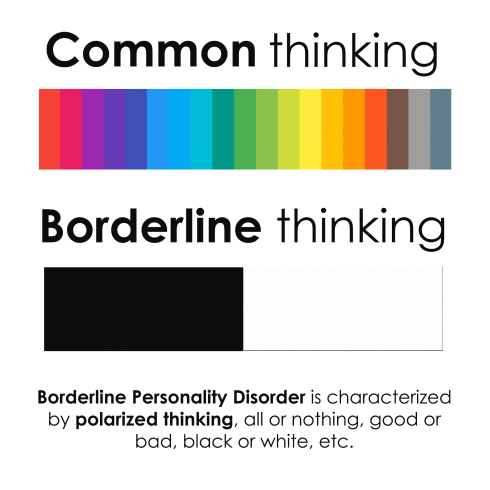
What they need to learn is to go within and ask, “What do I need now?” or “How can I make this better?” Instead of saying “What’s wrong with me? Why am I like this? I hate this! I feel crazy! I can’t take it, I want to die!” In individual therapy, we can also explore their different Parts (with Internal Family Systems Therapy/IFS) and gain understanding of their Exiled parts (Anderson, F., Sweeney, M. Schwartz, R. 2017)
I teach my clients to stop asking WHY questions, but to ask HOW questions instead. When we ask WHY, “Why am I like this? Why don’t I enjoy parties? Why am I so annoying to people? Why is this person ignoring me? Why do people dislike me? “Why am I still single?” they are on a slippery slope into anxiety and depression and possible self-harm.
When they learn to ask HOW questions, they start to change, “How can I make this better?” “How can I be useful?” “How can I learn to stay calm when I am triggered?” The HOW questions lead to discovery, growth, healing and empowerment.
In Conclusion
Dialectical Behavior Therapy for Post-Traumatic Stress Disorder is a powerful healing modality. From my experience, those clients suffering with BPD are particularly helped by this cognitive restructuring process, since typical pharmacological and generic talk therapy interventions are not always helpful. From my perspective, DBT serves as a newly installed behavioral software program. It is slowly downloaded into their minds through the completion of hundreds of handouts, worksheets, discussions, weekly practice and role playing. In sum, the DBT behavioral software in their minds replaces their previously corrupted and faulty software that was hurting them.
Copyright © by Lisa Wessan 2024. All rights reserved.


 The Lighter Side of Transformation