The Lighter Side of Transformation

with Lisa Wessan, LICSW

From Borderline to Balance: Dialectical Behavior Therapy for Post-Traumatic Stress Disorder (DBT-PTSD)

Abstract: This article offers a perspective on the impact of Dialectical Behavior Therapy (DBT) in treating Borderline Personality Disorder (BPD) and trauma. The author shares valuable insights on renaming BPD to “Intense Trauma Syndrome” for reduced stigma and increased therapeutic support. The post effectively conveys the author’s experience with DBT and the positive outcomes observed with clients. The inclusion of Solution Focused Therapy and reframing cognitive beliefs adds depth to the content, enhancing its value. Overall, it provides a comprehensive view of the transformative nature of DBT in addressing trauma-related challenges.

When I first became interested in the Dialectical Behavior Therapy methods and curriculum (DBT), one of my mentors said, “Lisa, I strongly advise you NOT to get involved with this work. If you offer DBT Skills, you will attract the WORST clients!  They will all be severely agitating with Borderline, Bipolar or severe mood disorders, it will be a nightmare for you!”

I heard what she said, and I did respect her opinion, but there was something so powerfully intriguing about the evidence-based science behind DBT, and the fact that so many people were getting well from it – people who had been considered “treatment resistant” prior to their DBT exposure.

I do like a challenge, however, and I was not afraid of this high risk population. Something inside me told me to continue…against the advice of this mentor, and other practitioners I knew.

It is now twelve years since my first DBT training, and I’m still excited to be sharing the DBT curriculum with adults (21+) in my virtual Zoom classroom.  I have had the privilege of witnessing hundreds of my DBT clients, in both individual and group sessions, go through this cognitive re-structuring process, shed their false beliefs, deconstruct their traumas, grieve and move on to have healthy, happy, contented lives.

In the process, I have learned that approximately 70% of my clients with Borderline Personality Disorder (BPD) suffer from severe co-occurring post-traumatic stress disorder (PTSD),  related to traumas that occurred during childhood. These traumas were not processed or expressed at the time,  and they caused a corruption of the client’s personality, mental and social skills.

These unresolved traumas, when treated, often bring upon a rebirth process, and the client is no longer exhibiting the Borderline symptoms.  Therefore, I humbly submit that it would serve everyone if BPD could be renamed Intense Trauma Syndrome (ITS).

Here is why:

  1. The term Borderline is heavily stigmatized in my guild.  “Borderline” sounds as if someone is on the edge of a cliff about to jump, perhaps on the verge of…suicide? Murder? Something worse?  Witness my mentor’s advice above, plus, each week I receive calls from clients who tell me “No one will work with me because I am Borderline.”  This is frustrating and heartbreaking to me.  Why is this heavily traumatized group eschewed because of their condition? Where should they go?  How will they get well? If BPD were to be re-labeled as Intense Trauma Syndrome, I think they would be helped by more therapists!  But this requires more than a branding campaign…
  2. Borderline clients often exhibit highly dissociative symptomatology, chronic suicidality, and ongoing non-suicidal self-injury.  This is also a big turn-off to my guild.  Many of my colleagues will NOT work with suicidal clients.  Why?  Too much liability, too many collateral calls, too much danger. Moreover,  my clients feel as if they are tacitly shamed by the mental health profession for being Borderline.   Yet I have found that this population, when they are truly sick and tired of being sick and tired, pick up these DBT Skills and other therapeutic interventions, and start their healing process.  They will always agree to a Safety Plan and stick with it. They learn, grow, and become healthier and successful members of society.   They do recover!
  3. When I tell my Borderline clients they have Intense Trauma Syndrome, and request that they stop describing themselves as Borderline, they start to feel so much better about their emotional challenges.  Many Borderline clients have described severe shame and self-hate due to their diagnosis. They feel hopeless and bereft of a cure. Receiving the Borderline diagnosis can make them feel worse!
    ⭐Here’s the H.O.P.E.  for Borderline clients,  Hold On, Pain Ends.⭐

Solution Focused Therapy

My DBT Skills groups cover the entire curriculum in one year, divided into three 14-week trimesters. This training includes the strengthening of the commitment to overall wellness and psychoeducation, DBT skills training, skills-assisted exposure, with radical acceptance of the past trauma and its effects on their lives.

Four leaf DBT

Finally, you explore the practice of self-compassion – as you learn to Fail Forward – and make efforts to build a life worth living. When a client has graduated from their Intense Trauma Syndrome to the more normative anxiety, career, dating, relationship challenges they are on their way to be fulfilled and satisfied with their lives.

The Intense Trauma Syndrome causes people to become quite polarized in their thinking. They often see the world in black and white, all or nothing, right or wrong, good or evil terms.  There is not much wiggle room for the vast spectrum of imperfection that exists in all of us!  One of the earliest cognitive shifts we work on is the ability to hold OPPOSITE VIEWS in their minds without having a meltdown.

Common Dialectical Beliefs

I teach that it is perfectly all right to love someone, but also to hate them at times. It is fine to be in a room of friends or family, and yet feel very lonely.  It is not a serious problem to want to go out, and want to stay home in the same breath. It is possible to feel strong and vulnerable. 

Prior to learning DBT skills, these opposing thoughts would cause a lot of stress for them, and cause them to feel as if they were having a meltdown.  To help them decompress from their polarized inner self-hating dialogue, I have learned to reduce their stress by saying, “You can feel dual emotions, you are ok and safe with these conflicting thoughts…In fact, you are not having a breakdown, you are having a breakthrough!”  This often helps them to reframe the intensity of their emotions into a more helpful and practical view.
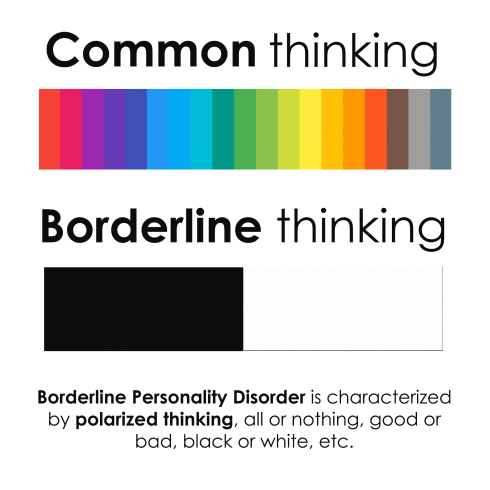
Borderline1

What they need to learn is to go within and ask, “What do I need now?”  or “How can I make this better?”  Instead of saying “What’s wrong with me? Why am I like this?   I hate this!  I feel crazy! I can’t take it, I want to die!” In individual therapy, we can also explore their different Parts (with Internal Family Systems Therapy/IFS)  and gain understanding of their Exiled parts (Anderson, F.,  Sweeney, M. Schwartz, R.  2017)

I teach my clients to stop asking WHY questions, but to ask HOW questions instead.  When we ask WHY, “Why am I like this?  Why don’t I enjoy parties?  Why am I so annoying to people? Why is this person ignoring me?  Why do people dislike me? “Why am I still single?” they are on a slippery slope into anxiety and depression and possible self-harm.

When they learn to ask HOW questions, they start to change, “How can I make this better?”  “How can I be useful?”  “How can I learn to stay calm when I am triggered?”  The HOW questions lead to discovery, growth, healing and empowerment.

In Conclusion

Dialectical Behavior Therapy for Post-Traumatic Stress Disorder is a powerful healing modality.  From my experience, those clients suffering with BPD are particularly helped by this cognitive restructuring process, since typical pharmacological and generic talk therapy interventions are not always helpful.  From my perspective, DBT serves as a newly installed behavioral software program. It is slowly downloaded into their minds through the completion of hundreds of handouts, worksheets, discussions, weekly practice and role playing.  In sum, the DBT behavioral software in their minds replaces their previously corrupted and faulty software that was hurting them.
Copyright © by Lisa Wessan 2024. All rights reserved.

Leave a comment »

How Dialectical Behavior Therapy (DBT) Skills help you learn to manage and cope better with difficult emotions, as “Serenity is not freedom from the storm, but peace amid the storm” – S. A. Jefferson-Wright.

I’m excited to announce that we are hastening slowly to transform the world from the inner to outer, one DBT student at a time…

Lisa Wessan, LICSW, DBT Skills Trainer

Up next: we will be exploring “Emotion Regulation and Mindfulness Skills” from January 23 – April 23, 2024 in the Zoom Classroom.  (All registration forms, intake sessions and tuition fees must be completed by January 19, 2024).

Four leaf DBT

The Emotion Regulation module has four sections:

  • Understanding and Naming Emotions
  • Changing Emotional Responses
  • Reducing Vulnerability to “Emotion Mind”
  • Managing Extremely Difficult Emotions
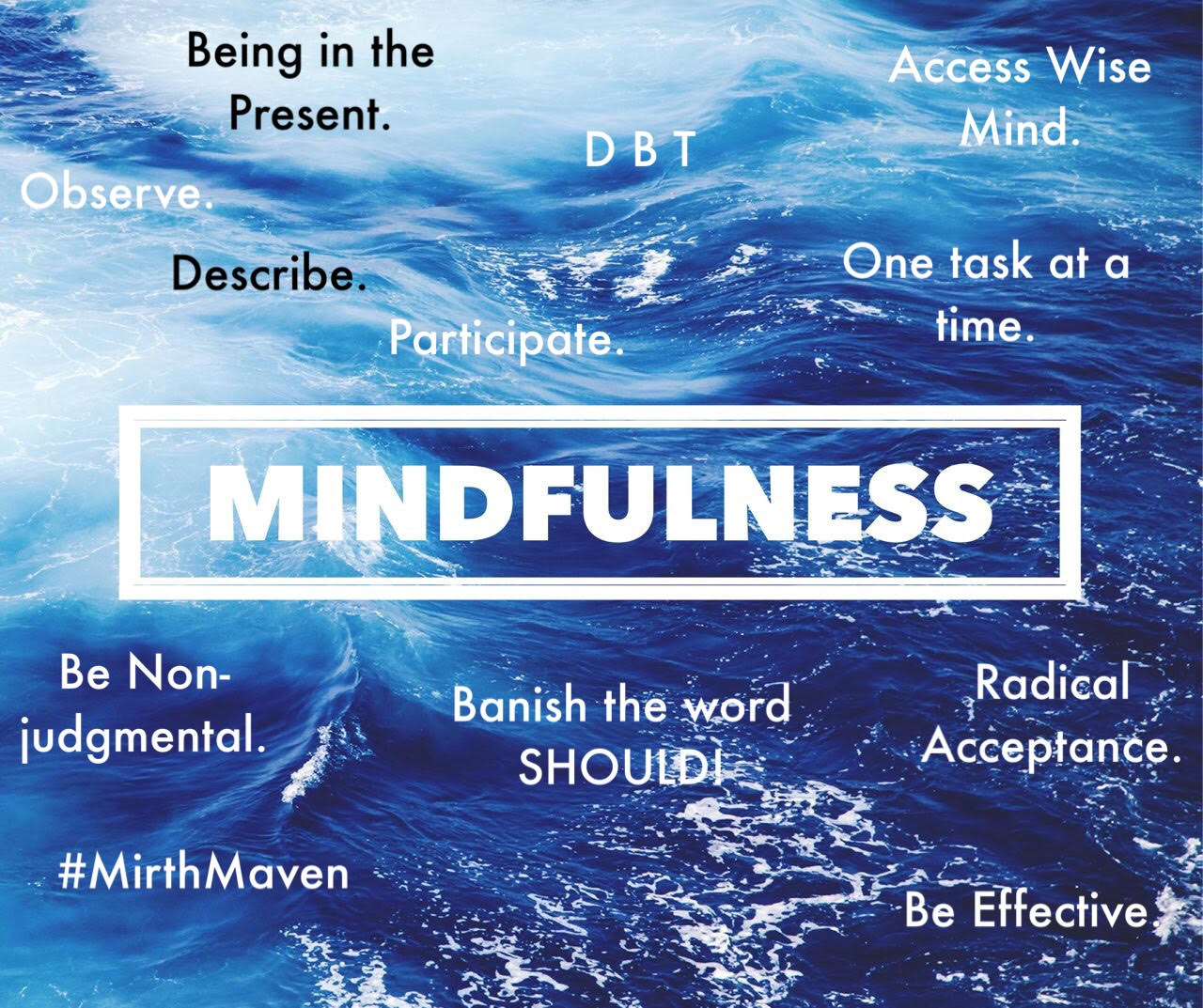
DBT Mindfulness

The Mindfulness material includes:

  • Learning to be a good observer
  • Being non-judgmental
  • Staying in the present
  • Practicing being effective
  • Accessing “Wise Mind” (aka higher self, higher consciousness)
  • Understanding Reality Acceptance and detaching from negative or critical thoughts.

As DBT founder Dr. Marsha Linehan says, “It is difficult to manage your emotions when you do not understand how emotions work. Knowledge is power.”

During this 14-week program:

  • You learn to cope better with social anxiety issues, negative thinking and stop falling into the Blame Game.
  • You learn to abstain from the Compare and Despair syndrome.
  • You practice “Face it, trace it and erase it” as you work the DBT Skills and grow stronger and wiser with effective emotional regulation and self-expression.
  • You learn to access “Wise Mind” and regain your center, remain calm.  You learn to take a stand for your inner peace, and become bulletproof to bullies, others’ judgments and negative, invalidating remarks.
  • You learn to practice Radical Acceptance, as needed, and problem solve when possible. You are no longer living with victim consciousness.

If this DBT Skills training group sounds good to you, please get in touch with me to start your enrollment process. Just complete the Contact Form on my web site to begin (not to worry, this is a No-Spam Zone! Your email will not be added to any mailing lists unless you request it).

🌀 For exact dates, fees, insurance info, FAQs, DBT Flyer, videos and more details, please visit https://www.lisawessan.com/dialectical-behavioral-therapy

Onward and Upward✨

Lisa Wessan

Copyright © by Lisa Wessan 2024. All rights reserved.
Leave a comment »

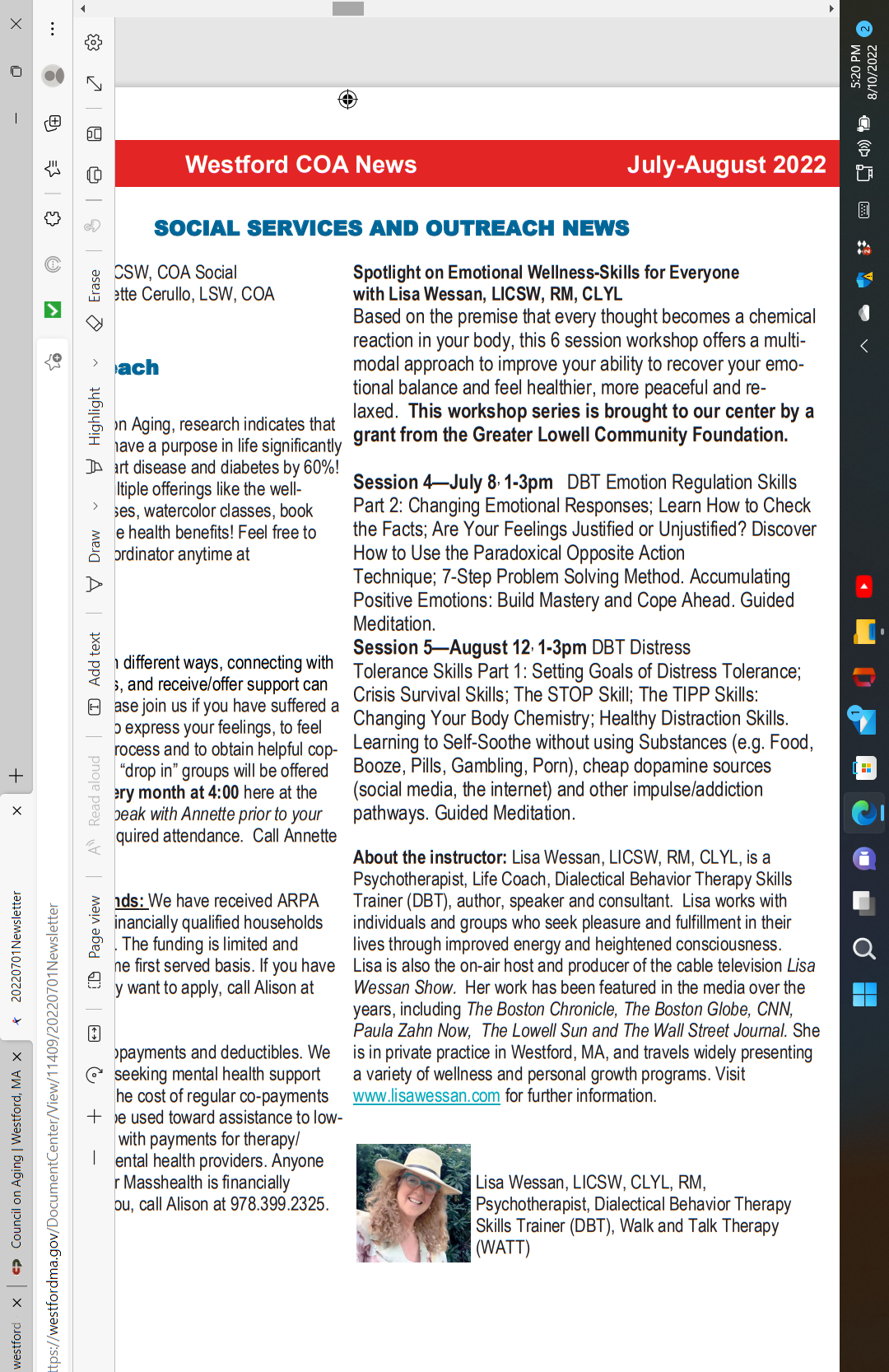
Free Dialectical Behavior Therapy Skills Group offered at the Cameron Senior Center, Westford, MA

I am delighted to be sharing this learning opportunity with you. May this program serve you well💙

As part of a six-month program, I am presenting Dialectical Behavior Therapy Skills Training in person at the Cameron Senior Center in Westford, MA.  

To learn more, go to page 6 of this newsletter: 

20220701Newsletter (westfordma.gov)

TO REGISTER:
Generously funded by a grant from the Greater Lowell Community Foundation, even though it is free to attend, you must pre-register by calling this number: 
(978) 692-5523

WHEN:
You can still attend the last two sessions:
1 – 3 PM on both August 12 and September 9, 2022.
You can attend these two workshops out of sequence and still gain value.

WHERE: 

Cameron Senior Center

20 Pleasant Street, Westford, MA 01886 (free parking)

Please do not contact me – I am not involved with registration!  They have a limited seat count, but plenty of room.  CALL NOW to reserve your spot!

Onward and Upward✨

Lisa Wessan

Leave a comment »

How Toxic Positivity Can Affect Your Health: Benefits of Complaining

Katie Couric spoke to a therapist about how she grieved Jay’s death, the dangers of toxic positivity and the benefits of negativity.
— Read on katiecouric.com/health/dangers-of-toxic-positivity-benefits-of-negativity/

🌀On the importance of doing a thorough Brain Dump to release and let go of your unexpressed grief, rage, disgust and other negative feelings. You cannot do a Spiritual or Cognitive By-Pass!

🌀Tears are the language of grief, and messy, hard crying jags are on the road to wellness.

🌀After reading this article, I will never again say “Everything happens for a reason” (out loud). Mea culpa, mea culpa…

Leave a comment »

Walk and Talk Therapy featured on Boston Chronicle with Lisa Wessan

Lisa Wessan featured on Inside/Outside episode

09.09.20 – ABC News/The Boston Chronicle, Inside/Outside episode. Finding Peace in the Great Outdoors. I was interviewed by great team from the Boston Chronicle concerning my work with Walk and Talk Therapy. This was part of a longer story about how we are taking our work outside during the pandemic.

Leave a comment »

Reflections on Juneteenth 2020 and the Evolution of Consciousness

Evolution of Consciousness

“One discovers the light in the darkness, that is what darkness is for.”  
James Arthur Baldwin, novelist

I have felt crushed and overloaded by the recent events of our times, but still feel peaceful and hopeful that we are having a wonderful new beginning.  History teaches me that the Dark ages are followed by the Renaissance, Saul becomes Paul, the heroin addicted sex worker becomes an addiction counselor, on and on. This is the emergence of consciousness, over and over here at Earth School.

The Program is designed to move us forward until we realize and accept our Oneness with each other and the Universe.  But what a long journey it is…probably many lifetimes of learning are achieved before we totally get it.

During the crisis, the saying goes,  “When one door closes, another one opens, but it is hell in the hallway.”  I’m the one who tells my clients “…It doesn’t have to be hell in the Hallway.  You can choose to create a different kind of experience during ambiguous times.”  Yes, I do believe that is still true. Yet during these past few months the Hallway has been brutal. Each day, it is a struggle to stay focused on solutions and find some joy, despite the chaos around us.

This pandemic chaos and  racism crisis also remind me of the Chinese word for crisis, which is made of two symbols, Danger and Opportunity.  In each crisis, we are totally at risk, and yet the opportunity for a new and improved consciousness is here.  That’s the good news. Again, it’s part of the Program for the evolution of our consciousness.

As much as I want to discuss ways to live in ambiguity with peace, even joy, today I feel the need to be quiet.  I am sitting with the grief, and processing the harsh reality of the racism, anti-Semitism, homophobia and other forms of tribal cognitive distortion that are still infecting our world in tandem with COVID-19.

Here are two resources which have been particularly soothing, uplifting and informative recently:

“Bleed the Same,” with Toby Mac and Kirk Franklin.
This song captures exactly what I am feeling, and what needs to be said now.
No other words say it so perfectly.

⭐ Tim Ferriss’  interview Coach George Raveling, 82,  “This Unique Moment in Time, How to Practice Self-Leadership, Navigating Difficult Conversations and much more” .

In the throes of feeling this intense outpouring of emotion after George Floyd was murdered, and under the suffocating history of  racism,  I appreciate hearing how this wise black man frames this moment.  This wide ranging interview will give you an intimate view of Raveling’s extraordinary journey from being born in the basement of a segregated hospital,  to becoming a world class coach, and how he navigated his life in this ocean of racism all these years.

At one point, Raveling says “We are both the problem and the solution.”  Yes, I love that dialectical view for each of us. We are ALL accountable for this situation. We need to step up and take a stand to create a world worth living in, with “Equality and justice for all.”  Simple, but not easy.

So I invite you to listen to “Bleed the Same,” and Raveling’s interview.  I think your heart and mind will be moved to a new level of awareness, acceptance and then action. 

YES, you can be an agent of transformation, and turn this Hellish Hallway experience into a magnificent corridor for the evolution of consciousness!

Onward and Upward❤

Lisa Wessan


Copyright © by Lisa Wessan 2020. All rights reserved.


Leave a comment »

Pandemic Retreat Tip 4 – Allowing time for Daily Grief Work

avoiding-5-stages-grief-visibility-program

Our culture has difficulty sitting still with feelings.  There is too often an attempt to keep busy and ignore the discomfort of our negative feelings. It has been my experience that many otherwise healthy people want to bypass their phases of grief and jump into positive thinking, avoiding those dark and mysterious pathways of  emotion.

Now we are faced with micro and macro levels of Ambiguous Loss and Grief.   Ambiguous Loss is when you lose someone but not all the way.  For example, you could lose a loved one to illness, such as Alzheimers Disease, Alcoholism, Cancer, Food Addiction/Anorexia. Your loved one might be lost at sea or on a mountain.

Ambiguous Loss is most painful when you live with someone who is “here but not here.”  If your loved one watches multiple hours of Netflix, or video games, and you miss them, you are experiencing Ambiguous Loss.  If your loved one is slowly deteriorating from any illness or addiction, and you are watching them slowly disappear, you are experiencing Ambiguous Loss. When you break up a relationship, divorce, move away, you experience Ambiguous Loss, “here but not here.”

Today we have the Ambiguous Loss of our culture and daily routines. By not seeing the people, places and things that make up our life, we develop anticipatory anxiety of what will come next.  The anxiety then quickly morphs into Anticipatory Grief.

What is Anticipatory Grief?

I defer to Scott Berinato who unpacks our micro and macro Anticipatory Grief so usefully in his recent article in the Harvard Business Review (23 March 2020).  Berinato interviews David Kessler, who is one of our leading grief experts, and explores Kessler’s overview of our current pandemic existence. Learn more here: That Discomfort You’re Feeling is Grief.  

You may  think you are lonely, or exhausted, or anxious. That may be true. But I would agree with Berinato and Kessler in that you probably have unexpressed grief (and rage), which is clogging up your inner world.

It’s exhausting to repress grief and “act as if” you are perfectly fine. Yet we are called upon to buckle up and deal with life on life’s terms, so there is no binary solution here. We are asked to grieve our current losses and future losses PLUS carry on and live our lives.  So how is this possible?   By scheduling some Grief Work time into your calendar. Allowing time to release and let go will enhance your life as you release the inner pressure. Give yourself permission to unravel a bit.

Tears are the language of grief. Something I frequently suggest to my clients is  “Make some time to do your Grief Work.  Let it flow out of you.”  Most people resist this process and just hope by keeping super busy (or medicated or numbed with screen time) they can bypass the Grief Work.  Nay, nay, it must be done.  Cry now or cry later, but crying will help release those grief-balls that are jamming you up.

CS Lewis grief (2)

When we begin to honestly defrost our grief with each other and then seek solutions for our dilemmas, we start to feel a little better.  I am a fan of the stoic philosophy, but just focusing on solutions and keeping a stiff upper lip all the time is not helpful — something within shuts down and can go numb inside from repressing all that emotion.

Perhaps one of the silver linings from the Corona virus is that now, in this time of profound herd vulnerability, we will be more authentic with ourselves and each other?  Simple, but not easy. This is a practice that takes as long as it takes, perhaps lifetimes.

I have come to believe that your vulnerability is your superpower.  When you are brave enough to be vulnerable, you release, let go and successfully move on.  This is part of the multidimensional journey to wholeness and deep fulfillment💙

References:

Berinato, S. (23 March 2020). Harvard Business Review. That discomfort you are feeling is grief. Retrieved from https://hbr.org/2020/03/that-discomfort-youre-feeling-is-grief

Mitchell, S. (1988). Tao Te Ching. New York: Harper Collins.

Wessan, L. (05 JAN 2019). On the “Myth of Closure,” Ambiguous Loss and Complicated Grief.  Retrieved from https://mirthmaven.blog/2019/01/05/on-the-myth-of-closure-ambiguous-loss-and-complicated-grief/

Helpful Scriptures for increased bravery and courage for your Grief Work:
Psalms 23, 31, 46, 126
Deuteronomy 31:6
Ecclesiastes 1:18
Proverbs 14:13

Copyright © by Lisa Wessan 2020. All rights reserved.

Leave a comment »

Pandemic Retreat Tip 3 – Shifting from Victim to Victor with the 2-2-2 Method of Transformation

Instead of feeling trapped inside your home or apartment, what if you started to see this as a temporary retreat? Can you turn this victim consciousness into a victorious consciousness?  What if you are being called to live, move and have your being refined in an enclosed space for a few months to evolve to a new level of consciousness? 

This appears to be a global retreat.  We are all being called to stay home and go within, on many levels.  The only real choice we have on this Earth is HOW WE RESPOND OR REACT to stress and crises. Moment by moment…victim or victor?  With ease or anxiety? We choose, again and again.

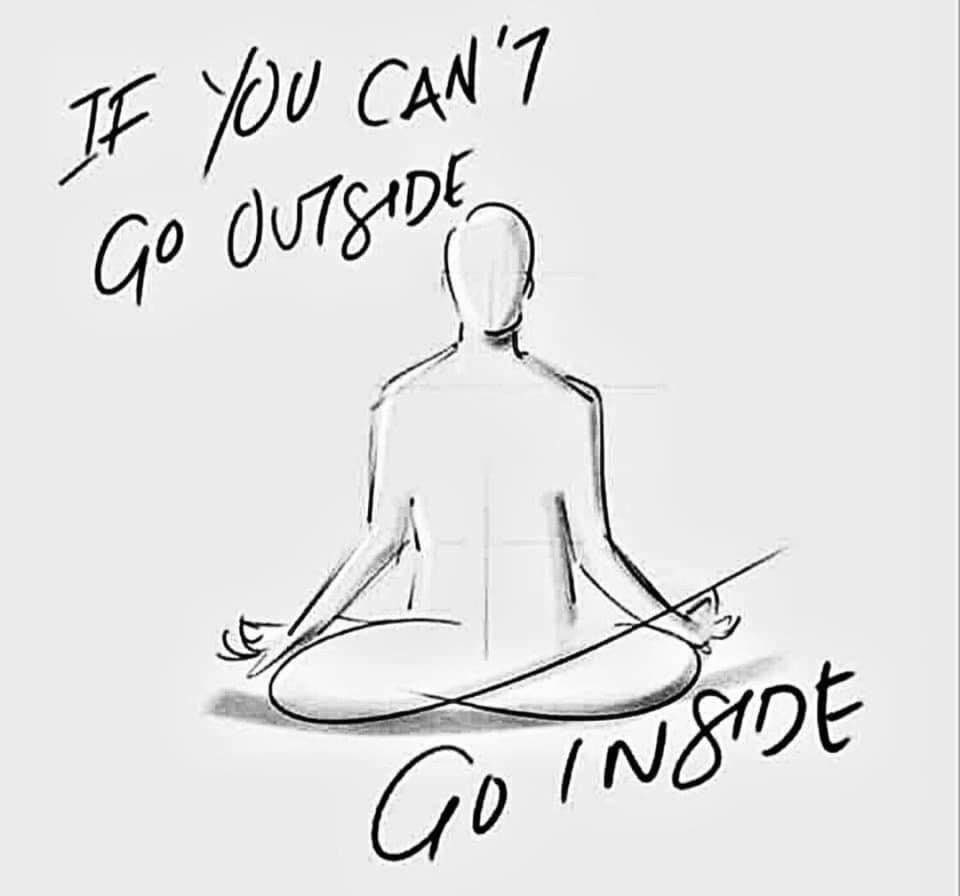
Go inside

I’m not going to list or catalog all the ways you can go inside…because you are smart, and have been aware of mindfulness techniques, prayer, contemplation, meditation, relaxation techniques, Reiki, yoga and much more.  There are many paths up that mountain to deepen your awareness, increase your insight and have more inner peace.  I’m just here to remind you of what you already know.

“Lisa, I know nothing about going inside myself.  Where should I begin?”  When I hear this,  I often invite my DBT Skills Students to use my 2-2-2 Method of Transformation.

What is the 2-2-2 Method?  The broad brush here is you spend two minutes connecting within, two minutes reading something inspirational and two minutes writing.  You can do these in any order. To feel successful and build momentum,  set a timer for six minutes each day for your practice.  If you stay in the process for six minutes, you’re good, even if you don’t tap each category perfectly.  The idea is to set your intention and do the best you can. 

Meditation:  Spend approximately 2 minutes sitting quietly, doing some kind of paced breathing.  During this time, consciously  seek to access your inner Wise Mind, Higher Power, Ha Shem, Christ Consciousness, Allah, Great Spirit, Buddha Nature, any label will work that is meaningful to you.

Reading: Spend approximately  two minutes reading from a personal growth book, inspirational  literature, Scripture, angel cards, your DBT book or whatever devotional or uplifting material you have handy.  If you have no inspirational literature, this will be a fun shopping trip for you.  Ask around, especially if you know someone who you admire for their mental and spiritual wellness.  See what they are reading. Take a risk and read it too.

Writing:  Finally, do two minutes of writing (in your journal or DBT worksheet).  You can just write what you are observing in your mood.  My favorite format for basic brief journaling is to write a fear list, do a quick brain dump and just get it out of your head onto the page.  Then make a gratitude list (6-10 items or so). Then make a to do list. Then if there’s still time, freestyle and just let it rip. See what comes out of you.

The 2-2-2 Method gives you a structure – but it is flexible – again, you can do these tasks in any order.  If you do this daily practice, this will help you advance and make a big difference over time.

If the timer goes off and you want to do more, that’s fine. But the six minutes a day minimum will be great for building momentum here.

Gentle Note: If you’re too busy to invest six minutes/day on your personal evolution, you are too busy. Dial down your Netflix, YouTube, Videogame and other streaming activities.  You are worth it!  Just six minutes/day will compound over time and create amazing changes in you and give you a life worth living.

Also, do NOT try to do this perfectly!  Allow some wiggle room on the 2-2-2 precision. It’s not exact, although sometimes it can be.

The 2-2-2 Method will give you a satisfying structure to add to your day.  Truly, this is such a good time to start a 2-2-2 practice and build from it.  Over time, you will see this move to longer sessions, and will feel deeply nurtured and empowered by it.

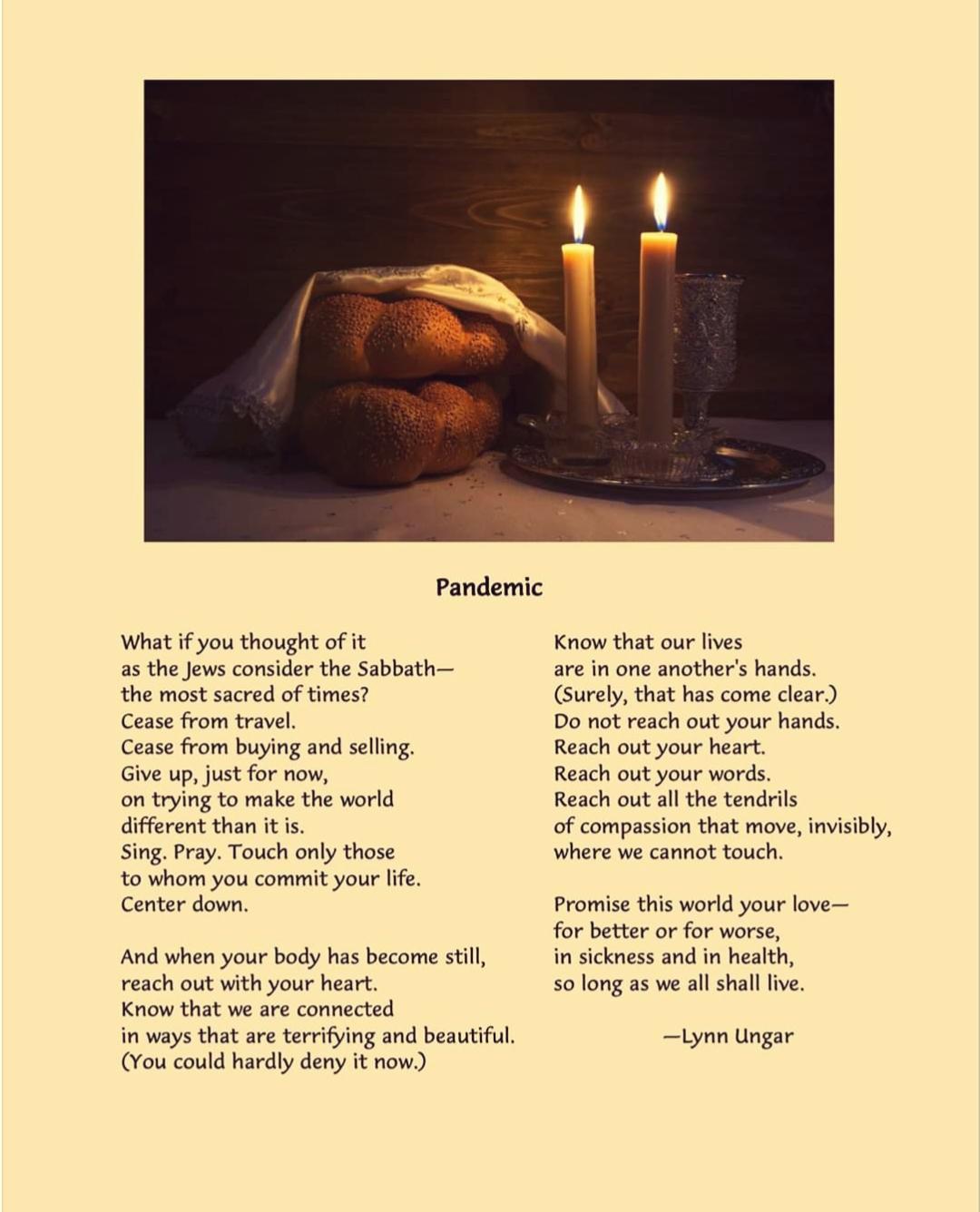
In closing, I appreciate Lynn Ungar’s approach to this pandemic…

Lynn Unger poem PANDEMIC

Stay safe and well,

Onward and Upward, 

Lisa Wessan

Leave a comment »

Coronavirus Retreat Tip 2 on Distress Tolerance Skills

Stay Home Stay OM

We are all struggling to feel safe, stable, useful and effective during this pandemic challenge. I know for sure that when I feel peaceful and useful, everything else falls into place.

Feeling peaceful and useful is the foundation for a great life…trying to be “happy” or “ecstatic” all the time is worthless to me.  Happiness is fleeting, and as much as I love ecstasy, it also does not last long enough. Being peaceful and useful, however, offers long term gains, which often bloom into happiness and sometimes the ecstatic joy of living.

HOW DO WE BECOME MORE PEACEFUL DURING THE PANDEMIC? 

There are many different paths of coping as you trudge up this pandemic mountain, the question is which path works for you.  I suggest you keep trying these methods — and others — to see what works.  Over time you will have a colorful tool kit with many different coping methods that you can use as needed.

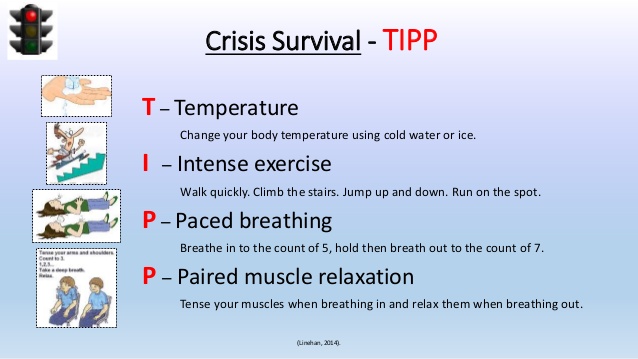
Today’s tip has some useful skills for increasing your tolerance to distress and anxiety.  There are two key principles at work with the TIPP skills.

⭐First, every thought becomes a chemical reaction in your body.  Change your thoughts, change your experience of your life. Mind/Body medicine works both ways.
⭐Second, “the issues are in your tissues.”  When you release the stress and toxins in your flesh, bones, muscles, skin, you feel a tremendous mental release and relief.
Let’s start with the empirically verified TIPP Skills  for quickly changing your body chemistry:tipp
Source:  Adapted from Linehan, M. (2015).Dialectical Behavior Therapy Skills Training Handouts and Worksheets. New York: Guildford Press. P. 329.

Let me unpack these TIPP skills and add in my suggestions:

Temperature – you can create what’s call the “The Dive Response” in a few ways.  The Dive Response will lower your blood pressure and relax your nervous system.  Ways to shift temperature include:

  • Set up a bowl of cold water and dunk your face into it for as long as you can hold your breath. Do this a few times, until you feel relief.
  • Take an ice pack, wrap in a towel and place on your cheeks, brow, neck.
  • Hold ice cubes in your hands.
  • Freeze a lemon or orange, and squeeze the frozen citrus.  Provides cooling effect plus aromatherapy.
  • Take a washcloth and moisten with cold water, but it on your brow (better effect laying down.)

Intense Exercise – in addition to the jumping jacks, push ups, running, walking fast, fast dancing, Vinyasa and Ashtanga yoga etc, I recommend the “Cross Crawl.”  You can do this standing up or on the floor.  This is a movement that gets your heart rate up super fast, can be done in place, and in five minutes you will feel the shift and release. It also provides excellent mental stimulation and has been shown to improve memory, creativity and focus as the cross-lateral activity heightens the exchange between the left and right hemispheres of our brains.

“Therapeutically, cross crawl refers to any intentional cross-lateral activity in which you cross the mid-line of the body, such as touching opposite hand and knee or foot.  Performing this movement builds the bridge between the right and left hemispheres of the brain, allowing for electrical impulses and information to pass freely between the two, which is essential for physical coordination as well as cerebral activities, such as learning language, reading, and hand-to-eye coordination.” (Source: https://www.yourtherapysource.com/blog1/2019/06/16/cross-crawl/)

Paced Breathing – Whether you do the “Take 5” method, which is inhaling to count of five, holding for 5 and then exhaling to 5, or any variation of slowed down breathwork, it will work.   The only way to do this wrong is to not do it at all!  When we do this in my DBT Skills Groups, I add on the physical hand movement of placing the dominant hand on the heart area and the other hand on the naval area.  Touching these two power centers (Solar Plexus and Heart chakra) has an additional calming effect.   The body feels more centered and cared for, a sense of compassion flows, and we feel we are doing useful self-parenting in this position.  This is also considered the Reiki I position, which begins a deeply relaxing sequence of psycho-spiritual  events in the body.

Paired Muscle Relaxation – This is when we begin to scan our bodies head to toe or toe to head, and start to tighten and release muscle groups.  This can be done sitting or lying down. It is most effective to inhale, tighten, hold for a few seconds, and then release.   I sometimes like to pair the muscle contractions with cognitive suggestions, e.g. Breathe in harmony, breathe out chaos. Breath in unconditional love, breathe out fear. Breathe in acceptance, breathe out anger.

You can find many free versions of Paced Breathing and Paired Muscle Relaxation at Insight Timer, and all over the internet.   Insight Timer has versions as short as 2 minutes, and as long as 90 minutes for each of these processes. (I also have a few videos on YouTube concerning Body Scans and Paced Breathing as well.)

May these TIPP Skills enhance your Coronavirus Retreat today!

Onward and Upward in good health,

Lisa Wessan


Copyright © by Lisa Wessan 2020. All rights reserved.


Leave a comment »

Coronavirus Retreat Tip #1

Dog in mask

Over the years I have been trained up to always see the pros and cons of each challenge. Not to be in denial of the pain, trauma and suffering — but to see the possibility of hidden value in the challenges.  “What if everything that is happening to you is happening for you?” asked  Colin Tipping years ago in a lecture in New York.   That thought percolated through me for years before I could finally understand what it truly meant, and the freedom and peace of mind that comes from living with this deep level of acceptance. 

What are the pros and cons of this Covid-19 challenge we now face? Here are some resources which have helped me sort this out and remain more peaceful and relaxed during this difficult time. 

To be transparent as ever,  I am feeling the full dialectical nature of this moment: sometimes I feel a deep peace and stillness within, and at the same time I feel the edge of a panic attack creeping up on me.  The difference between now and 30 years ago, however,  is that I have learned to observe my inner world so much better…so when I sense that edge, I use some breathwork, distress tolerance skills and physical release to shift out of it.  (More on those skills in the next Coronavirus post).

Over the next few days, I’m going to unpack some useful tips for coping with this extra level of anxiety we all share from the pandemic.  As always,  I have been sorting and cycling through my personal tool kit, plus I have found some new and impactful ideas that I will share here too.  The best of the best for you, my dear reader…as we trudge this road through the forced Retreat to wellness and bliss.

First, listening to Jack Kornfield  and Tim Ferriss discuss ways to re-frame and re-focus during this difficult time gave me more insight and some good practical advice. Kornfield’s  75 years on this Earth have been well spent.  As a brief overview, he was a Buddhist Monk in Thailand, then served as co-founder of the Insight Meditation Center in Barre, MA,  then became a psychologist. Now he is involved in many educational and activist programs to help bring mindfulness and other useful transformative skills to the public. 

Tim Ferriss is one of my favorite teachers. First, I love Ferriss’  passion for extreme wellness.  I love his awesome lifestyle hacks and his never ending curiosity about world class performers  and the minutia of their morning routines, what they eat for breakfast,  favorite books, how they sleep and more. He also has an impressive history of  brilliant investing, living with bipolar illness and managing well.  Yes, I’m a fan of Ferriss! 

You can access this podcast wherever you listen to your podcasts:  Listen to #414: Jack Kornfield — How to Find Peace Amidst COVID-19, How to Cultivate Calm in Chaos from The Tim Ferriss Show in Podcasts.

For your consideration, here is my brief summary of this  podcast. During this two hour, wide ranging conversation, you will learn: 

  1. During the first hour, “It’s not about perfecting yourself, it’s about perfecting your Love.”  Learning to live in this world with more love, embracing the inner and outer imperfections with radical acceptance is one path to more inner peace and joy here.  Kornfield delves into some wonderful coping and practice skills to help move through the anxiety and depression of these pandemic days.
  2. From 1:07 there is a discussion of psychedelic research aka Sacred Medicines, for the treatment of drug resistant depression and anxiety.   Kornfield discusses the mysteries of our multi-dimensional selves.  “We are learning to use sacred medicines to know who we are.”  Apparently, this paradigm shifting research helps us form more positive and useful world views. Ferriss cites exciting and impressive research coming out of Johns Hopkins Medical School which has gotten robust results.   After listening to this  segment, I made a note to read The Cosmic Game, by psychiatrist Stanislav Grof, which describes the wisdom and understanding that hundreds of trials of Sacred Medicines have offered seekers in laboratory conditions, to help better understand the nature of consciousness Itself. (As it happens, Harvard Medical School is hosting a large conference here in Boston  May 1-2, 2020, on Meditation and Psychotherapy: Learning from Non-Ordinary States).
  3.  From 1:23 Kornfield deconstructs suicide and suicidal patterns and how to reduce treatment resistant depression.  I was intrigued with this curious idea,  how we long for “sleep,” and how for some suicide is the big sleep that they think will solve their painful life for good. Suicidal people have  worthy intentions, not the best solutions…Kornfield’s approach to suicide is practical and soothing.  
  4.  From 1:32  Kornfield explains his trauma work, and how to be in the field of compassion which allows us to process the trauma successfully. “To witness with a loving gaze, it’s not who you are, it’s something that you went through.”   This reminds me of the teaching that “We make mistakes, but we are not a mistake.”   Again, learning to pause, observe, step back and see the pain as something that we passed through is very different then feeling a permanent imprint from it, rendering us emotionally compromised,  with anxiety, depression, PTSD and other conditions.  

I hope you enjoy listening to this podcast as much as I did.  It really gave me a booster during these troubled times. There is hope! There is a solution…

Stay tuned for my next Coronavirus Retreat Tip…may these tips serve you well! 

Onwards and Upwards in good health, 

Lisa Wessan


Related reading: 

Dr. Abdu Sharkawy: My Turn: Mass panic may be worse than virus itself


Leave a comment »