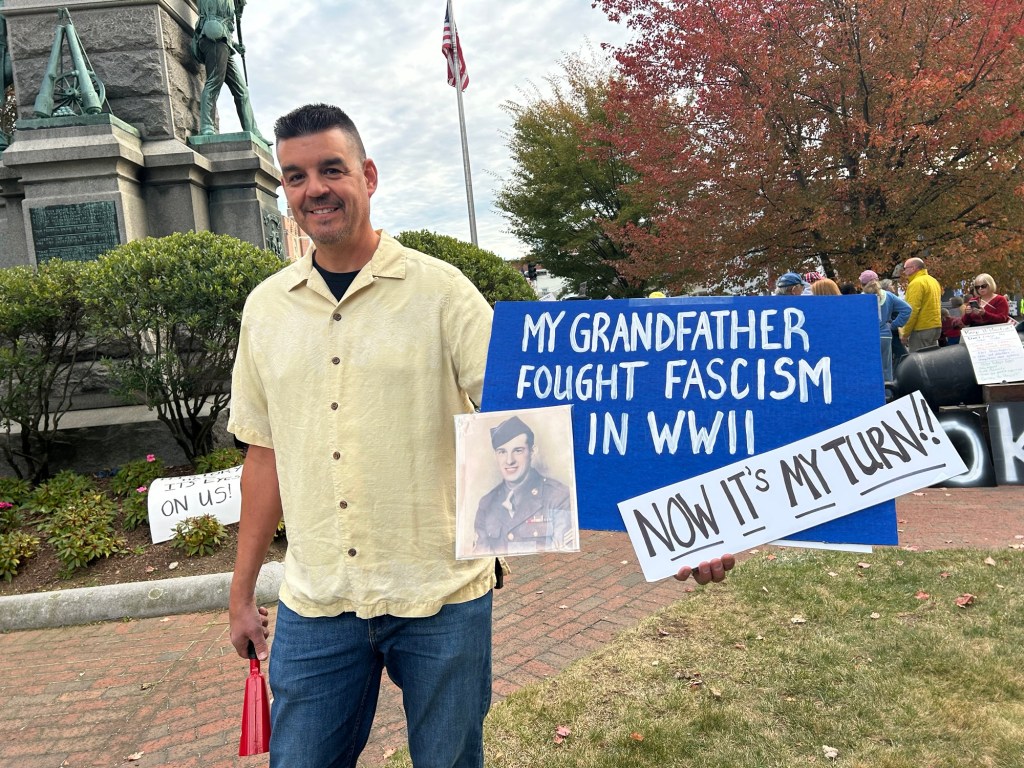
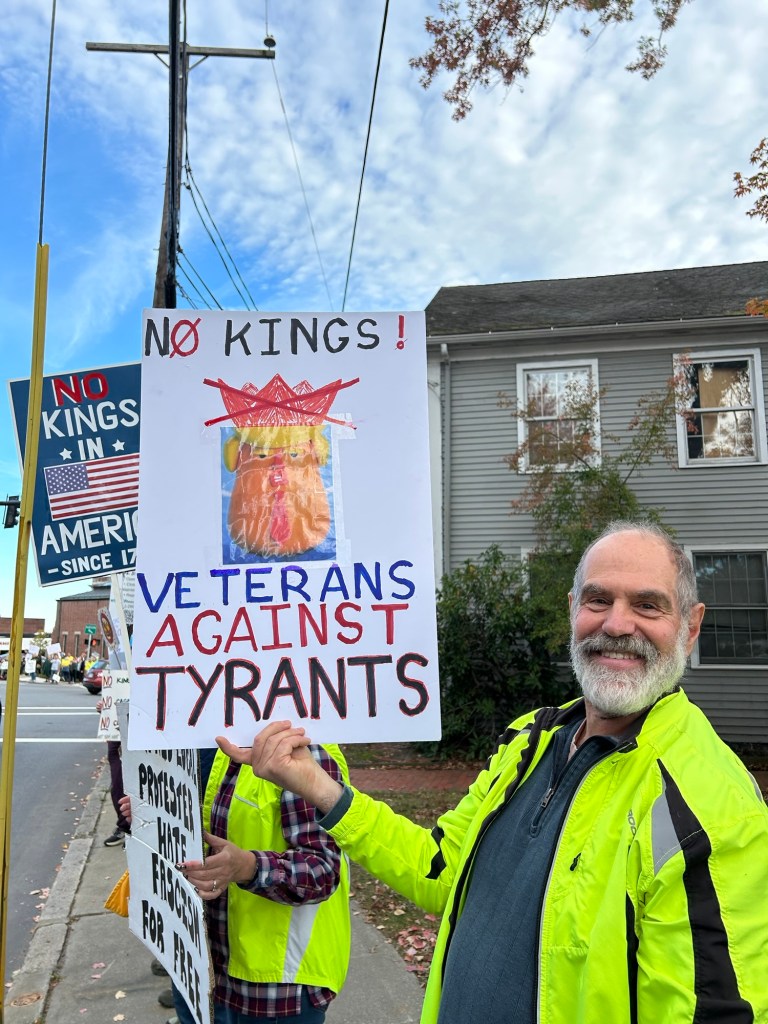
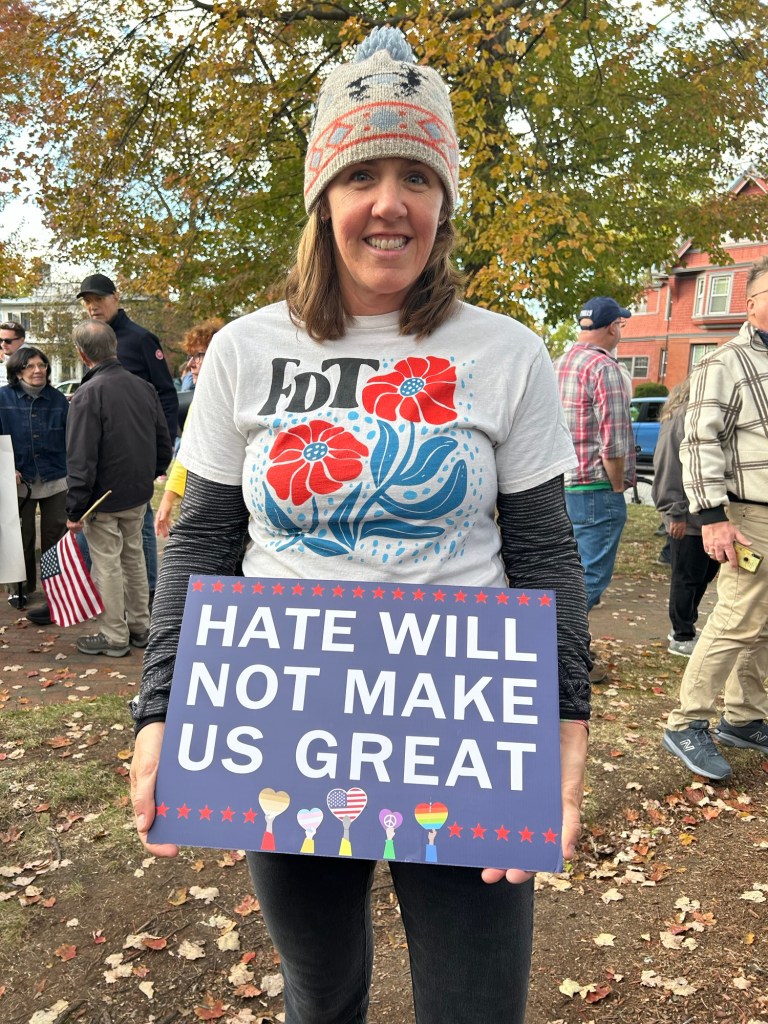
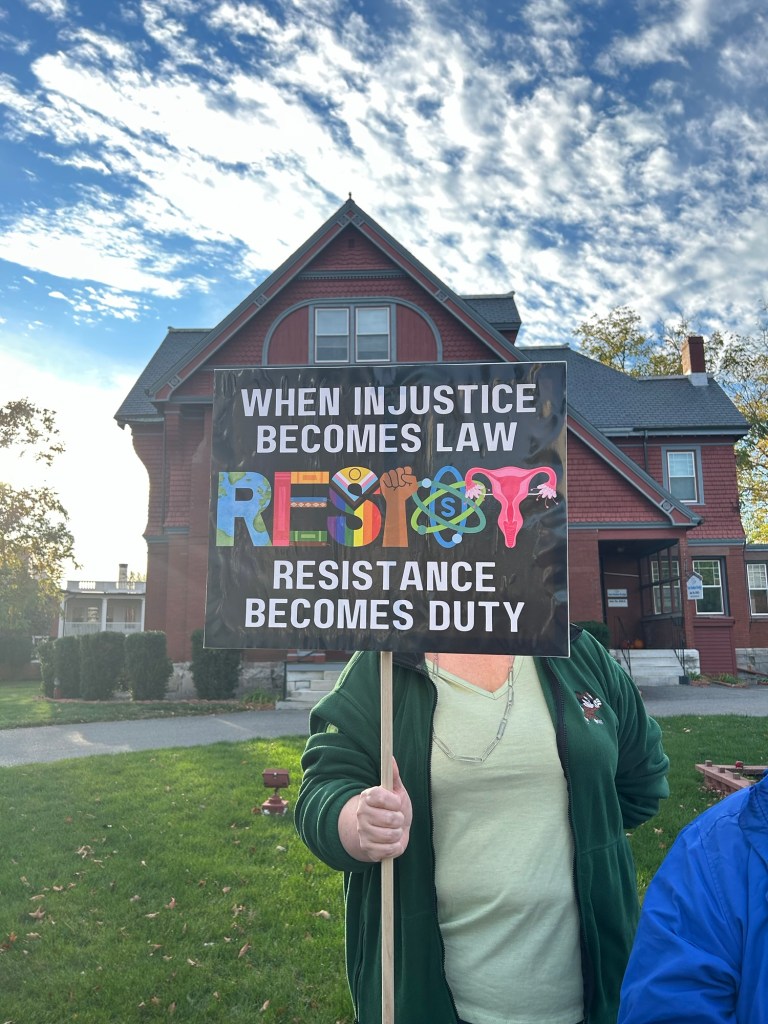
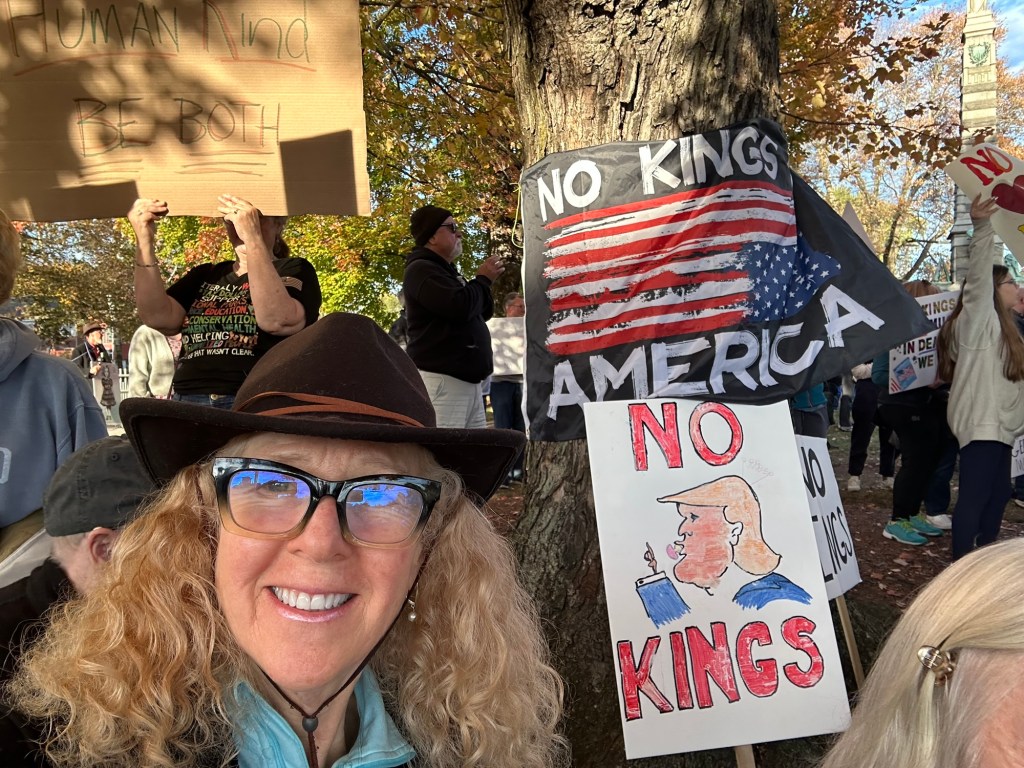
I attended my first No Kings Rally in Nashua, NH this past weekend, 10/18/25.
I went way out of my comfort zone to be there.
My concerns: 1. The noise, people screaming. Megaphones. I have high acuity hearing – “Dog Ears” – so loud sounds hurt. 2. The Covid Factor. 3. Heavy urban traffic, congestion, parking.
I’m grateful to report that this was a peaceful and not too noisy rally. Parking was easy. As of this writing, I’m Covid free. So all my fears were allayed.
I was most deeply affected listening to the WW II veterans. They drew astute parallels to the fascism of other countries and their WW II battle fatigue. They experienced so much loss and grief to fight for our freedom and democracy. And now, POOF! Our freedoms are eroding away daily.
There were also some beautiful art works created with such loving messages. These were my favorites:
I learned so much from being at the Rally. I realized that I need to step up once again and become more active with the resistance.
Before my sweet younger sister and husband got sick, I used to attend the INDIVISIBLE meetings in my town. Due to both the pandemic and my increasing caregiver burnout I chose to take a pause on my participation there.
Now that my sister and husband are resting in peace, I am 80% recovered from those chronic medical traumas. I believe I can be more useful and helpful again.
Another action tool that is part of the “Antidote for despair” is using the 5 Calls App. This is an excellent tool to be effective and also lower your blood pressure and cortisol levels quickly! I’ve shared about it before, Reduce anxiety: use the 5 Calls App
However you choose to express yourself, please remember, “There are no victims, only volunteers!” If you decide to do nothing, that is not nothing. Your tacit approval is built into doing “nothing.”
Gentle suggestion….take one tiny action per week to put forward your beliefs and reduce your anxiety. Action is the magic word!
DBT is evidence-based; over 80% of 10,000 participants showed significant improvement after practicing these skills (Linehan, 2016). Many, including Lady Gaga, have since benefited from DBT.
Lady Gaga credits DBT for helping her manage trauma, PTSD, and self-harm urges. She uses skills like Radical Acceptance and TIPP (Temperature, Intense Exercise, Paced Breathing, Progressive Muscle Relaxation) to handle emotions and reduce symptoms. Her advocacy of DBT Skills training has highlighted the value of mental health care.
Hear how DBT transformed Lady Gaga’s life:
You can learn DBT skills too! This is not an exclusive training just for celebrities…
FEES: $100/week for 90-minute session, 14 weeks x $100 = $1400 – no insurance (except PPOs) (plus one Intake Session prior to group start)
What is Dialectical Behavior Therapy (DBT) and how can this program enhance your life?
One Year Program Includes:
1. DBT Core Mindfulness [focusing skills]
2. Distress Tolerance [crisis survival skills]
3. Emotion Regulation [de‐escalation skills]
4. Interpersonal Effectiveness [‘people skills’]
🌀🌀This trimester starting January 6 – April 7, 2026 – we are focusing on Mindfulness and Interpersonal Effectiveness skills.
Interpersonal Effectiveness helps you communicate better, set boundaries, validate yourself and others, confidently ask for what you need, seek support, and end unhealthy relationships. Each class covers DBT skills, practice, role play, and guided meditation.
The full scope of Interpersonal Effectiveness focuses on improving communication, reducing social anxiety, learning to set healthy boundaries, learning to validate yourself and others, gaining confidence in asking for what you want, enrolling others to help you in your dreams and goals, and letting go of toxic relationships.
Below is an excerpt of one of my sessions for Interpersonal Effectiveness.
Learning to say Yes when you mean Yes, and No when you mean NO
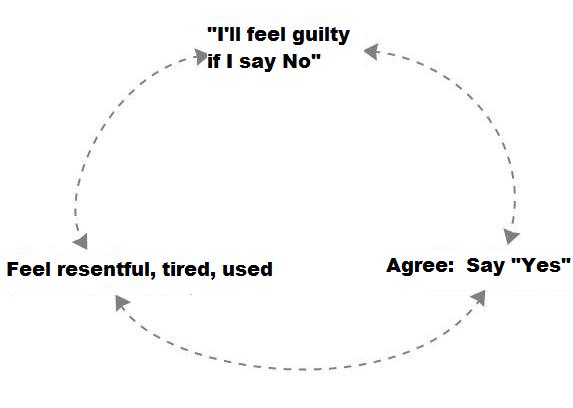
It can very often be difficult to say no to people who make demands of us, and if we say no, we can get caught up in self-critical thoughts leading us to feel guilty. To avoid feeling guilty, we just keep on saying “yes” to every request.
Someone asks us to do something:
We can learn ways of saying “No” that don’t lead us to think self-critically or feel guilty (during the group session, we practice some role playing to say No more effectively).
For example, try these suggestions on like a loose garment and see if they fit:
I’m sorry but I really can’t take on anything else at the moment.
I’m quite busy right now. Perhaps another time.
I’d like to help you out, but I just don’t feel up to it at the moment.
Thank you for asking me. You’re a nice person, but I don’t want to go out with you.
I don’t need a new roof (double glazing, vacuum cleaner etc). I’m happy with what I have thank you.
If the person seems to have trouble accepting your “No,” then just keep repeating yourself. You can learn the art of polite persistence. You might have to add the word “No” to the beginning of those statements, perhaps with some emphasis on that word. For example:
No. I’m sorry but I really can’t at the moment.
Be wary of those self-critical thoughts afterwards. Practice challenging and/or dismissing them, by telling yourself:
I explained to them why I couldn’t do it.
It’s not my responsibility.
It would only end up upsetting me if I agreed to it – this is best for me. If I feel less tired and not resentful, then I might be a better position to help them out next time.
They’re just thoughts – I don’t need to pay them any attention (then put your focus of attention on something else).
The following dialectic affirmations about control and esteem can be helpful for finding that balance.
I cannot control some things but I am not helpless.
I cannot control other people but I am not helpless.
I am not responsible for those things I cannot control.
I accept those things in myself that I cannot change.
I can make positive choices for myself.
My strengths and abilities deserve my appreciation. Appreciate those abilities you have.
Create your own affirmations by completing the following sentences:
I am not powerless, I can ___________________________________________________
I have the right to refuse ___________________________________________________
I am not helpless, I can _____________________________________________________
I deserve to _________________________________________________________________
Remember, a wise person once said “Repetition is the mother of all skills…” so aim to repeat these phrases at least twice a day, with focused energy, enthusiasm and passion!
It takes one year to go through the full curriculum for the DBT Program. (Some students choose to stay on for more than more year, to deepen their practice.)
During the year, we cover these modules:
DBT Core Mindfulness [focusing skills]
Distress Tolerance [crisis survival skills]
Emotion Regulation [de‐escalation skills]
Interpersonal Effectiveness [‘people skills’]
During class, we explore the act of saying “No” and turn these into powerful “Moves” to help you build new neural networks in your brain. We combine neurology, physiology and cognitive restructuring to do this, and sometimes add music and dancing to ramp up our energy. This helps you develop a fresh new response more easily and will become your “new normal” response to people’s inappropriate or untimely requests.
Take charge of your social interactions and personal growth with a 14-week Dialectical Behavior Therapy Skills Training Group (DBT). Learn effective strategies from expert Lisa Wessan to build confidence, set boundaries, and communicate assertively.
You can develop skills to set healthy boundaries, communicate clearly, and become resilient to others’ disapproval. Learning effective ways to interact can reduce social anxiety and enhance your success and relationships. You’ll also discover useful strategies for making requests and easing into small talk, such as discussing work, weather, or the weekend. By focusing on skill-building rather than willpower, you can foster more fulfilling social interactions.
Developing interpersonal effectiveness skills also involves investing time, effort, and resources. Many individuals choose to develop these skills when they seek change in their behavioral patterns. Sometimes your inner dialogue says “I am sick and tired of being sick and tired! I need to do SOMETHING to turn this around!” Research suggests that focusing attention on skill development leads to improvement in those areas, including social skills.
Neale Donald Walsch once wrote, “Life begins at the end of your comfort zone.” Yes, becoming comfortable with discomfort takes time and practice. By learning neuroscience-based skills, you can improve your ability to build new neural networks and succeed in mastering interpersonal skills.
Solution-Focused Therapy
The next virtual DBT Skills Group focused on Interpersonal Effectiveness and Mindfulness will run from September 30 to December 30, 2025. The course is taught by Lisa Wessan, LICSW, CLYL, RM, who trained directly with DBT founder Dr. Marsha M. Linehan and has over a decade of group facilitation experience. This 14-week program features weekly 90-minute sessions at $80 per week, providing participants with hands-on practice in social skills within small groups of 6-10.
Music has been essential in my path to wellness, helping me process emotions with songs for milestones, change, grief, and loss.
Here is a selection of songs curated for our upcoming Interpersonal Skills Training. This music has been chosen to align with the themes of the training, which focuses on developing confidence, emotional awareness, and healthy boundary-setting. Participants will work on communicating clearly, saying yes or no as intended, and doing so without guilt or regret as part of the learning process.
Learning to improve your interpersonal skills, increase your emotional intelligence and reduce your anxiety is an exciting journey. May you find your path to more freedom, inner peace and joy!
Dialectical Behavior Therapy (DBT) is a solution focused emotional intelligence curriculum that works!
For ten years, I have continued to be honored and delighted to work with my amazing DBT adult students (age 21+). We meet on Tuesday nights, 7:30 – 9 PM EST in the Zoom classroom.
Over the span of a year, you develop tactical and practical skills in Emotion Regulation, Distress Tolerance, Interpersonal Effectiveness, and Mindfulness.
FEE: New students pay $1420 for the first 14-week semester, which includes an individual intake session. The continuing students pay $1120.
GROUP SIZE: Minimum 6, maximum 10.
TOPIC: This semester you will study and practice Interpersonal Effectiveness & Mindfulness Skills.
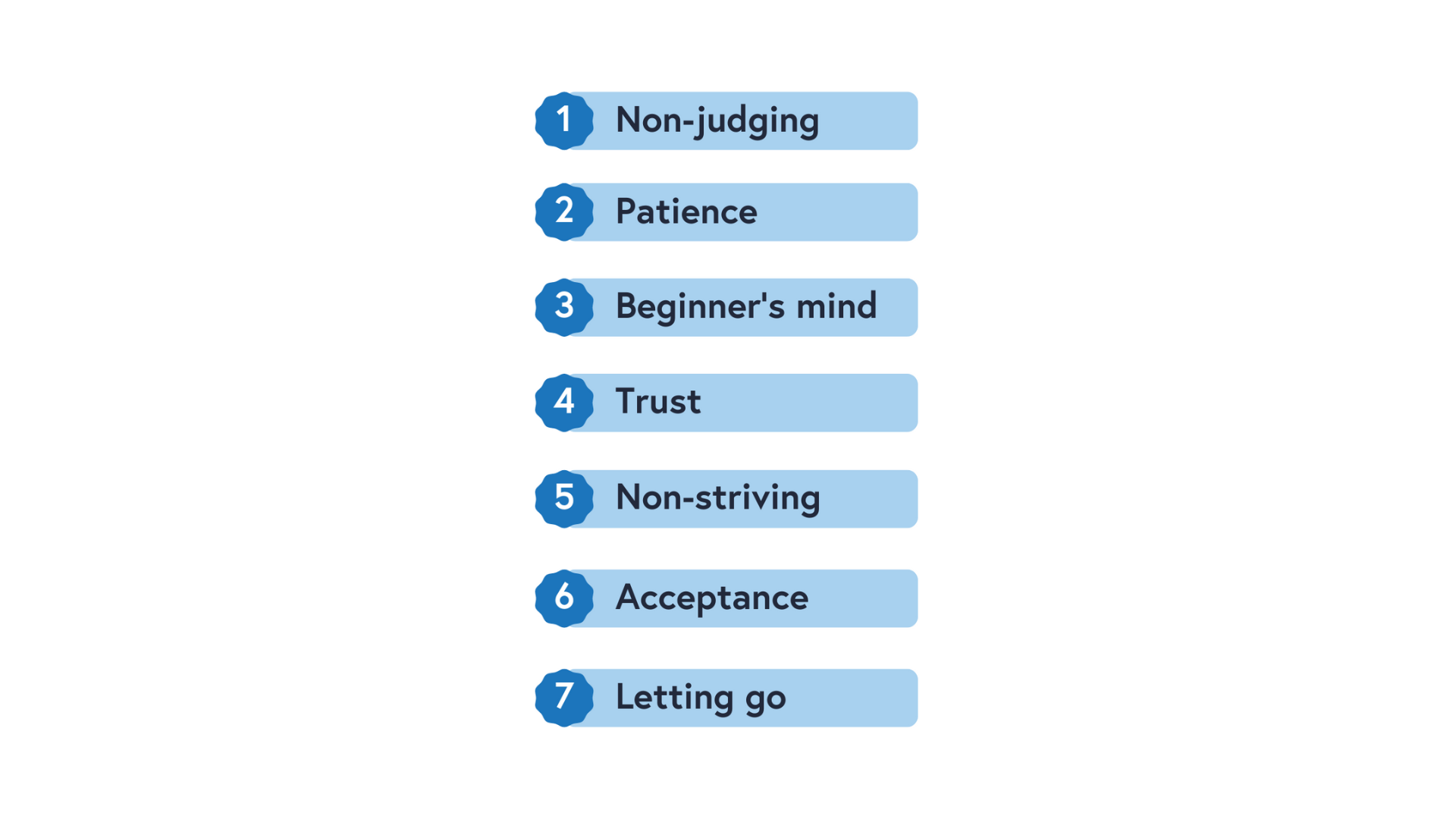
Mindfulness has grown into a significant industry with extensive literature on the subject. Among Western contributors to mindfulness, Jon Kabat-Zinn (1990) is one of our thought leaders on this topic. He outlined seven now classical attitudes of mindfulness. These attitudes are elaborated upon here, for your reflection and more insight.
Non-Judging – Try to become aware of your mind as it judges and assesses things, situations, and people. With Dialectical Behavior Therapy (DBT), you learn to observe your judgmental thoughts while you are synthesizing your opposite beliefs. You might even count them to detach from them. Don’t stop yourself from being critical but instead observe yourself and thoughts without criticism. This will lead after some time to the realization that you are often functioning from a critical mode. This is not the healthiest point of view. Judging yourself (and others) causes stressful cortisol spikes, for every thought becomes a chemical reaction in your body.
Patience – Healing takes time, so be patient with yourself and notice small progress. Join my Recovering Perfectionists club and embrace failing forward—growth comes from stepping out of your comfort zone and learning from mistakes.
Beginner’s Mind – This is a mindset that is willing to see the world as a beginner and not as someone who has all the answers. Another way to express the Beginner’s Mind is the child’s point of view – you still have some wonder and a sense openness to new ideas. Learn to be curious, not furious, about your state of being. Let go of SHAME for not being perfect. SHAME = SHOULD HAVE ALREADY MASTERED EVERYTHING. Nay, Nay, you can be exactly where you are without any shame, perfectly imperfect. You’re on your way. Yes, you are good enough, as is (and you could improve).
Trust – Learn to trust your own ideas and feelings. You don’t need to defer to all the experts if something doesn’t ring true for you. Begin to know that your inner wisdom is best.
Non-Striving – Sometimes you don’t need to do anything – just be. Don’t try so hard to relax, thinking about ways to accomplish relaxation – watch how you feel when you stop striving. This includes letting go of your Compare and Despair, especially on social media. People typically post their “Happy Reel.” You don’t see the grimy, depressing, conflicted stuff they are dealing with privately.
Acceptance – See things as they are; do you still need to lose weight? So be it. Are you still arguing with your spouse? Life gets LIFEY! Are you chronically constipated, depressed, exhausted? You’re taking action to move on. You don’t need to sugar-coat anything. This is how your life is and recognizing the reality of your life allows you to move forward and work on healing.
Letting Go – You recognize that not all of your behaviors, thoughts and feelings have served you well. You need to make some changes in your life and that can happen when you accept your circumstance, then you will begin to make changes and let go of negative patterns. The paradox of letting go includes the 3 A’s: Awareness-Acceptance-Action. During the Awareness phase, you are just waking up to your true reality, the beautiful and brutal truth of the life you are living. When you let go of your judgments and negative self-talk, you enter the Acceptance phase, and the healing begins. Before you know it, you are taking new actions and transforming your life.
References
Kabat-Zinn, J. (1990). Full catastrophe living: Using the wisdom of your body and mind to face stress, pain and illness. New York, NY: Delacorte.
“The best part has been the content of the class. It is all so relevant! I like the way you have created an organized pathway through the workbook. DBT is truly not a “do it yourself” program. I very much appreciate the weekly page numbers for relevant handouts and worksheets. The structure you’ve created is one of the best parts of the class. I love that each class includes guided meditation.” M.M., New York, NY
“I was slightly surprised that the DBT group tends to have several participants who are a bit reticent. Group dynamics are always unpredictable. I thought the participants would be much more dramatic and self-aggrandizing. I expected them to be aggressively talkative or domineering. I also thought Lisa would have had to be very hands-on in managing that. Instead, the group is rather quiet, and everyone seems so delightfully ordinary. It’s been a relief, frankly. I’m not a weirdo for having intense emotions and struggling to manage them. I’m just an ordinary person and so are the other group members. I also didn’t expect so much humor. Your sense of humor has been quite welcome. It adds levity and makes the class feel less burdensome or “heavy.” C.S.E., Cambridge, MA
Up next: Virtual DBT Distress Tolerance and Mindfulness Skills, June 10 – September 9, 2025. Tuesdays, 7:30 – 9 PM EST. There are still a few spots open. To learn more, visit Summer DBT Group.
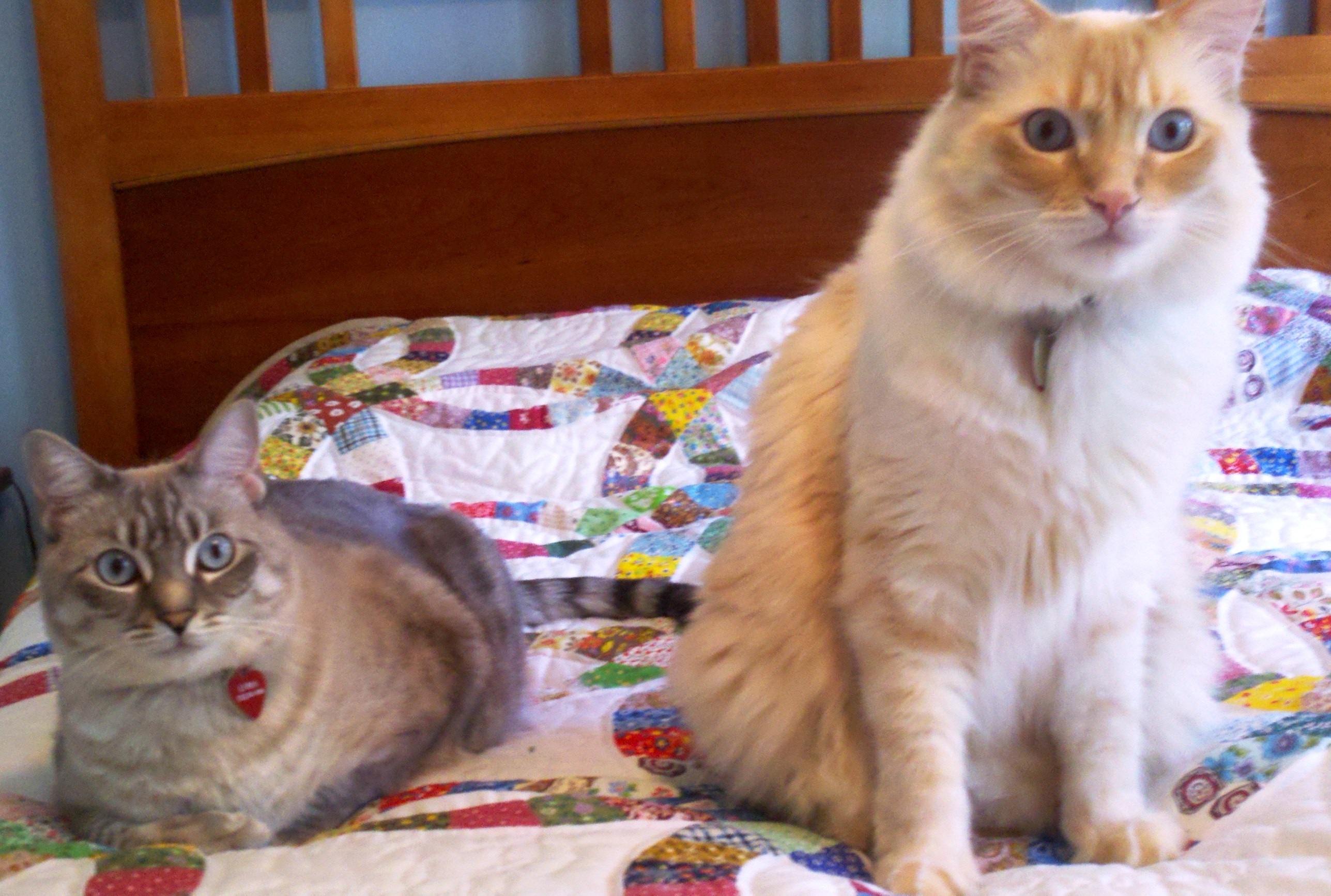
Q-tip was adopted from Nevins Farms, a beautiful MSPCA animal shelter in Methuen, MA. He was part of a litter of gorgeous kittens. The volunteer who enrolled the kittens into the shelter named it the Diva Litter. Each cat was magnificent and dramatically beautiful.
Q-tip’s temporary animal shelter name was Liberace. He was renamed Q-tip, which is an acronym for Quit Taking It Personally. His mix of Turkish Angora and Siamese breeds gave him a fabulous coat of fur. His bright blue eyes made him a handsome little guy. Here’s a 15 second video of him in action, Qtip playing with balloon.
His sister, Luna, was temporarily named Cher. Their litter mates were Elvis, Frank, Barbara, Madonna, Lady Gaga and other renowned Divas of the time.
From the start, Q-tip was very warm and affectionate. He needed no time to become a lapcat. He loved to be brushed, snuggled, kissed and held closely. No amount of hugs was too much for Q-tip. His sister, Luna, was more of an acrobat, and barely spent time on people’s laps. She hated being brushed. (Luna ran away in 2014 and was never found.) Eventually a second cat was adopted, to replace Luna. Her name is Yum-Yum, and she was very good company for Q-Tip.
Q-tip was extremely intuitive and connected to his human mother, Lisa Wessan. When Lisa’s deceased husband, Gary Malkin, was in the ER, Q-tip stepped up. Lisa’s friends and family were always helpful, but Q-tip was her emotional support buddy at home. He helped when Gary was recovering from strokes in rehab nursing homes. He knew she was struggling and made an extra effort to be comforting, attentive and loving. He helped Lisa get through the many medical traumas and crises of Gary’s multiple illnesses the past five years. Without Q-tip, it would have been a much harsher caregiver journey for Lisa. Q-tip was always loving, soothing and a force for healing energy in Lisa’s home life. Lisa referred to him as “her furry angel.”
For 17 human years (119 kitty years), Q-tip was a super healthy indoor kitty. He was not sick for one day of his long life. He was given excellent grain-free food, drank only filtered water and was well loved. He is survived by his step sister Yum-Yum, and his human mother Lisa, who is missing him terribly now.
Precious siblings Luna and Q-tip, resting in peace with Gary💙
In the spirit of “Good Food, Good Mood,” and Food As Medicine (FAM)…Broccoli Sprouts are in the top 1% of super foods you want to enter your body on a regular basis. (you can watch the 5 minute video here, Food As Medicine: Fun to grow Broccoli Sprouts, a Super Food! )
FUN FACT: Broccoli sprouts are known for their exceptionally high concentration of sulforaphane. This potent antioxidant has multiple health benefits. These benefits include reducing inflammation, boosting your immune system, and enhancing your cognitive ability, memory, and reaction times, plus more. Sulforaphane is a sulfur-containing compound naturally found in broccoli and other cruciferous vegetables, but its concentration is significantly higher in sprouts.
🌀🌀 Based on these three academic sources below, Broccoli Sprouts have the most sulforaphane of all the cruciferous vegetables.