The full scope of Interpersonal Effectiveness focuses on improving communication, reducing social anxiety, learning to set healthy boundaries, learning to validate yourself and others, gaining confidence in asking for what you want, enrolling others to help you in your dreams and goals, and letting go of toxic relationships.
Below is an excerpt of one of my sessions for Interpersonal Effectiveness.
Learning to say Yes when you mean Yes, and No when you mean NO
It can very often be difficult to say no to people who make demands of us, and if we say no, we can get caught up in self-critical thoughts leading us to feel guilty. To avoid feeling guilty, we just keep on saying “yes” to every request.
Someone asks us to do something:
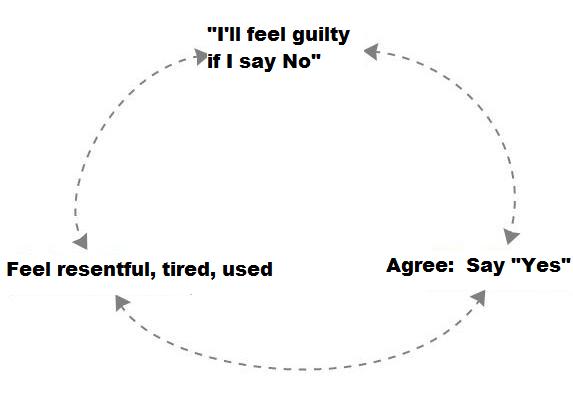
We can learn ways of saying “No” that don’t lead us to think self-critically or feel guilty (during the group session, we practice some role playing to say No more effectively).
For example, try these suggestions on like a loose garment and see if they fit:
- I’m sorry but I really can’t take on anything else at the moment.
- I’m quite busy right now. Perhaps another time.
- I’d like to help you out, but I just don’t feel up to it at the moment.
- Thank you for asking me. You’re a nice person, but I don’t want to go out with you.
- I don’t need a new roof (double glazing, vacuum cleaner etc). I’m happy with what I have thank you.

- If the person seems to have trouble accepting your “No,” then just keep repeating yourself. You can learn the art of polite persistence. You might have to add the word “No” to the beginning of those statements, perhaps with some emphasis on that word. For example:
- No. I’m sorry but I really can’t at the moment.

Be wary of those self-critical thoughts afterwards. Practice challenging and/or dismissing them, by telling yourself:
- I explained to them why I couldn’t do it.
- It’s not my responsibility.
- It would only end up upsetting me if I agreed to it – this is best for me. If I feel less tired and not resentful, then I might be a better position to help them out next time.
They’re just thoughts – I don’t need to pay them any attention (then put your focus of attention on something else).
The following dialectic affirmations about control and esteem can be helpful for finding that balance.
- I cannot control some things but I am not helpless.
- I cannot control other people but I am not helpless.
- I am not responsible for those things I cannot control.
- I accept those things in myself that I cannot change.
- I can make positive choices for myself.
- My strengths and abilities deserve my appreciation. Appreciate those abilities you have.
Create your own affirmations by completing the following sentences:
I am not powerless, I can ___________________________________________________
I have the right to refuse ___________________________________________________
I am not helpless, I can _____________________________________________________
I deserve to _________________________________________________________________
Remember, a wise person once said “Repetition is the mother of all skills…” so aim to repeat these phrases at least twice a day, with focused energy, enthusiasm and passion!
Onward and Upward✨
Lisa Wessan
___________________________________________________________________________________________
NOTES:
It takes one year to go through the full curriculum for the DBT Program. (Some students choose to stay on for more than more year, to deepen their practice.)
During the year, we cover these modules:
- DBT Core Mindfulness [focusing skills]
- Distress Tolerance [crisis survival skills]
- Emotion Regulation [de‐escalation skills]
- Interpersonal Effectiveness [‘people skills’]
During class, we explore the act of saying “No” and turn these into powerful “Moves” to help you build new neural networks in your brain. We combine neurology, physiology and cognitive restructuring to do this, and sometimes add music and dancing to ramp up our energy. This helps you develop a fresh new response more easily and will become your “new normal” response to people’s inappropriate or untimely requests.
** For more information, please visit www.lisawessan.com.
Copyright © by Lisa Wessan 2025. All rights reserved.
 The Lighter Side of Transformation