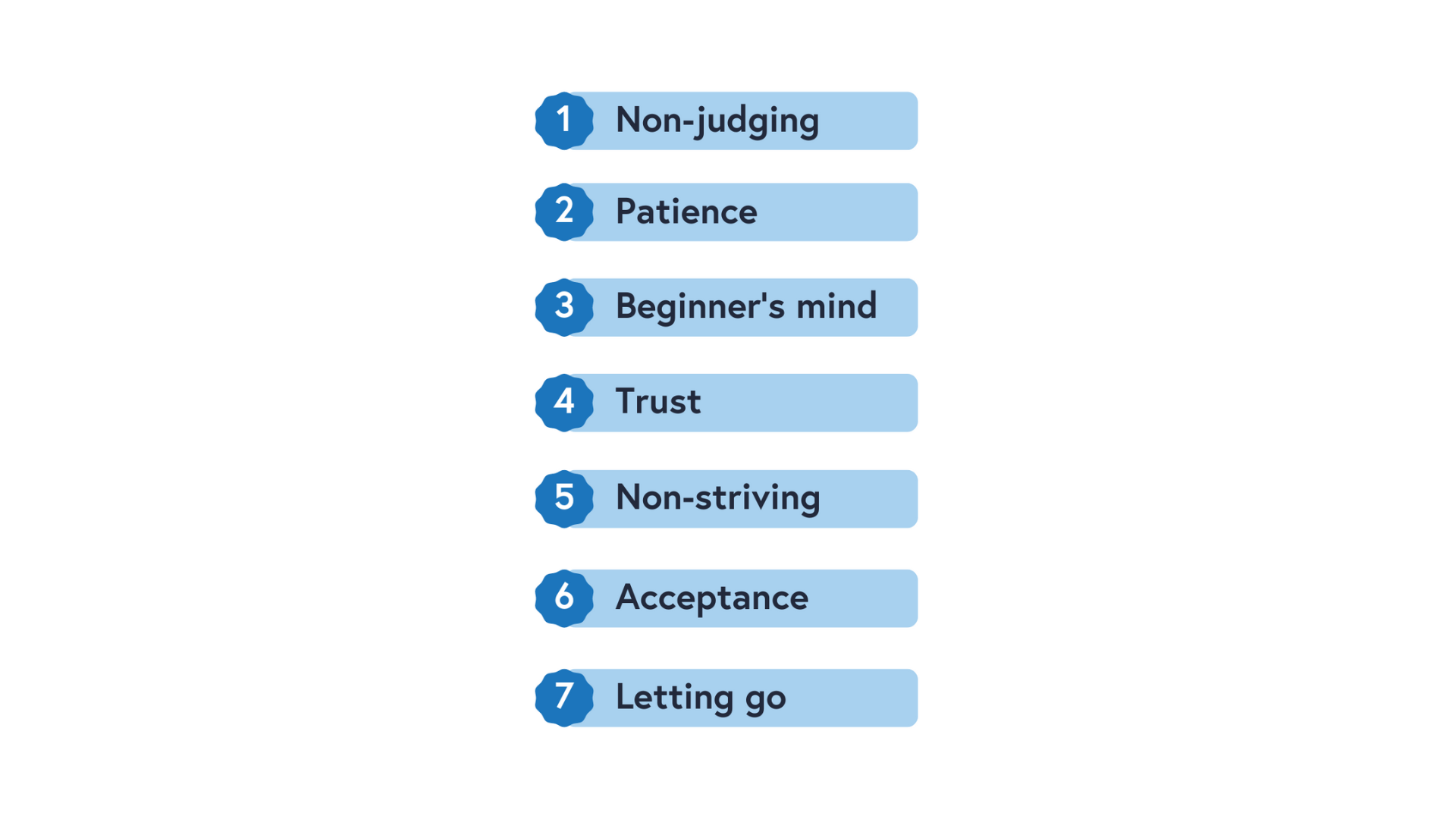
Mindfulness has grown into a significant industry with extensive literature on the subject. Among Western contributors to mindfulness, Jon Kabat-Zinn (1990) is one of our thought leaders on this topic. He outlined seven now classical attitudes of mindfulness. These attitudes are elaborated upon here, for your reflection and more insight.
- Non-Judging – Try to become aware of your mind as it judges and assesses things, situations, and people. With Dialectical Behavior Therapy (DBT), you learn to observe your judgmental thoughts while you are synthesizing your opposite beliefs. You might even count them to detach from them. Don’t stop yourself from being critical but instead observe yourself and thoughts without criticism. This will lead after some time to the realization that you are often functioning from a critical mode. This is not the healthiest point of view. Judging yourself (and others) causes stressful cortisol spikes, for every thought becomes a chemical reaction in your body.
- Patience – Healing takes time, so be patient with yourself and notice small progress. Join my Recovering Perfectionists club and embrace failing forward—growth comes from stepping out of your comfort zone and learning from mistakes.
- Beginner’s Mind – This is a mindset that is willing to see the world as a beginner and not as someone who has all the answers. Another way to express the Beginner’s Mind is the child’s point of view – you still have some wonder and a sense openness to new ideas. Learn to be curious, not furious, about your state of being. Let go of SHAME for not being perfect. SHAME = SHOULD HAVE ALREADY MASTERED EVERYTHING. Nay, Nay, you can be exactly where you are without any shame, perfectly imperfect. You’re on your way. Yes, you are good enough, as is (and you could improve).
- Trust – Learn to trust your own ideas and feelings. You don’t need to defer to all the experts if something doesn’t ring true for you. Begin to know that your inner wisdom is best.
- Non-Striving – Sometimes you don’t need to do anything – just be. Don’t try so hard to relax, thinking about ways to accomplish relaxation – watch how you feel when you stop striving. This includes letting go of your Compare and Despair, especially on social media. People typically post their “Happy Reel.” You don’t see the grimy, depressing, conflicted stuff they are dealing with privately.
- Acceptance – See things as they are; do you still need to lose weight? So be it. Are you still arguing with your spouse? Life gets LIFEY! Are you chronically constipated, depressed, exhausted? You’re taking action to move on. You don’t need to sugar-coat anything. This is how your life is and recognizing the reality of your life allows you to move forward and work on healing.
- Letting Go – You recognize that not all of your behaviors, thoughts and feelings have served you well. You need to make some changes in your life and that can happen when you accept your circumstance, then you will begin to make changes and let go of negative patterns. The paradox of letting go includes the 3 A’s: Awareness-Acceptance-Action. During the Awareness phase, you are just waking up to your true reality, the beautiful and brutal truth of the life you are living. When you let go of your judgments and negative self-talk, you enter the Acceptance phase, and the healing begins. Before you know it, you are taking new actions and transforming your life.
References
Kabat-Zinn, J. (1990). Full catastrophe living: Using the wisdom of your body and mind to face stress, pain and illness. New York, NY: Delacorte.
Dialectical Behavior Therapy (DBT)
 The Lighter Side of Transformation
Leave a comment